25 days ago
Space Food Insurance: Cultivating Moon salads
Periskopi(4 years ago)
(4 years ago)Scientists have planted plants on the soil from the moon's surface. This is a sign that people can live on the moon someday, provide food there, and produce water. Florida University researchers say that they have planted plants in the soil from the moon and discovered [...]
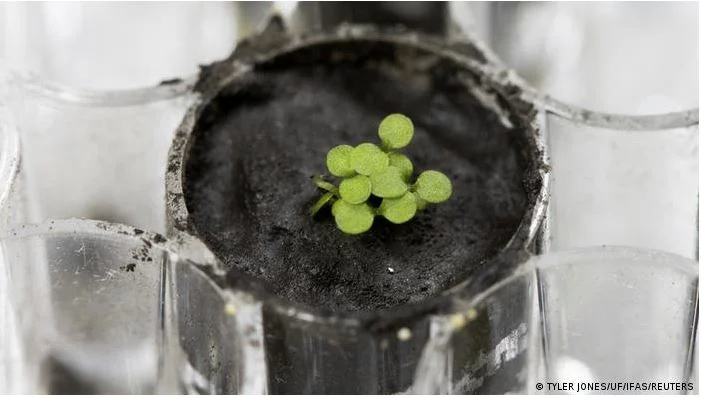
University of Florida researchers say they have planted plants in the soil taken from the moon and have discovered it, which one researcher calls “the basis of exploratory dreams”. It's the first time that scientists show that life can be created by regolith, material taken from the moon's surface.
They say their discovery, published in the magazine Communications Biology, may have an impact on future explorations on the moon.
Rob Ferl, one of the coauthors of the study, says that their discovery can help astronauts with missions on the moon, take out their food, and lower it
The need for frequent Earth supplies. When people move like civilisation, not to explore for a few days, but when we go somewhere to stay, we always take with us our agri-cultural”, Ferl says.
In addition to improving the level of food security in space, the study brings other benefits. It can help astronauts clear air, ward off carbon dioxide from the atmosphere, and produce clean water.
How plants sow soil
Scholars planted the Arabiandopsis seed (a type of stone grass) on earthè Moone received about 50 years ago, during the three special Apollo missions on the moon: Apollo 11 and 12 in 1969 and Apollo 17 in 1972.
They divided the earth into three ounces [1 g] and threw it into vessels. There they added water, light, and plant food. They also planted another part in volcanic ash - a substance similar to the lunar soil - to serve as control.
Scientists saw plant plants in both groups in less than 48 hours, but a few days later they noticed that plants on the moon were stressed. Regolith plants seemed numb compared with those in volcanic ashes.
But Ferl says that the fact that plants were able to grow in general is a positive discovery. The important thing is that before this experiment was done, no one knew whether plants, especially those with roots, would be able to interact with the very hot soil, many antagonists, such as the lunar regolith”, Ferl says.
The Challenge Remains in Providing Evidence
The expertise in itself was easy, but finding the material needed to do the experiment was difficult. There was only a small amount of lunar soil to do the experiment, 12 grams, the size of a spoon, and there had to be requests several times over a decade in order to get it from the American Space Agency, NASA.
These tests are natural treasures of high value”, says study co-author Anna-Lisa Paul. When we work with them we change them. The first of the air (they're placed in contact with air) and water, they're no longer original and they lose their archive nature, which is very, very protected. ”
Benefits for Future Monday Missions
The discovery is important, perhaps more important than ever, given that NASA and the European Space Agency hope to restore man to the moon with their program, Artemis.
There are plans to make the first launch of the mission Artemis without a crew in 2022 and the crew mission a decade later. Other countries are also planning to visit the moon in the coming years, including Japan and China.
But scientists still do not know how earth's plants will react to the lunar, real, unmultipated environment. The moon is very dry in comparison with the earth, and this can change the ability of plants to sprout.