2 minutes ago
Borrell warns Serbia: European futures if contacts are kept with Putin
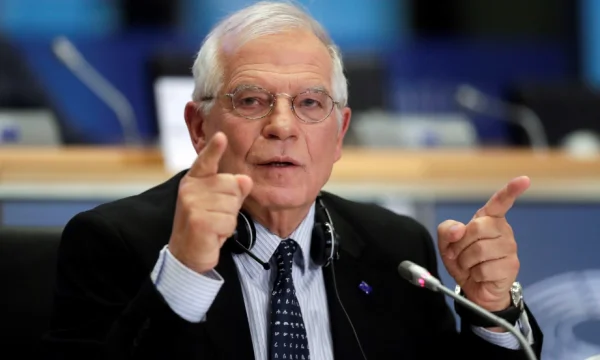
Periskopi(4 years ago)
(4 years ago)European Union diplomacy chief Josep Borrell called on Serbia to support European sanctions against Russia following a meeting in Brussels, attended by the top diplomats of six Western Balkan states. For me it's clear, as high representative and my colleagues, that keeping in touch [...]
European Union diplomacy chief Josep Borrell called on Serbia to support European sanctions against Russia following a meeting in Brussels, attended by the top diplomats of six Western Balkan states.
The “for me is clear, as high representative and my colleagues, that keeping close ties with the regime of [Russian president Vladimir] Putin is no longer in line with building the future in the EU. These two things no longer go at the same time”, Borrell said.
Borrell, back in Brussels, said that neutrality today faced the unprotested Russian invasion of Ukraine is the “concept wrong”.
Being neutral about war in Ukraine today is a misconception. A state invaded another state and placed them in a bag does not distinguish between the attackers and the attacks”, Borrell said.
Serbia is the only state in the Western Balkan region that has not followed the EU's policy to sanction Russia, as Moscow began its invasion of Ukraine on 24 February.
A document that was the subject of discussion among EU ministers, and in which Radio Free Europe has access, suggests Serbia is expected to decide on its strategic choice.
Serbia is expected to leave no doubt in its strategic choice for European integration and dedication to EU values in order to progress on the road to EU membership. A full commitment is needed for accelerated reforms regarding the EU, especially in the area of rule of law. Serbia is the key to stability and security in the region”, the document says.
That various ministers pressured Serbia to impose sanctions on Russia was also accepted by Serbian Foreign Minister Nikola Selakovovic, who confirmed at the end of the meeting that several “countries had effectively announced” that Belgrade is expected to respect EU policy against Russia.
Selakovic, but other sources from the meeting confirmed that only Hungary has supported Serbia and its stance regarding the consequences following possible sanctions.
In Kosovo- Serbia needs “to create confidence”
Borrell said that dialogue between Kosovo and Serbia, mediated by the European Union, has also been discussed during the meeting.
He said the parties should build confidence and move towards normalising relations.
“Of course we have talked about the Pristina-Belgrade dialogue, and the ministers expressed full respect for the implementation of preliminary agreements, which is not happening, and the continuation of the EU-led dialogue and constructive engagement, rapid progress in normalising reports between Kosovo and Serbia. Both sides agree on these, but when they sit together it is difficult to make progress”, he said.
Borrell added that he hopes a next meeting between Kosovo Prime Minister Albin Kurti, and Serbia's president, Aleksandar Vuciq, will be held before the summer.
“We need to build confidence, it is essential to improve the atmosphere in dialogue. A commitment to positive actions to build confidence and avoid unilateral steps and I hope that before the summer we will be able to hold a new meeting at the high political level with Kosovo's prime minister and Serbia's president, but the work is still continuing”, the EU diplomacy chief stressed.
The dialogue on normalising relations between Kosovo and Serbia, with the European Union mediating, started in 2011.
The sides have reached dozens of agreements, but most of them have not found application on the ground.
On May 14th, the foreign ministers of the group of the world's seven most industrialized states (G7) have called on the two countries to engage constructively in dialogue and reach agreement on normalising the reports.
Meanwhile, speaking of visa liberalisation for Kosovo, Borrell said he supports such a thing.
“has also had many calls for visa liberalisation for Kosovo. The Commission has sometimes presented the Council with proposals and opinions, through which it has argued that Kosovo meets all criteria for visa liberalisation. We continue to support visa liberalisation with Kosovo”, Borrell said.
EU promises expanded commitment with states supporting sanctions
Meanwhile, prior to the meeting between EU foreign ministers, German Foreign Minister Annalena Baerbock reiterated the importance of EU support for sanctions by all partners in the Western Balkans, “not only in terms of common values, but also in strategic issues of”.
At this meeting in Brussels, Western Balkan states, which have fully harmonised their policies towards Russia with European Union policies (BE), have been promised enhanced political commitment with the European bloc.
In the EU, they say they welcome the fact that Kosovo as a whole has supported Western positions for war in Ukraine, even though formally that is not required.
Likewise, states that have supported the sanctions policy are expected to be invited more often to EU summits.
A work document discussed by EU foreign ministers during May 16th said representatives of Albania, Montenegro and Northern Macedonia could be invited to participate in elected meetings of the EU Council and foreign policy preparations. / REL