17 minutes ago
Russia: An Imaginative yet Dangerous superpower
Periskopi(4 years ago)
(4 years ago)Russia is only large on the surface and nuclear weapons. However, compared with the great world powers, in a number of other indicators, it does not result in a real superpower. Economics, technology and innovation, environmental challenges and other factors rank the Russian Federation in a second category. But this [...]
Russia is only large on the surface and nuclear weapons. However, compared with the great world powers, in a number of other indicators, it does not result in a real superpower. Economics, technology and innovation, environmental challenges and other factors rank the Russian Federation in a second category. But this analysis does not paint the picture of a less dangerous Russia. On the contrary.
The Modest yet Risked Economy
The Russian economy, although ranked 11th in the world in size, is unmovable if compared to the economies of countries and unions with which it has entered a collision spiral, or even of partner countries. Russia's economy is 10 times smaller than that of the European Union, 15 times smaller than the United States and almost 10 times smaller than that of China.

In Europe, Russia is left behind by Germany, France, the United Kingdom and Italy. If compared with US, California, Texas and New York, they have bigger economies than Russia.
The gap between the Russian economy and others becomes even more significant if it is considered that Russia ranks first in the world on the surface of over 17 million square miles [17 million sq km]. The three countries that follow Canada, China and the U.S. have between 10 million square miles and up to more than nine million square miles.
Also, its favourable positioning between Europe and Asia has helped Russia to present itself as a large economy, but not as large as it could be, compared to other countries with much less resources but with stronger economies.

During the period 2010-2020, Russia has marked an average annual growth of about 1.7%. This is a poor performance. But this decade has been troubled for all. The European Union marked an average annual increase of only 1%, while the US scored as much as Russia, by 1.7%. These growth rates are not as alarming for the US and the EU, if taken into account that structured economies tend to mark lower but sustainable growth compared to developing countries. The big difference is that the US increased by 1.7% an economy much larger than Russia's. The same analogy applies to the Eurozone.

GDP per capita, which shares a country's economic output with population numbers, is a significant indicator to understand the standard of living of a state. Even on this indicator, Russia appears severalfold weaker than its Western competitors, being on an almost identical level with China. Simply put, this indicates that Russians are a comparatively poor people.

As a country with large gas and oil reserves, Russia's trade balance represents positive, with $42 billion more exports than imports. About 70% of Russia's exports are from this sector, which speaks of the country's high dependence on fuel and energy production.
Compared to that, most EU exports are machines and equipment, pharmaceutical and chemical products, technological products. Key US exports are food and drink, oil and its byproducts, planes and parts of them, other industrial products. Chinese exports feature technology products, including transmission devices, computers, office electronics, telephones, various electronic circuits, and other innovative devices.
Depending on the methodology used, fossil fuels and energy are estimated to be up to 25% of the Russian economy. On the other hand, the EU represents a more diverse sectoral economy, including agriculture, tourism and energy.
The lack of diversification and high dependence on Russia's economy on oil and gas also manifests its vulnerability in the event of any shocks in the energy sector. For example, the financial crisis in Russia during 2014-2016, which culminated in an economic decline of about 2% of GDP in 2015, resulted in a severe devaluation of the Russian ruble. This devaluation was in itself a result of the decline in the economy of this country, which prompted investors to sell their Russian assets. Market trust was shaken by two factors. The first was the global decline in oil prices by about 50%, one of the leading Russian exports. The other factor involved international economic sanctions on Russia as a result of the Crimea annexation.
In a concrete case, the Russian offensive in Ukraine is taking place in a period of global energy crisis at high energy prices, while the war has only increased them. Therefore, the first factor of a potential economic crisis is missing. But even Western measures are not the same. The current mutating sanctions that are just growing are expected to have serious, perhaps unprecedented effects on the Russian economy.
Delayed in the Race
Russia's major problem is time. Once a world superpower under the Soviet conglomerate, today's Russia represents another country. In fact, the term “colaps of superpower” refers primarily to the intervention of the Soviet Union in the face of the several-planed primacy of the West. Also, the cash entering the Russian economy comes mainly from gas and oil, and for the near future, this trend is expected to continue.
The European Union provides about 40% of gas from Russia, which owns most of the world's natural gas reserves. In 2021 alone, Russia sold 100 billion euros in gas to Europe. About 25% of EU energy is provided through natural gas. Meanwhile, the European bloc has been slow to adapt new energy sources.
Public pressure on climate change, however, has increased the impetus and investment in the construction of alternative energy capacities. Early in February, the European Commission declared nuclear energy a stable and environmentally helpful source. This decision implies that financial and regulatory support and stimulus are expected to open the green light for increased, potentially multiplied, energy from atomic reaction.
This is just the beginning. A few days after the Commission's preliminary decision, European scientists reported a remarkable progress in the practical realisation of nuclear fusion. This achievement implies that opportunities to produce even greater volumes of energy can thus be made vulnerable through conventional nuclear plants in the very near future. In symbolic terms, it is the same energy that stars produce, including the sun.
A report published last year by Carbon Tracker estimated that by 2035, solar energy combined with wind energy can reduce fossil fuels to negligible levels to produce electricity. On the other hand, transportation is also undergoing an electrical update. In 2020, 1.3 million electric vehicles were sold in China and the European Union. At the global level, it is estimated that electrical transport vehicles will mark 7% of the total of such sales. Other estimates predict that sales of electric vehicles by 2030 will exceed 50% of total.
These updates are bad news for those countries whose economies depend heavily on oil and gas production and marketing. For more than a decade, wealthy Gulf countries have been involved in a race against time for modernising their economies and infrastructure, seeking to develop alternative resources beyond oil and gas. As Russia shares the same problem, it lacks financial and technological resources to transform its economy.
Military spending is also a manifestation of economic power. Although having the second largest army in the world after the United States, it should be noted that the Russian Federation has inherited most of its weapons from the Soviet Union. In the current military spending rankings, Russia lags behind the US, China, the EU and India.

In fact, the Russian military machine depends heavily on the revenues provided by fossil energy trading. The only way the country can finance its growing army is through the use of the reserve fund that the Kremlin has managed to set aside in recent years, when fuel prices were high. But in a world that is developing so rapidly, this pattern is no longer certain.
Technologicalally outdated, primitively dangerous
Russia exports gas and oil, while mainly imports cars, industrial and technological equipment, and others. Most of this country's imports come from China. China imports fossil energy from Russia, which it uses to produce technology devices that it sells to the same. In other words, Russia only produces fuel that supplies the most innovative economies of other countries, including those allies, if China can be considered such.
The Chinese model has resulted in more success than Russian, replacing the latter as the true non-Western superpower in the world. For example, if they look into space, it is the Chinese mission to the moon, where its Rover is exploring the lunar terrain by sending images to Earth. Now it's the Tiangong Space Station that competes with the International Space Station. Russia continues to launch a satellite, but when it fought with the U.S. for space, and Gagarin's efficiency was the global symbol of overstepping the planet's borders, it's gone forever. There is no indication that China has not replaced Russia as the world superpower.
Technology and innovation are the true arena of the race for wealth and power in this brave new world. This is a sphere where Russia doesn't shine. As it does not rank in the top 10 economies, the Russian Federation is placed in 15th. The United States, China and a host of EU countries leave the nuclear superpower behind. Even in the arms race, the Russian machine shows up relatively backward compared to NATO and China.
This picture speaks of Russia as a country that is being brought down by competition from others and non-stop technological evolution. The flourishing democracies in its narrow perimeter are a major political legitimacy problem for dictator Vladimir Putin. To catch the pace of time, Russia needs money, which is investing extensively in weapons. While the main economic source of this revenue is oil and gas risking from the near future.
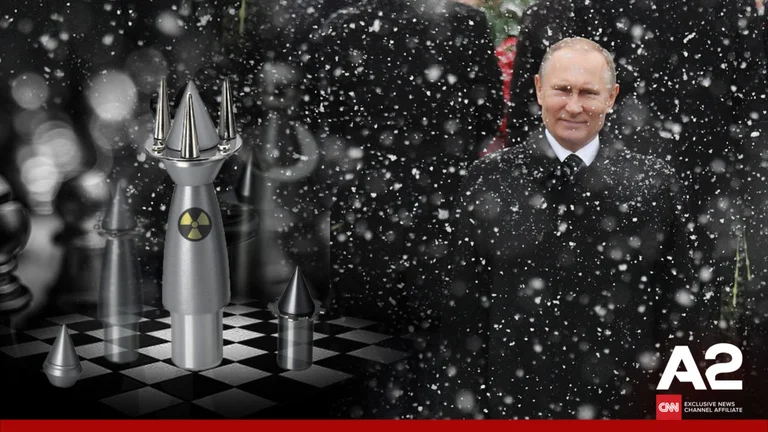
In the absence of all these opportunities, the Russian president is using the only stone left in the chess field: the military conflict supported by the nuclear threat of world destruction. In a documentary in 2018, Putin posed a philosophical question: “What's a world where Russia isn't? / CNN