15 minutes ago
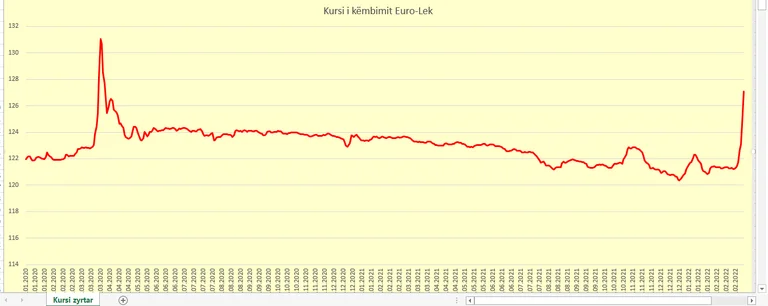
The euro won't stop, it's $1 127, in a week it's overloaded by almost 5%.
Periskopi(4 years ago)
(4 years ago)Euros were strengthened again rapidly in exchange courses with the money today. According to the Bank of Albania's official course, the European currency was converted to $1 127.08, up by 2.5 points compared to Monday. In the bow of a week, the euro has been overestimated with 4.7% against the money and has [...]
Euros were strengthened again rapidly in exchange courses with the money today. According to the Bank of Albania's official course, the European currency was converted to $1 127.08, up by 2.5 points compared to Monday. In the bow of a week, the euro has been overestimated with 4.7% against the money and has scored a new record for the past two years. The trend of strengthening the euro is similar to that marked at the end of March 2020. In that case, the factor that prompted the depreciation of the local currency had been pandemic, while in this case, the drive has been war in Ukraine and the serious consequences it is bringing to the first-broad markets.
The supply of oil, energy and food products is also felt in Albania, translated into expensive import, but also a kind of incentive to create reserves, taking into account the turbulent period where markets are located and pessimistic expectations for the future. Experts think the currency exchange market is already involved in a kind of panic, which is further promoting demand to buy euros, due to the rapid strengthening of European currency.
A quick overload of the euro represents an additional risk factor in relation to rising inflation affecting the economy. Since Albania imports most consumer goods and because the euro is the main currency in which these goods are bought, a humiliation of money against it will produce an additional inflationary effect on the economy. Until two weeks ago, the Bank of Albania stood by the basic projection for a passing inflation that would begin to fade in the second half of this year. War in Eastern Europe has already made inflationary risk and uncertainty about the future far greater.
The Albanian economy has a deficit foreign position in goods and services, so in net terms a currency humiliation produces negative effect, expressed in expanding the current account deficit. Importers have greater costs of buying goods and services abroad, while the beneficiaries are exporters of goods and services, who sell in euros but have most of their spending in money. However, even for those euro-income subjects, the profit is gambling, due to the additional inflationary effect that brings a quick overload of the European currency.
On the other hand, a rapid strengthening of the euro can also be a source of risks to the financial sector, where much of the loan is exposed to the risk of exchange rate. According to the Bank of Albania approximately half of the loan portfolio for the economy is in foreign currency, while 37% of the currency credit (less than 20% of the total loan) is exposed to the risk of exchange rate. Euro-income lenders are those who lose much in strengthening the euro, while first-looking profits have individuals and subjects that have savings in euros. However, this too can be relative because, apart from the inflationary effect of the course devaluation, most of the assets of high value in the economy are compared to the euro rather than money.
Implicating strong exchange rate fluctuations in inflation and financial stability are situations that can justify a intervention by the Bank of Albania in the currency market. The recent intervention of this type took place two years ago, at the end of March 2020, when a similar panic had brought rapid devaluation of the lek in the exchange course with the euro, with about 6.5% in the 10-day bow.

This is the exclusive article of the Monitor Review, which enjoys copyright under Law No. 35/2016, “for copyrights and copyrights connected to them”.
The article can be re-published by other media just quoting “Revista Monitor” associated with the link to the original article.