20 minutes ago
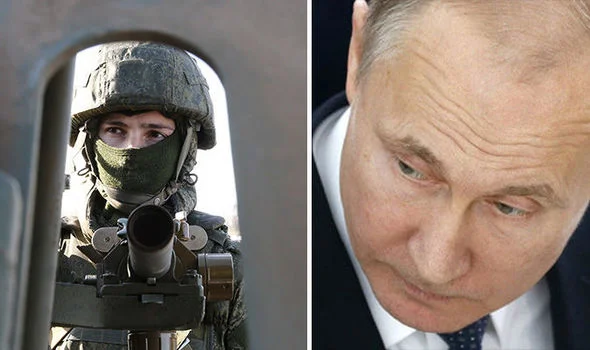
Ukraine is not even close to NATO membership, but why is Putin being so concerned?
Periskopi(4 years ago)
(4 years ago)At the heart of the Ukraine crisis is a puzzle: Why does Russian President Vladimir Putin want to push Europe to the brink of war to ask the West not to do something he has no plans to do? Russia has said NATO's military alliance led by Americans that [...]
Russia has said that NATO's American-led military alliance with the biggest European crisis in its hands in decades should never offer membership to Ukraine, a state that was independent when the Soviet Union was disbanded about 30 years ago.
Ukraine long aspires to join NATO, but the alliance is not ready to extend its membership invitation, in part due to Ukraine's official corruption, lack of progress in increasing defence and lack of control over its international borders.
Putin's demands go beyond the issue of Ukraine's NATO membership, but this topic is crucial to his complaint that the West has caused him to lose patience, due to the alliance's approach to Russian borders. He has confirmed that expansion NATO years ago has stepped up the alliance's security at Russia's expense.
The Russians seek legal guarantees that Ukraine will be denied NATO membership, given that NATO, has principled it not to rule out possible membership of any European state even of Russia, but that the alliance has no plans to start the Ukraine membership process in a predictable future. NATO has cited the principle that all states should be free to choose with whom they want to line up.
So why is Moscow now raising the issue of reports between Ukraine and NATO? The answer to that question is complicated.
Why does Putin worry about Ukraine's possible NATO membership?
The reason that has been declared is that a further expansion of NATO eastward would pose a security threat to Russia. Washington and its allies dismiss this concern, arguing that no state NATO is not threatening to use force against Russia.
Furthermore, Putin wants to withdraw the current military presence NATO has in Eastern Europe, which includes a series of regular exercises in Lithuania, Latvia and Estonia, which are states of the former Soviet Union. In the states of Baltic, however, there are no American troops who are long placed. Currently there are about 100 troops serving in rotating tours in Lithuania and about 60 in Estonia and Latvia, the Pentagon has said.
Russian President Putin also opposes the presence of defence missiles the alliance has in Romania, a former Soviet satellite state. He also opposes a similar base being built in Poland, arguing they could turn into offensive weapons capable of threatening Russia. American President Joe Biden has approved the sending of 2,700 additional American troops to Eastern Europe, 1,700 to Poland and 1,000 to Romania plus 300 to Germany.
Ukraine has deep historical and cultural ties with Russia, and Putin has repeatedly claimed that the Russians and Ukrainians are “a people”. He has said that a large part of Ukraine's territory has been a historic part of Russia, and arbitraryly these parts have been given to Ukraine by communist leaders in the time of the Soviet Union.
Putin's actions, however, have served to strengthen the feeling of Ukrainian national identity. After Russia annexed the Ukrainian Crime Peninsula in 2014, Ukraine's desire to approach the West and join NATO just grew.
Recently, Putin has more specifically described his concern for Ukraine. He has drawn up a scenario in which Ukraine can use military force to regain Crime or regain areas in eastern Ukraine, controlled by Russian-backed separatists.
“Imagine if Ukraine becomes a NATO member and starts these military operations”, Putin has said. “Should we then fight NATO? Has anyone thought about this?
In fact, some in NATO have thought about the possibility of an expanded war with Russia within Ukraine. This is a reminder of what NATO membership means... an attack on a member state is an attack on all, which in Ukraine's theoretical case, if this state were to be attacked by Russia, it would mean there would be a legal pledge by all NATO states that would have to come to defend Kiev.
What are Ukraine's chances of joining NATO?
The chances of Ukraine joining NATO a predictable future are extremely small.
Although Ukraine has no NATO membership bid, it has approached the alliance, starting in 1997 when the NATO-Ukrainian Charter was created and continued co-operation with the alliance.
The heads of the governments of NATO member states publicly declared in 2008 that Ukraine and Georgia another state of the former Soviet Union ♫ “will become NATO members”. They did not say when and how this will happen, but this statement can be seen as explaining Moscow's concern that Kiev will one day join the alliance.
On the other hand, the US and other NATO leaders, who signed the 2008 declaration regarding Ukraine and Georgia, decided to give these two states what is known as the Membership Action Plan, which is a road leading to eventual membership. Germany and France have strongly opposed Ukraine moving towards membership, and widely within NATO the idea that Ukraine should initially carry out major government reforms before becoming a candidate for membership.
That controversy seems to have never been resolved, meaning that since NATO's door is open, Ukraine will not be included in a near future.
How's Putin putting pressure on Ukraine?
Moscow has said it has no plans to invade Ukraine, but in recent months it has deployed military forces and equipment along the Ukrainian border and has hinted it would take action if its demands on Washington and NATO are not met. The Beden administration has said Russia is now capable of a wide range of actions, including the wide-scale invasion of Kiev.
Putin has said that NATO has overstepped borders not only by offering Ukraine military weapons and training, but also by stationing forces in other Eastern European states, which according to him, compromise Russian security.
It is also true that in the last decade, there has been an increase in the US and NATO military presence in Eastern Europe, which has sparked the Russian annexation of Crime and the eastern Ukraine in 2014. These Russian actions push NATO to double its focus on collective security. In September 2014, NATO leaders established a new force for quick response, which is capable of being deployed within days and leaders have reconsidered their pledges to increase their defence spending.