6 minutes ago
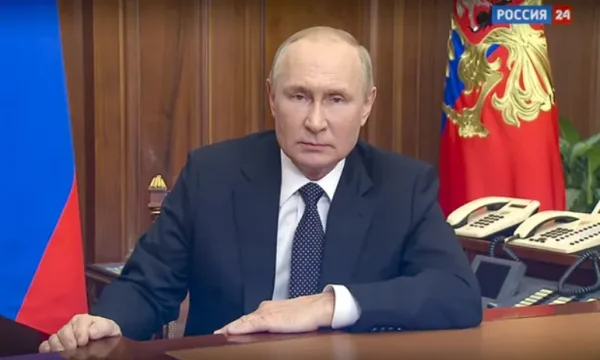
Putin's journey: From Pledging Stability to the Nuclear Threat
Periskopi(4 years ago)
(4 years ago)For decades, Russian President Vladimir Putin presented himself as guarantor of stability in his country. But on its 70th anniversary, he finds himself in the centre of the storm, amid military losses in Ukraine, mass escapes following his order for mobilization and clashes at the high military command of [...]
But on its 70th anniversary, he finds himself in the centre of the storm, amid military losses in Ukraine, mass escapes following his order for mobilization and clashes at the country's top military command.
Vladimir Putin took the country's lead in 2000, replacing his predecessor Boris Jelcen, who resigned on December 31, 1999.
The Russian president has described former President Jelcen's rule as a time of disagreement and decline, when millions of Russians plunged into poverty while national assets were robbed by tycoons linked to the Kremlin as well as the West.
Stanisislav Belkovsky is experienced political consultant and closely recognises the Kremlin regime.
He was the figure that responded to the popular sense of historical retaliation that prevailed in the late 1990s because of the humiliation associated with the fall of the Soviet Union and the recent socioeconomic problems of the 1990s”, he says.
The Russians, tired of a decade of political and post-Soviet economic unrest, embraced with enthusiasm the president's promises to restore Russia's greatness.
We must first acknowledge that the collapse of the Soviet Union was the greatest geopolitical disaster of the century. And it was a real drama for the Russian people”, expressed at the time the Russian president, Putin.
Russian citizens remained generally indifferent to his movements to limit political freedoms in the post-Soviet period amid the economic prosperity provided by oil.
But the situation changed after the 2008 global financial crisis, which led to a slowdown in economic growth and income contraction.
However, the situation of Russian citizens continued to be much better, compared to the economic downturn of the 1990s.
At the beginning of his mandate, President Putin tried to cultivate closer ties with the West, and even considered the possibility of Russia joining NATO's military alliance.
But then he changed his policy course, challenging the US and its allies.
A key moment was the retake of the presidency in 2012, after a four-year period as prime minister, due to restrictions on the mandate.
His president-elect Dmitry Medvedev, in subjection to his boss, resigned after a mandate, prompting massive protests against Mr. Putin's return to the presidency.
President Putin accused the US of promoting protests in Moscow and responded by roughing up the crackdown on instability in the country and embracing a more aggressive course abroad.
Journalist Mikhail Zygar has had continued contact with the Kremlin elite and has published a book for President Putin and his circle.
“Dirium of 2011-2012, Bolotnaya Square, all those mass gatherings were the last moment of a good life, and he shattered hope that a terrible and dark ending could be avoided. In my opinion everything that has happened since 2012 is a continuing drop”, he says.
In 2014, President Putin made his decision on annexing the Crimean Peninsula. It also supported the pro-Russian separatist movement in eastern Ukraine.
Moscow's intervention in Ukraine brought relations with the West to the lowest levels of post-Cold War, and repeated efforts to negotiate a political solution to end fighting in eastern Ukraine failed.
Tensions rose in autumn 2021, when President Putin gave President Putin a west ultimatum, requesting that he officially reject Ukraine's request to join NATO and withdraw alliance forces from Eastern Europe.
When the West rejected his demands, the Russian president began what he called a special military “ ” on February 24th.
Russian citizens differ on war.
“First, he is our president, we (us) believe in him. The 70-year-old is not that old to be discouraged”, says Moscow resident Vladimir Mironov.
The situation in Ukraine is known to everyone, I think. The consequences of this situation as mobilization do not have a positive effect, unfortunately”, says Anastasia.
Asked what President Putin would wish, she says she would wish good mental well-being <x0. ”
Russian president's hopes of a quick victory waned in the face of strong Ukrainian resistance and billions of dollars' military support for Ukraine from Western allies.
He has repeatedly signaled that he can use nuclear weapons -- a warning that is in sharp contrast with his promise of restoring stability that he has repeatedly repeated during the 22-year regime.
Andrei Kolesnikov, a senior associate at the Carnegie Foundation, describes nuclear threats as a reflection of the Russian president's growing despair.
This is the last step for him, in a sense suicide. He's ready for this step, which means we're seeing a dictator who would say he's even worse than (Josip) Stalin”, he says.
The US and its allies have said they are taking Putin's threats seriously, but will not surrender to what they call a blackmail to force the West to abandon Ukraine.
And Ukraine has pledged to continue its counterattack despite Russian rhetoric.