7 minutes ago
Fright on earth, what are the tactical nuclear weapons Putin is threatening with
Periskopi(4 years ago)
(4 years ago)Nuclear tactical weapons have begun to be mentioned more and more frequently on the international stage, as they face heavy losses in the field of battle in eastern Ukraine, President Vladimir Putin has threatened that Russia will use all available weapons systems” in the event territorial integrity is threatened [...]
Putin has described the war in Ukraine as a existential battle against the West, which he said wants to weaken, divide and destroy Russia. US President Joe Biden criticised Putin's open nuclear threats against Europe.
Meanwhile, Secretary General NATO, Jens Stoltenberg downplayed the threat, saying Putin “knows very well that a nuclear war should never happen and that it cannot be won by either side”.
This is not the first time Putin uses threat with his nuclear weapons to try to prevent NATO continues aid to Ukraine. Russia's huge nuclear tactical weapons arsenal -- and which does not submit to any international treaty -- has significantly increased tensions.
Separation of nuclear weapons into strategic and non-strategic
But nuclear tactical weapons are not just another kind of weapon on the battlefield. Tactical nuclear weapons, sometimes called non-strategic nuclear weapons, are built to be used in the field of battle. For example, to eliminate large infantry formations and armoured units.
They're smaller than strategic nuclear weapons, which are weapons that are launched through intercstrian ballistic missiles. Nuclear tactical weapons vary in their productivity, ranging from 1-50 kilotons, compared to strategic nuclear weapons, which range from about 100 kilotons to over 1 megaton.
As for reference, the atom bomb thrown at Hiroshima was 15 kilotones. Hence, some tactical nuclear weapons are capable of causing large - scale destruction.
So the biggest conventional bomb, the Mother of All Bombs or MOAB, which has been using the U.S., has a production of 0.011 kiloton. Even the launch systems of these weapons tend to have shorter rays, usually under 300 miles [500 km] compared to strategic nuclear weapons, which are usually designed to overcome continents.
Because the nuclear explosive force with low productivity is not much larger than that of ever more powerful conventional weapons, the US Army has reduced its support to them.
Most of its remaining stock -- around 150 B61 gravity bombs -- are currently located in Europe. Great Britain and France have completely eliminated their reserves with tactical nuclear weapons. Meanwhile, Pakistan, China, India, Israel, and North Korea have several types of these weapons.
Russia with mostly nuclear tactical weapons
Russia is the country that has stored the most nuclear tactical weapons, with an estimated number of about 2,000. Moscow relies heavily on them than Washington, mainly because of Russia's less conventional weapons and capabilities. Russia's tactical nuclear weapons could be launched by ships, planes and ground forces. Most of them are placed on air-land missiles, short-range ballistic missiles, gravity bombs, or anti-ship system and submarines.
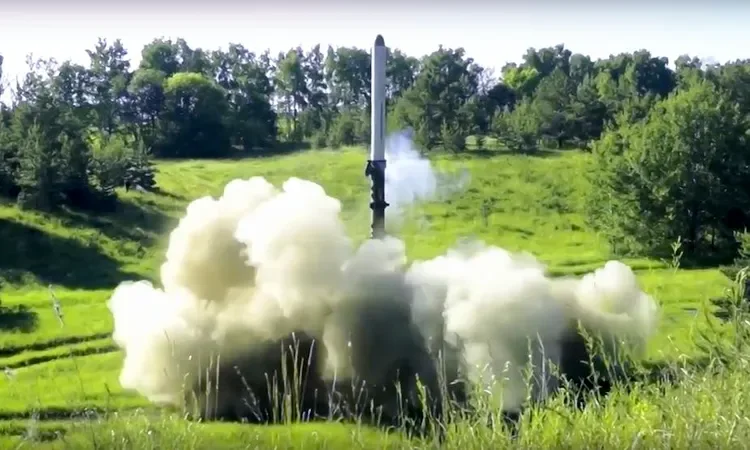
Russia has updated its distribution systems so that they will be able to carry nuclear or conventional bombs. In the West, there is currently a growing concern for these double-powered distribution systems, because Russia has used many of these short-range missile systems, especially Iscarnder-M, to bomb Ukraine.
The short-range Russian ballistic missiles Iscarnder-M can carry conventional or nuclear weapons. Nuclear tactical weapons are essentially more destructive than their conventional counterparts, even those that release the same explosive energy.
Nuclear blasts are more powerful than 10 to 100 million times than chemical explosions, and leave behind lethal radiation that would occur to air, land, water and food supplies, similar to the effects of the Chernobyl nuclear reactor explosion in 1986.
Unlike strategic nuclear weapons, tactical weapons do not focus on mutually secure destruction through large-scale revenge or nuclear umbrella to protect the Allies. While tactical nuclear weapons are not involved in arms control deals, those in middle-range were included in the treaty that has already expired of Middle-ray Nuclear Forces Action (1987-2018), which reduced nuclear weapons in Europe.
Both the United States and Russia reduced their general nuclear arsenals from about 19,000 respectively, 35,000 at the end of the Cold War at about 3,700 and 4,480 in January of this year. Russia's reluctance to negotiate its non-strategic nuclear weapons has hampered further nuclear weapons control efforts.
The main question is whether nuclear tactical weapons are used “and therefore could cause a full-scale nuclear war. Their development was part of an attempt to overcome concerns because large - scale nuclear attacks were widely viewed as unimaginable, strategic nuclear weapons were losing their value as an obstacle to the war between superpowers.
In theory, nuclear powers would be more likely to use tactical nuclear weapons, thus strengthening the nuclear strategy of a nation. But any use of nuclear tactical weapons would promote a nuclear protection strategy.
In fact, then Defence Secretary James Mattis declared in 2018: “I don't think there is a nuclear tactical weapon. Any use of nuclear weapons at all times is a strategic change of the” game. This indicates that the danger of nuclear war has changed and may have increased since the end of the Cold War.
Russia can only destroy its image even more
US has criticised Russia's nuclear strategy, in which nuclear tactical weapons can be used to prevent expansion of war to include NATO. While there is disagreement among experts, Russian and American nuclear strategies focus on prevention.
Hence, they include large - scale nuclear attacks on behalf of any first use of the nuclear weapon. And that means Russia's threat to use nuclear weapons as a preventative tool against conventional war is threatening a move that, according to nuclear war doctrine, would trigger a nuclear revenge attack in case it targeted the US or other NATO countries.
It is believed that the use of nuclear tactical weapons from Russia to Ukraine would not achieve any military goal. Something like that would only be radioactively affecting the territory Russia claims to be a part of its historic empire, perhaps moving into Russia's real territory.
Above all, such an act would increase the likelihood of NATO's direct intervention in war, and would completely destroy Russia's image in the world. Putin aims to prevent Ukraine's continued successes in regaining occupied territory, publicly annexing areas east of the country following holding farce referenda.
It could then declare that Russia will use nuclear weapons to protect the new territory, with the excuse that the existence of the Russian state is threatened. But this claim makes Russia's nuclear strategy unbelievable.
Putin has openly stated that his threat to use tactical nuclear weapons is not a bluff. He does this because from a strategic point of view, their use is not reliable. So in any reasonable strategy, using weapons is unimaginable, so the threat of using them is by definition a bluff. / The Conversion ABC News