a month ago
The rare crocodile holds 100 babies on its back after mating 7-8 females
Periskopi(6 years ago)
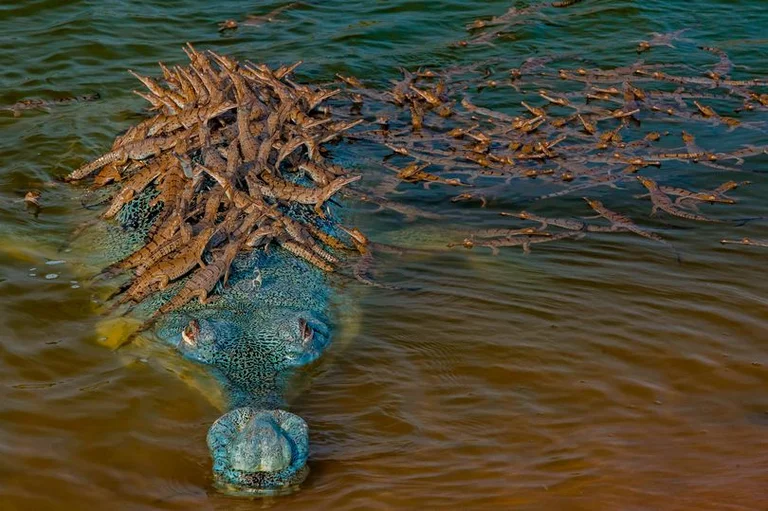
(6 years ago)Taking a walk with your children takes on a whole different meaning for your crocodile parents. In this image of Indian photographer Dritisman Mukherjee, a male crocodile in Chambal National Park waits patiently as more than 100 babies a month on their backs to travel with him. “has crocodiles [...]
Taking a walk with your children takes on a whole different meaning for your crocodile parents.
In this image of Indian photographer Dritisman Mukherjee, a male crocodile in Chambal National Park waits patiently as more than 100 babies a month on their backs to travel with him.
There are other crocodiles that keep their babies in their mouths,” says British reptile expert Patrick Campbell.
However, Indian gaffeins have an unusual morfology of mouth and tendon, and this is not possible, so babies stick to their back and head for protection or to form a link to it”, he adds.
Garial crocodiles reach up to 15 feet [ 4.5 m] in length and weigh about 900 pounds [900 kg]. They are thus referred to as bumps at the end of the tour of males known as the NIgaharaʹ in Indian. With these bumps they power their sound and blow bubbles during mating season.
Mukherjee says he had photographed his father on sight mating seven or eight different females to reach the fertility of more than 100 babies.
Grains are a endangered species of crocodiles, with about 650 adults left in the waters of India and Nepal. Some 500 adult specimens are found in the Chambal Indian reservation.
Mukherjee's photo is one of the 100 “most recommended competitions this year “Wildlife Photographer of the Year” held in London's Natural History Museum and will be included in its exhibition.