11 minutes ago
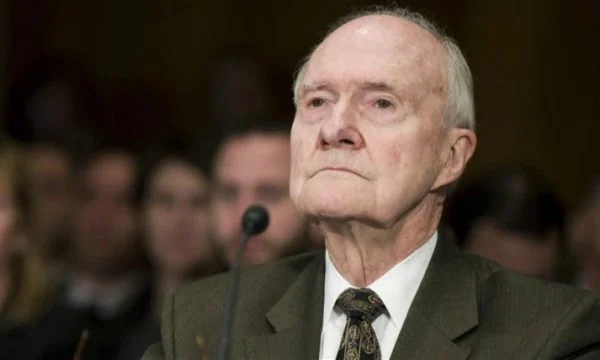
General Sowcroft dies, former President of Ford and old Bush
Periskopi(6 years ago)
(6 years ago)Brent Scocroft, the pragmatic three-star general who served as national security adviser to Republican presidents Gerald Ford and George H.W. Bush and later criticised President George W. Bush for Iraq died Thursday. He was 95 years old. Scoowcroft, member of the presidential commission that investigated the biggest scandal [...]
Scoowcroft, a member of the presidential commission investigating the biggest scandal in Ronald Reagan's presidency and architect of the 1991 Gulf War under President George H.W. Bush died of natural causes, according to a statement made Friday by a Bush family spokesman.
Scoowcroft reached the rank of Lieutenant Air Force General during a 29-year military career and for decades was an influential voice in US national security. He was a careful internationalist (he considered himself realistic), quite close in view with former Secretary of State Henry Kissinger.
Scoowcroft served as Republican President Richard Nixon's principal assistant during a time when the United States was seeking to get out of the Vietnam War; then he became national security adviser to Ford presidency from 1975 to 1977 and then to President George H.W. Bush from 1989 to 1993.
“He is simply magnificent and never seeks credit”, said old President Bush for Scowcroft, after winning the Gulf War in March 1991.
Scoowcroft, a small man with typical gestures from an intelligent Westerner, remained very close to President George H.W. Bush and wrote a book with him in 1998. But he did not endorse his son President George W. Bush on world affairs.
Scoowcroft was the president's chief adviser during the Gulf War in 1991, in which the American forces, together with a coalition of allies, expelled Iraqi troops who had invaded their wealthy oil neighbour Kuwait in August 1990.
President Bush decided to leave Iraqi leader Saddam Hussein in Baghdad after Iraqi forces withdrew from Kuwait soon. Twelve years later, the son of old President Bush ordered the invasion of Iraq that brought down Saddam and led to his execution, but forced American troops to wage a bloody war there from 2003 to 2011.
In an interview for PBS television five years later, Sowcroft explained the first Bush administration's decision not to send American forces to Baghdad in 1991 to overthrow Saddam:
We never intended to bring down Saddam Hussein. If we had tried to do this, Baghdad would still be occupied by us today. This would have turned a big success into a pretty big and bloody loss. ”
In 2004, Scowcroft called the wars of new President Bush in Iraq and Afghanistan a failed “ ” blaming the president for being “maggeur” by Israeli Prime Minister Ariel Sharon.
In 2005, Scowcroft said the continuation of the American presence in Iraq was flooding the Middle East into flames. It was for the US operation in Iraq to surrender to NATO or the United Nations.
Born on March 19, 1925, in Ogden, Utah State, Scowcroft graduated from the U.S. Military Academy in 1947 and later received a doctorate from Columbia University for international relations.
His career as a military pilot ended in 1949 when his P-51 Mustang plane crashed in New Hamcher, damaging it on his back.
He and the Russian history lab at West Point Academy and directed the Air Force Academy political science department before starting work at the Pentagon in the 1960s.