7 minutes ago
19 years from peace agreement between Macedonia, Albanian rebels
Periskopi(6 years ago)
(6 years ago)On July 5th 2001, the government of Macedonia and Albanian rebels reach the peace agreement. With this agreement, the conflict was reached, which ended with the so-called Ohrid Agreement signed on 13 August in Ohrid, Macedonia. The destruction of RSFJ and the adoption of the Republic of Macedonia caused profound political changes, [...]
On July 5th 2001, the government of Macedonia and Albanian rebels reach the peace agreement.
With this agreement, the conflict was reached, which ended with the so-called Ohrid Agreement signed on 13 August in Ohrid, Macedonia.
The destruction of RSFJ and the adoption of the Republic of Macedonia triggered profound political, social and economic changes back then. Pluralism manifested with the formation of political parties, which rather than ideological, had powerful ethnic characters.
As a result of this transition, a large part of the population remains unemployed, while poverty, corruption, crime, and economic crisis take enormous toll.
The destroyed economy, relatives and political scandals, corruption and deteriorating interethnic relations further destabilise the country.
It should be emphasized that with the 1991 Constitution, Albanians lost the rights which they formally enjoyed with the 1974 Constitution. For these reasons the Constitution was adopted without the votes of Albanian deputies in Parliament.
The period of 2000-2001 in Macedonia is marked by high unemployment (40,000 skilled workers are unemployed, while 80,000 families receive social aid) and the unfinished privatisation process accompanied by bankruptcy procedures for many companies.
Political life is characterized by an ethnic party, while the government was led by nationalist parties. The government was centralised, while the legal system and laws were not finalised (not adopted necessary laws, while those adopted often changed, and courts very slowly decide on subjects).
Although there were Albanian representatives in Parliament and there were ministers in the government coalition, in administration and state structures, Albanians were not proportionally represented. The Albanian political parties in the UK publicly continue to show dissatisfaction with their status in political and public life in the country.
The strain of interethnic relations comes on display during Albanian protests with the requirement for boosting collective rights, where they are punished and confronted with police, as well as during Macedonian protests against increasing Albanian rights.
Armed conflict began at the Skopje suburb of Tanusha in February 2001. Military activities were held in the Kumanovo and Lipkova region, Tetovo and Skopje.
During the KLA conflict, it attacked the security forces of the Republic of Macedonia, mobilised part of the Albanian population to participate in combat activities and activities against the civilian population.
Security forces attacked U position Heavy-armed CKs prepared ambushes for KLA members, arrested citizens suspected of being members and KLA associates, were doing anti-civil population activities. Police roadblocks were set up in and around the crisis.
Many left their spots in crisis regions, and as refugees or internal displaced persons, they were located in other countries, both inside and outside the country.
On both sides there were victims in people, and in crisis regions there were material damage to the home and property of the population as well as to the destruction of religious and cultural-historic sites.
The international community was active since the beginning of the armed conflict, even though its participation was not equal. At first it condemned KLA activities and declared them terrorist, while later called on the Government and Parliament to consider their demands.
Under the influence of the international community, the government of the broad coalition consists of the four largest parties, in which apart from V MRO- The DPMNE and the DPA also entered the LSDM and PPD.
Through its EU and US-appointed representatives, the international Community participated in the formation of the Framework Agreement and stimulated the signing of the same. Shortly after that, NATO forces on the territory of the Republic of Macedonia are watching and stationing.
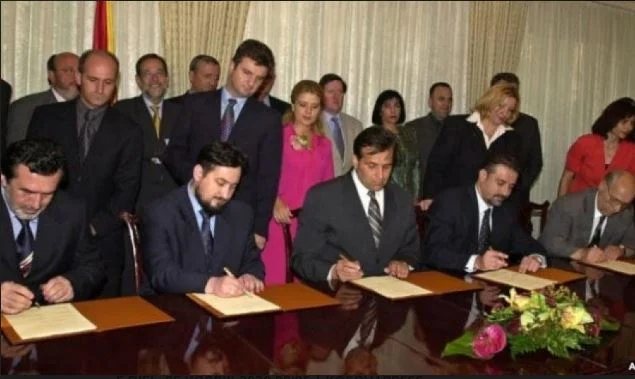
The contents of the framework agreement on resolving the political and security situation in Macedonia, which on Monday, as well as officially, were signed by the chairman of the Republic of Macedonia, Boris Trajkovski, VMRO-DPMNE leader and Prime Minister Lubco Georgievski, LSDM leaders Branko Crvenkovski, Imer Imer and DPA Arboni Xhaferi. In the document, signatures as official witnesses also put international facilitators in dialogue é Fransoa Leotar and James Pardew.