9 minutes ago
Kurti: A father should be equal in his child's life and in his household chores
Periskopi(6 years ago)
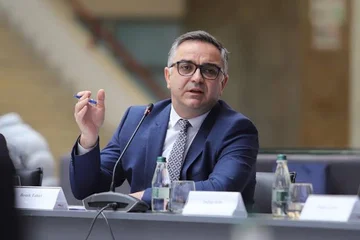
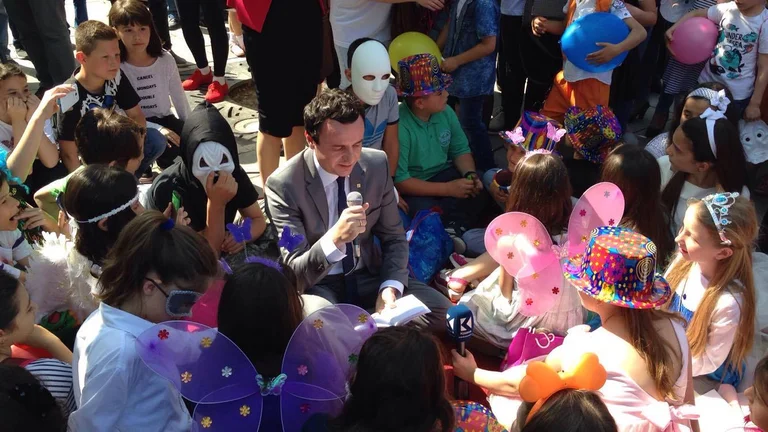
(6 years ago)The prime minister in office, Albin Kurti, has been giving a speech today at the Third International Conference on Health, Goodness, Education and Child Rights, which he pointed out is being organised not only on June 1rd children's day but also on the day the Government opened nests for all children after nearly three months of interruption. [...]
The prime minister in office, Albin Kurti, has been giving a speech today at the Third International Conference on Health, Goodness, Education and Child Rights, which he pointed out is being organised not only on June 1rd children's day but also on the day the Government opened nests for all children after nearly three months of interruption.
Among other things, incumbent Prime Minister Kurti added that nearly all the most important priorities of our society and economy are directly related to health, welfare, education and children's rights.
In his speech he said children should be seen as future citizens of our common democracy. So it is essential how we educate children, both in the family and in schools and communities.
Acting Prime Minister Kurti raised concern that in Kosovo the support of the father to learn is much lower than the mother, where 6% of fathers help children with lessons, compared to 42.8% of mothers. This has to be changed, and we all have to engage in change. The father should be equal in the child's life but also in family chores. The equal commitment of parents at home is the best example that a child can carry so that equality - gender equality - can come naturally.
Family education is also linked with women's rights because the family is where gender roles are learned. Women's rights start with girls' rights. The example of how boys should treat girls, how men should treat women, is shown, and is initially shaped in the way a father deals with his mother.
Full word of incumbent Prime Minister Kurti:
Hello everyone, present and host of today's conference. First, thank you for hosting this conference for the third time, and this year is being organised not only on the day of the children on June 1st but also on the day the Government opened nests for all the children after nearly three months of interruption.
There are many surveys and researches around the world that produce results towards advancing certain issues. I haven't heard, however, that there's been any survey or research on how children would build a society where they would like to live. The results we can only guess, but I believe we would agree that that friendship made by children would be much more funny, more fair, sincere and loving.
Our priorities, however important, do not draw our attention to our children's dreams. What we engage in as an individual and as a society today will be inherited by children, so the question that we adults have to ask ourselves is what is the future that we are building on children? Are our actions in the ministry only of our close families or of all society? As leaders, we have the highest responsibility to lead through example. For children, we must offer good examples to follow.
The desire to listen is more widespread than all our social desires. Each of us wants our voice to be heard so that our role will be recognized and our contribution appreciated. And that need is even more expressed in young people who want to talk to them than we do to them. Rarely do they need a good speaker for a good listener or a critic for a model. School and family should be given more opportunities to express their opinion. The right of children to express themselves both in Kosovo and elsewhere is being lost by those who have forgotten to listen. Listen to our children, really listen, love them, respect them, understand them and accept them, every day and everything. Let's learn about their concerns, raise their self-confidence, and demonstrate the respect they deserve, and have it from themselves and others.
Our government seeks to bring about substantial changes in this regard. Nearly all of the most important priorities of our society and economy are directly associated with the health, welfare, education and rights of children. Children should be seen as future citizens of our common democracy. So it is essential how we educate children, both in the family and in schools and communities. Very often, children submit to authoritarian behavior by parents and teachers. This makes them unable to grow up as literal democratic citizens. Children must gradually be able to exercise the responsibilities of citizenship. That means giving them an added voice within the family and school, teaching them to think critically and speak against injustice wherever they find them.
World healing is also charity and justice. Values of empathy and volunteerism, emotional intelligence in children, should be as important as cognitive intelligence. The ability to understand another's perspective is the main step toward active citizenship, and it is essential for future delicience. By thinking about ourselves and others, we need to make children part of the social changes that we now learn about organizing and coordinating with others against injustice and charity. Otherwise, we deny them the most important lessons in life that would protect and empower them in the face of any challenge. So let us raise our citizen awareness from childhood by conversing with them and serving as good examples.
There are disturbing indicators that Kosovo is not doing enough to protect the safety of children. We have high-level problems with poverty, and there are great difficulties in building a comprehensive society with social services. In addition to children living in poverty, 11% of children are involved in work, and 7% of them work in dangerous conditions. 61% of children, by the age of 14, have suffered psychological and physical violence. Social protection costs are the lowest in the region. Kosovo spends only 6% of the gross domestic product for social protection compared to other countries in the region and Europe, which spend 10.8%. Social protection programmes are not focused on reducing poverty or increasing equality. Children are not orphans only when they have no parents but also when they have no country. We have to take care of war veterans, but more for peace kids.
The other problems we all know and I believe will be discussed at this conference are low continuation in early education and poor quality of education; harassment, kindness and other forms of physical and psychological violence; stigmatisation and insufficient access to children with special needs; and widespread social inequality among children in urban areas compared to those in rural areas, girls, mostly to minorities, etc.
We also need to invest in environmental protection to increase air quality. No group is more vulnerable to environmental damage, and no category will experience the consequences of such damage as children. Air pollution, water pollution, and exposure to toxic substances, along with other types of environmental damage, cause premature death and chronic illness. A report by the European Environment Agency concluded that Kosovo has among the highest concentrations in Europe of dangerous PM 2.5 particles, a situation that has contributed to 3,700 premature deaths in Kosovo. Our government considers it the task to prevent environmental damage; to provide educational programmes that increase the understanding and capacity of children for environmental issues; and to facilitate children's participation in decision-making processes. Among the first steps we took in government was to reverse the decision on building conditions for the neighborhood that was reaching near Lake Badovci. We have made other decisions aimed at cleaning water and air.
As we leave the Covid-19 pandemic, we have to work very hard towards improving the quality and results of education, and ensure that disabled children are involved in health, education, and sports from the pre-school level. Our government, with the aim of preparing and training students, has destined more budgetary support for pre-school objects, construction of new schools and physical education halls, and especially modernising infrastructure at all levels (so, more labs, concrete tools, physical and electronic literature, digitizing materials and educational infrastructure). We believe that schools should take responsibility for the success children show. Therefore, in the event of counterproductive results in state tests, measures of responsibility to directors and teachers must be considered. In cooperation with “Save the Children”, we've also launched the platform for extensive instruction for children with special needs.
I am a parent myself, and I have said that school should be home and school. In Kosovo, the father's support for learning is much lower than the mother, where 6% of fathers help children with lessons, compared to 42.8% of mothers. We have to change that. The father should be equal in the child's life but also in family chores. The equal commitment of parents at home is the best example that a child can carry so that equality - gender equality - can come naturally. Perhaps even more disturbing is the fact that these statistics show that half the children receive no support from any parent, not from their mother or father. Institutions must carry out their share and ensure the missing conditions, but remember that no government or school programme can replace the role of parents and family. All parents need to take care that the incentive for instruction and reading, and for sound development, they follow their children home as well as at school.
Family education is also linked with women's rights because the family is where gender roles are learned. Many families indoctrinate their daughters to believe that housework belongs to women and girls and that their main life in the future is to serve as a wife and mother, not as a lawyer, a doctor, an engineer, or a business owner. And many families indoctrinate their sons to view their sisters and mothers as not equal. So we have underestimated daughter “in front of the “over-valued”. The UN Convention against Discrimination against Women, which under the Constitution is directly applicable in the Republic of Kosovo, clearly speaks on this subject. It determines that: “States take all appropriate measures . . . to change the social and cultural characteristics and patterns of men and women's behavior in order to eliminate prejudice and customary practices, and to rely on the idea of inferiority or superiority of one or another sex, or the stereotype roles of husband and wife”. Especially in a society like ours, which values family life above all, the obligation to combat the idea of inferiority or superiority of one or the other sex, or to challenge the stereotical roles of husband and wife must definitely begin within the family, with the education of children. Women's rights start with girls' rights. The example of how boys should treat girls, how men should treat women, is shown, and is initially shaped in the way a father deals with his mother.
Let's work for children throughout the country to build the future they deserve; let us make sure that every child has a soft bed, and a safe home; make sure that he has good food and the presence and care of parents; make sure that he has quality schooling and equal opportunities. I thank you for inviting me to speak to you today. It was an honor for me and I wish this conference would contribute as much to improving the lives of all Kosovo's children, both today and in future generations.