11 minutes ago
Doctors: Kosovo has no test for the entire population
Periskopi(6 years ago)
(6 years ago)Health authorities in Kosovo have been criticised several times for the small number of tests for suspected persons with the new coronary. But those involved in fighting pandemics say they don't have tests to test all citizens as suspects. However, they say that in the coming days they will increase the level [...]
But those involved in fighting pandemics say they don't have tests to test all citizens as suspects.
However, they say that in the coming days it will increase the level of testing of persons, but require different citizens and organisations not to pressure medical personnel to undergo tests.
On February 8th of this year, about 7,000 people in Kosovo have been tested as suspects with the new choreography.
In contrast, Kosovo currently has more than 7,300 available tests, says in a response to Radio Free Europe, Faik Hoti spokesperson at the Health Ministry. As a result, Hoti says the number of tests has increased in recent days and is expected to increase by next week.
“over the past weekend, the National Institute of Public Health of Kosovo (IKSHPK) has been supplied with 7,300 tests for COVIDD diagnosis-19. Of these, 4,100 from the Health Ministry contract, 3,000 donations from the United Nations Development Programme (UNDP) and 200 other donations”, says Hoti.
Kosovo, Albania with fewer tests in Balkans
Some of the Western Balkan countries seem to stay better in the testing process. According to the Worldometers website, which traces the cases of Coronavirus, by April 28th, Serbia has tested over 7,700 people in one million people -- Croatia about 8,000 people -- Bosnia and Herzegovina over 8,000 -- North Macedonia around 7,300 and Montenegro has tested 8,100.
Kosovo does not figure on this site, but according to a simple estimate, Kosovo has over 1.7 million inhabitants and 6,955 tests, which have reportedly tested over 3,970 people in one million people. The worst is Albania, with 2,603 people tested at one million people.
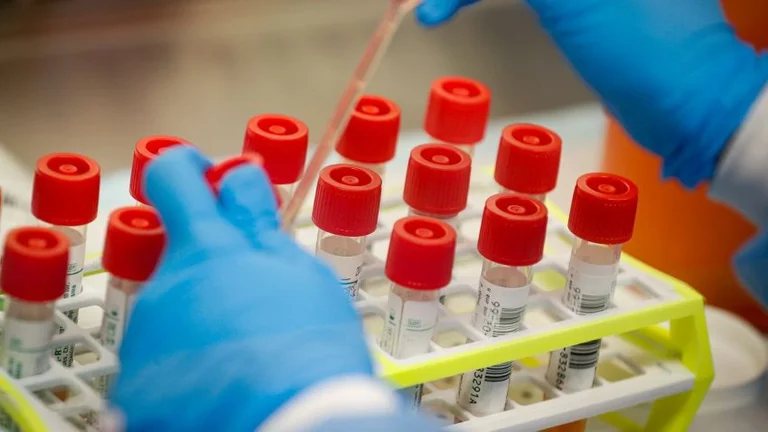
A health worker conducting rapid tests for the coronary in Germany. Picture from the archive.
Meanwhile, microbiologist Lul Raka, from the Kosovo National Institute of Public Health, says the number of samples depends on the number of available tests.
As Kosovo cannot produce tests and depends on import, Raka says the supply with them is very difficult because of the global demand for this product.
According to him, the Institute decides which persons should be tested because there is no possibility for all.
The main problem is the difficulty in providing tests, because the application for tests is global. It's very hard to make sure, that's why tests have been done as much as they have done in recent days. Of course we cannot test the entire population of Kosovo, this is understandable”, Raka said.
Even World Health Organisation officials (OBSH) in Kosovo stress that the number of tests at the country level is small, but according to them, depends on existing capacities.
Isme Humolli, official for emergencies in this organisation, told Radio Free Europe, that testing alone is not a solution to the prevention of coronary. According to her, Kosovo citizens must implement the health authorities' recommendations for isolation.
No state can test each person. But, it becomes selection based on criteria that define O BSH and are approved by health authorities in Kosovo. WHO argues that people with symptoms should be tested, contact persons. The institute, on the other hand, has added individuals to quarantine. I'm thinking that's enough”, Humolly said.
IK Don't pressure us!
Kosovo's National Public Health Institute (IKSHPK) on Monday has called on citizens and individuals from various organisations to stop the pressure on this institution and not prevent its work.
“IKSHPK understands each citizen's concern about his health status, but he cannot submit to the dictates of anyone self-esteeming that he should be tested because such a responsibility belongs to I KSHPK”, said in notification.
The institute does not appoint any institutions or individuals that connect to these alleged pressures.
So far, the National Institute of Public Health in Kosovo has confirmed that 790 people have been infected with coronarys, 232 have recovered and 22 have died. /REL