15 minutes ago
The Turkish couple's story that was working for cancer medicine for 30 years but discovered the anti-Convidian vaccine.
Periskopi(6 years ago)
(6 years ago)The vaccine is one of the most developed ever, but also before it was discovered, it was a 30-year job of two Turkish-born and grown scientists in a small German town. The history of the first David-19 vaccine that was authorized in the West began 30 years ago in rural Germany [...]
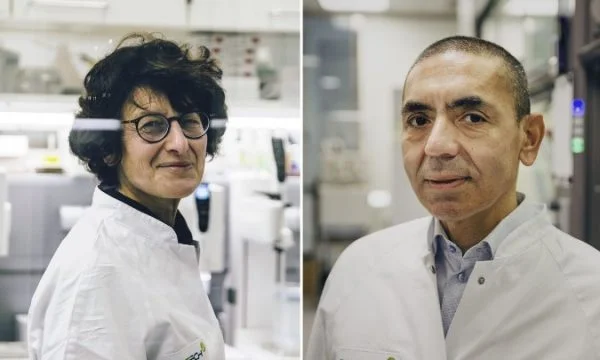
The story of the first David-19 vaccine that was authorized in the West began 30 years ago in rural Germany when two young doctors, children of Turkish and newly beloved immigrants, vowed to invent a new treatment for cancer.
It has taken 10 months since BioNTech SE BNTX of Germany and its American partner, Pfizer Inc. to develop the vaccine that was granted permission for use Wednesday in the United Kingdom, beating the previous Western record for a vaccine, discovered for more than three years, writes the Wall Street Journal.
However, for the founders of BioNTech, Ugur Sahin and Ozlem Türeci, the man-made team that stands behind the successful effort was the result of three decades of work, beginning long before the Coronavirus first appeared to people last winter, reports Online Reporter.net.
When the pandemic exploded, Dr. Sahin had spent years studying m ARN, genetic guidance that can be sent to the body to help it protect itself from viruses and other threats. In January, several days before the disease was first diagnosed in Europe, he used this knowledge on his home computer to design a version of the vaccine.
“Success of Ugur and quezlem is a fantastic combination of two people filling each other”, said Rolf Zinkernagel, a Swiss Nobel Prize laureate who once employed Dr. Sahin in his Cyril lab.
He's an innovative scientist, and she's an amazing customer with a great sense of running a business. ”
Dr. Sahin was born in Iskenderun on Turkey's Mediterranean coast in 1965. He moved to Germany four years later when his father was recruited to work at the Ford factory near Culnyn as part of a policy to rebuild post-war Germany with foreign workers.
Dr. Türeci, a surgeon, came to Germany at the same time to work in a Catholic hospital in the small town of Lastrup, where she was raised inspired by nuns who cared for her father's patients.
After considering becoming a nun herself, she followed in her father's footsteps. Dr. Sahin and Dr. Türeci said their disappointment as young doctors over the lack of options faced by cancer patients for whom chemotherapy was no longer functioning had been the driving force of their ARN work.
When both met at Hamburg University Hospital in the 1990s, we realised that with standard therapy we would soon come to a point where we would have nothing to offer patients”, Dr. Türeci. “was a formative experience. ”
The couple wrote their doctorial dissertations on experimental therapies. Christoph Hüber, then head of the hematology and oncology department of Johannes Gutenberg University in Mainz and now a non-executive director of BioNTech, convinced them to join his faculty. There they began investigating new treatments based on programming the body's immune system to overcome cancer as an infectious disease.
In 2001, the couple established their first company, Ganymed Pharmacticals GmbH, to develop an antibody treatment. Dr. Türeci was chief executive and Dr. Sahin was responsible for the search.
“Motivation... was to overcome the gap from science to survive: In our research we saw solutions that we couldn't bring to our patients' hospital beds”, Dr. Türeci.
One day in 2002, Dr. Sahin and Dr. Türeci left their laboratory around lunch and headed to the civil office, where they were married before wearing their laboratory coat and returned to work.
The couple's earliest and most important supporters were Andreas and Thomas Strungmann, twin brothers and billionaire investors who have been pouring more than 200m euros into the couple's companies since 2001.
“Ugur is the visionary who tells us the future, and ⇩ it shows us how to get there,” said Helmut Yeggle, the board chairman bioNTech and Strüngmann family office manager. The brothers, he said, were happy to give the two scientists broad strategic space.
In 2008, Dr. Sahin and Türeci founded BioNTech to expand their research by antibodies treatments at the ARNi. Since Ganymed was sold for $1.4 billion in 2016 and the couple invested in their new venture, BioNTech has been their only focus.
All executive directors in BioNTech are scientists, including finance and sales chiefs. CEO executes his professor at local university, where he trains Ph.D. candidates, sometimes with an eye on the recruit.
When talking about his job, Dr. Sahin, who holds a Turkish amulet known as the Nazar around his neck, often extends the blackboard to design formulas. BioNTech's team, half of them women, includes scientists with 60 nationalities, including m field authorities ARN as Catalin Cariko, a professor of biochemy at Pennsylvania University Medical School.
“Most biotechnology CEOs are salesmen, but Ugur is a scientist who convinced me that science is good here”, Prof said. Cariko, who is Hungarian.
There is no plan for our products, no one has done it before.” On January 25, one Saturday after reading a study, he said that he convinced her that the dark illness in China will soon devour the globe.
Later that day, he told Mr. Yeggles that BioNTech would focus its work on fighting a virus that still had no name and had not yet been diagnosed in Europe.
I was surprised, to say at least,” said Mr. Yeggle, who worked with Dr. Sahin since 2001. We didn't have much free capital and we were related to our cancer research. ”
Dr. Sahin mentioned Hong Kong flu in 1968-69 that claimed up to four million lives. In two hours, Mr. Yeggle agreed.
The following Monday, Dr. Sahin re-organised his staff in seven-day shifts, urged key workers to cancel their holidays and stop using public transportation. The Lightpeed Project, as it called the effort, would develop a vaccine a month and not in years, as it had been so far. In February, Dr. Sahin was observing the effect of being struck in a microscope. He made a phone call with two employees present. I think this is the birth of our vaccine candidate,” he said.
B NTech had worked with Pfizer to develop a flu vaccine based on m technology ARN. So when Dr. Sahin needed a partner to organise clinical trials across continents, produce the product globally, and help distribute it to the US. and Europe, he knew who to address. In March, the two companies signed a co-operation agreement, and in April, they started their first tests on people.
Later, BioNTech bought an American company and a large pharmaceutical factory in Germany to increase production pending authorisation ) a high-risk approach in case the goal fails.
Morgan Stanley estimated that the vaccine could bring to Pfizer and BioNTech more than $13 billion in revenue. Any income will be invested, Dr. Sahin. Its main focus has not changed: to bring new mARN-based cancer treatments to the market, and 11 of which are on clinical trials.
Many scientists are still skeptical that this can be done. Thomas C. Roberts, an old postdoctoral scientist who specializes in mARN from Oxford University, said the vaccine results were exciting but my application. ARN beyond its impact would face major challenges.
Return to Mainz, Dr. Sahin disagrees, saying the vaccine's authorization would evaluate his technology and “would introduce a whole new category of drugs”.