42 minutes ago
Institute for Justice: Judiciary Council Breaks Down Pristina's Crime Department
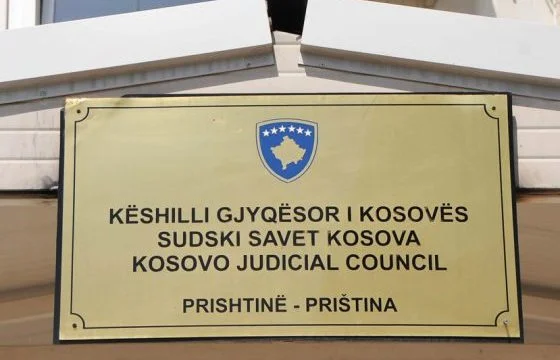
Periskopi(5 years ago)
(5 years ago)Kosovo's Institute for Justice (IKD) has reacted to a series of decisions adopted by the Kosovo Judicial Council (KGJK), at the 244th meeting held on 21 December 2020, contrary to principles and criteria defined in the Constitution, law and policy review of the functional rule of law in Kosovo, of [...]
According to the IKD, KPC's illegal decisions, or in opposition to policies adopted by the same mechanism concern the establishment of seven (7) judges from the Department of Founding Crimes in Pristina at the Special Department of the Constitutional Court in Pristina and Apel, the return of a judge to the Constitutional Court in Pec, the vote against the announcement of contests for the three founding courts, in Prizren, Pristina and Feriz.
Full media announcement:
IKD: Kosovo Judiciary Council destroys Department for War Crimes in Pristina
Pristina, December 21, 2020 Kosovo's Institute for Justice (IKD) reacts to a series of decisions adopted by the Kosovo Judicial Council (KGJK) at the 244th meeting held on 21 December 2020, contrary to principles and criteria set out in the Constitutions, law and policy reviews of the rule of law in Kosovo, adopted by this council itself.
The KPC's illegal decisions, or contrary to policies adopted by the same mechanism, concern the establishment of seven (7) judges from the Department of Criminal Affairs in Pristina at the Special Department of the Foundation Court in Pristina and Appeals, the return of a judge to the Constitutional Court in Pec, the vote against the announcement of contests for the chairmanship of three founding courts, her in Prizren, Pristina and Feriz.
Destruction of the Department for Crime at the Constitutional Court in Pristina:
The Department for Crime at the Constitutional Court in Pristina to date has had 13 judges dealing with serious crimes. From today this department will have only six (6) judges, that is, after six (6) judges of this department, and the head of the Constitutional Court in Pristina today have been promoted to the special departments of this court and the Appeals, while a judge has returned to the Constitutional Court in Pec.
During 2020, the Ministry of Justice in co-operation with the Judiciary Council and the Kosovo Prosecutorial Council (KPK) have approved policy documents related to the Functional Review of the Kosovo Law Rule Sector, which the document is the result of a deep, conservative and well-reasoning analysis of the current situation in Kosovo's justice system. These adopted documents are expected to be finalised in the Kosovo Law Rule Sector strategy, the first of its kind since the post-war. Part of these documents are also a set of recommendations that the KDR would have to take to improve efficiency, transparency, accountability and integrity of the judicial system in Kosovo.
According to policies documents adopted by the KDR itself, the Constitutional Court in Pristina is one of seven courts in Kosovo, which has four branches: Glogovac, Gracanica, Podujevo and Lipjan. The Basic Court's Department of Crimes in Pristina is the most in charge of the unresolved department in Kosovo, with 44% of all subjects or 4091 outstanding substances in all the serious crimes departments of Kosovo's basic courts. However, the number of judges at the GjTh Department of War Crimes in Pristina was 14 or 32% of the number of judges assigned to the heavy crimes departments at the national level.[1]
Among the hundreds of recommendations of the Functional Review was also the requirement to improve the capacities of both councils, court heads and prosecutors for strategic planning based on such data (human resources, budgetary policies and decisions are reasoned based on material burden and performance in courts and prosecutors). According to the corresponding analysis of functional revision, there is a huge difference between courts and prosecutors regarding the collection of materials and materials. Not all courts have workloads of problems. It is important to assess and analyse shared courts (including department levels) and to take separate measures. More importantly, the Constitutional Court in Pristina represents a special case that needs attention, as it focuses most of the burden on matter of matter (and the collection of materials) on the national level, as presented in the chapter that refers to determining the problem. Interconnection should be improved between the materials and the appointment of resources to courts in Kosovo, specifically at the Foundation Court in Pristina.
K The JPS, contrary to all these recommendations, has ruled that eight (8) judges of this department are distributed in other departments, leaving this department in just six (6).
The Reda Crime Department at the Constitutional Court in Pristina currently has 1,444 unresolved substances, which the remaining judges will have to handle by six (6). According to the KKPPRK, in any criminal case when the court is changed or the chairman of the Judicial Chamber is changed, then the subject should be converted to zero point, with which cases must be cancelled or declared invalid of all court hearings that were held earlier. With the fact that seven (7) judges of this department will leave, almost 60% of the materials at work will be returned to trial from the start.
When added to this, the fact that six judges in this department are unable to perform 1,444 working materials within the deadline, the possibility that many of these materials in later stages will be submitted or treated with very large delays is almost inevitable.
Such an approach of the KGS is equivalent to consciously destroying a system built for years, with more than 1,444 materials deliberately prescribing or treated with severe delays, which will affect the large number of cases from failing. KDR members with such an approach have changed roles by officials who would have to maintain the independence, impartiality and integrity of the judicial system, in those who by their actions have violated all these principles, enabling potential offenders to benefit in the future.
Prizren Foundation Court Speaker Competition
As of July 4th 2020, the Constitutional Court in Prizren has been operating with the court chairman's task officer until the Kosovo Judicial Council (KGJK) has yet to announce competition for the post. In Article 3, paragraph 1 of the Order's Procedures of Elections, Ratings, Prustimation and Downloading of Courts and Judges, it has been determined that the competition for the heads of courts or magistrates opens 45 days before the current mayors have expired.
This way, The KRC had to announce the competition for chairman of the Constitutional Court in Prizren by May 19th 2020.
But despite the fact that the KDR has not respected this legal deadline it has established, this council has not yet announced the competition for chairman of the Constitutional Court in Prizren.
Otherwise, the KDR leader, whose mandate ends on March 8, 2021, is the judge of the Foundation Court in Prizren. Based on the legal provisions of the Law on Prevention of Conflict of Interest in the Public Function Army, members of the KDR have been prohibited from electing court heads for the next two (2) years, but that there have been cases in practice when this provision has not been respected, both by KDR and KKP.
Despite the demand that competitions for the Constitutional Courts in Pristina, Prizren and Ferizaj be announced in accordance with legal obligations, the KDR has not implemented the same standard as with its practices, which on 23 June 2020 had announced the court's internal competition at the Special Department of the Foundation Court in Pristina and Appeals.
Limiting access to candidate files for judges sent for decree
During the KPC meeting, two (2) members have voiced their doubts about the process of recruiting and sending new judges to decree, raising concerns that candidates with criminal files have been nominated to the president for decree.
The two members of the KDR, although they have requested access to these files, it has been restricted by the leader of the KDR, with the reason the members should send email or paperwork to get access to these documents.
Moreover, this process has also been conveyed with a lack of transparency and accountability. The process of selecting judges and prosecutors should be transparent. This means that procedures and criteria must be clearly determined by law, reports of free countries and all conditions of qualifications, as well as any other conditions related to applications, should be announced publicly and distributed widely[2].
KK The GEB underlined that “It is essential that, in accordance with practice in some countries, each Judiciary Council, the criteria for appointment and selection make it accessible to the general public”. K The JCK, in the concrete case, has limited transparency and accountability not only in relation to the public but also to members of the KDR itself.
Moreover, accusations that candidates with criminal pasts have been nominated and no information was provided during the KDR meeting.