7 minutes ago
Bosnia elections: Izetbegovic loses Sarajevo as Dodik Banja Luka
Periskopi(6 years ago)
(6 years ago)The Party of Democratic Action (SDA), whose president is Bakir Izetbegovic and Milorad Dodik's Union of Independent Social Democrats (SNSD), have lost power in Bosnia and Herzegovina's largest cities: Sarajevo and Banja Luqa. “The SDA has lost three important municipalities in the Sarajevo canton. And it was hard to [...]
“The SDA has lost three important municipalities in the Sarajevo canton. And it was hard to keep, given that everyone has joined us”, Bakir Izetbegovic said at a news conference Sunday (November 15th) evening.
While SNSD President Milorad Dodik conceded defeat in Banja Luka, the administrative centre of Republika Srpska Bosnia.
“Banja Luka chose in a democratic manner and we respect that election. Banja Luka citizens have deployed”, Dodik said.
In the town of Banja Luka, opposition candidate Drasko Stanivovovic won from the Party of Democratic Progress (PDP). He stated at the press conference that Banja Luka will be the city of all citizens.
“This is the happiest day in the modern history of our town”, Stanivovovic noted in his speech from the party's main election headquarters.
According to the Central Election Commission, nearly 54 per cent of the approximately 3.3 million registered voters came out to vote for mayors and councils in the two autonomous regions of Bosnia, the Muslim-Croatian Federation and Republika Srpska CHA, as well as the Brcko District.
The elections were initially scheduled for 4 October, but the government's delay in adopting a national budget, including financing for the elections, led to their postponement.
Bosniak, Serbian and Croat nationalist parties have held power for most of the period since the end of the war in Bosnia, 1992-1995.
But criticism of the treatment of the coronary pandemic and scandals over medical equipment purchase have strengthened support for the opposition.
The number of cases of coronarys and deaths linked to COVID-19 in Bosnia has increased significantly in recent weeks. Health authorities have said that 72,000 people have been infected so far, while more than 1,800 have died.
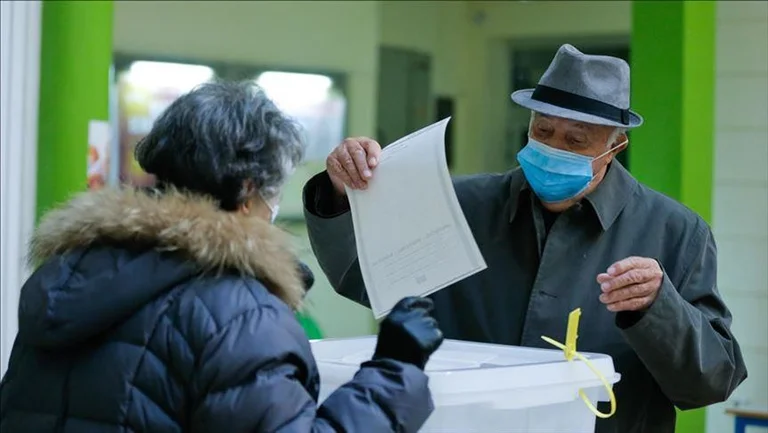
To avoid the risk of spreading the coronary, voters at polling stations were required to keep strict physical distances, wear facial masks, and wash their hands.
The ethnically divided southern town of Mostar will hold elections separately on 20 December.
These elections will be the first in Mostar in 12 years, and will be held after Bosnia and Herzegovina's leading Bosniak and Croat parties reached an agreement on a new statute for the city in June.
Mostar has not held municipal elections since 2008 due to the authorities' failure to implement a 2010 decision by the Constitutional Court of Bosnia, which ruled that the city's division structure was unconstitutional and should be reformed.