3 minutes ago
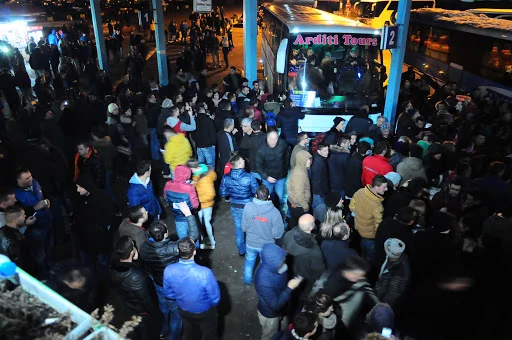
Kosovo is empty: For a decade, 220 thousand people have fled.
Periskopi(6 years ago)
(6 years ago)More than 220 thousand Kosovo citizens have emigrated in the last decade, the Kosovo Statistics Agency reports. This figure, according to demographics and civil society representatives, is considered very disturbing. The largest number of citizens who emigrated from Kosovo during the 2010-2018 period was marked in the year [...]
More than 220 thousand Kosovo citizens have emigrated in the last decade, the Kosovo Statistics Agency reports. This figure, according to demographics and civil society representatives, is considered very disturbing.
The largest number of citizens who emigrated from Kosovo during the 2010-2018 period was marked in 2015, when over 75 thousand citizens left Kosovo.
Then in 2016 and 2017, migration had marked a decline, and in 2018, more than 28 thousand again decided to leave the country.
The Kosovo Statistics Agency has no figures yet published for 2019.
Official immigration records include regular and irregular immigration.
The countries where Kosovo citizens have emigrated mostly during 2010-18 are Germany, France, Austria, Croatia and other states.
For the period 2016-2018, it is estimated that Kosovo has lost about 2 percent of the country's population.
Demaft Rifat Blaku, in a proposal for Radio Free Europe, considers the number of citizens who are releasing Kosovo as disturbing. More disturbing, he says, is that the country is abandoning the most vital part of the population - young people who, according to him, are most productive and educated.
The “is a huge loss and a major disorder in the demographic, biological structure, and for this is the time not only to consider and discuss, but also to create an efficient, practical, political and institutional action, to create a policy of migration, which would be initiated by treatment that migration is controlled, managed, temporary to translate positive aspects, as it owns great capital and minimizes the negative effects of migration”, says Blaku.
Germany, Slovenia and Croatia, according to a recent report on the migration of the Ministry of Internal Affairs, are states resulting in an apparent increase in the accession of Kosovo citizens for employment purposes during 2018.
Meanwhile, on March 1, 2020, the German Labour Force Law is expected to take effect, regulating in detail the arrival of the workforce from countries outside the European Union.
With the law's entry into force, Demush Shasha from the Kosovo Institute for European Policy (EPIK) says there may be an even greater influx of young people from Kosovo and less developed countries that will release the country.
This law facilitates the movement of people, the movement of workers to Germany, has potential for a large influx, will wait and see the impact this law will have, says Shasha.
Some youths surveyed by Radio Free Europe say the reason they would leave is the lack of perspective in Kosovo.
Ermira Sylejmani, a student, says he would leave Kosovo due to better conditions for employment that European Union countries offer.
This is where you do the faculty and you still stay home. There (in EU countries) young people give better opportunities than here (in Kosovo). There they appreciate a student who ends his studies, and here in Kosovo not”, Ermira says.
Abednego Hoxha, a young man from Pristina, says he would go to work in any of the EU countries and only for a certain time, not forever.
I leave Kosovo forever, but for a better opportunity I would go for a while. I would go for a better job, for a better future, for example, in Germany I would go to work for a while. Germany offers you the best perspective, but Kosovo offers the other good ones, you have your home, your family, and so many other”, he says.
The increasing number of young people to issue Kosovo, Demush Shasha from EPIK says, has resulted from poor economic, political and social developments that are accompanying Kosovo.
In a survey of the United Nations Development Programme (UNDP), called “PublicPulsis”, which was published in 2019, it was noted that more than half of all respondents in Kosovo have claimed that the biggest issues facing Kosovo are related to corruption and socio-economic conditions.
About 50 percent of respondents have been declared either dissatisfied or very unhappy with Kosovo's current political direction.
Also, according to this UNDP poll, nearly half the population does not see democratic processes in Kosovo in positive light, and neither does the economy have a positive outlook.
In the past three years, businesses in Kosovo had also stressed that, despite the high unemployment rate in Kosovo, there has been a shortage of workers.
They had said they had problems finding workers in the construction sector, in the hotel, and in some sectors where seasonal jobs are worked.
The number of Kosovo citizens living abroad, according to data from the Kosovo Statistics Agency, by the end of 2018, is estimated to be over 850 thousand people.
Demaft Rifat Blaku points out that according to demographic projections and the current migration district based on the population census that will take place in 2021, Kosovo will have a smaller population of 1.7 million, as far as it was in its latest census in 2011.
“IKA, abandoning along with birth loss are two events, developments and the most severe experiences of Albanian society since it is about contracting the population, the most expensive national capital. So this should finally get into the mid- and long-term development plans. I remember that Albanian society and the institutions of the Republic, should be declared the 2020-2030 crisis decade, respectively, of demographic awareness”, Blaku says.
The high migration also reportedly will affect the population structure in the following years, since it is estimated that the overwhelming proportion of migration in recent years had included young age groups mostly 25-44.