3 minutes ago
Green or Borell, who's gonna find the tangle of Kosovo Serbia
Periskopi(6 years ago)
(6 years ago)Dialogue on normalisation of reports between Kosovo and Serbia has been blocked for more than a year. Such a process has led to a deadlock of Thaci-Wucciq discussions on border correction and taxes that Ramush Haradinaj's government had imposed on Serbia. But, 2020, many see it as a time when they can [...]
Dialogue on normalisation of reports between Kosovo and Serbia has been blocked for more than a year. Such a process has led to a deadlock of Thaci-Wucciq discussions on border correction and taxes that Ramush Haradinaj's government had imposed on Serbia. But, 2020, many see it as a period when a dialogue can be revived and an agreement reached. Europeans are seen as a natural mediator, but Donald Trump has already unveiled plans to take over the process.
Since Kosovo's declaration of independence, rounds of Kosovo-Serbia bilateral talks have been held. In 2013, meanwhile, the signing of the much discussed Brussels Agreement was reached, which was thought to lead the two countries towards mutual recognition.
However, such an agreement has remained only on paper, until Pristina and Belgrade maintain accusations of disrespect. Kosovo accuses Serbia of failing to comply with a series of energy-related agreements, free movement, meanwhile, Belgrade continues to mention Kosovo not to establish the Association of Serb Majorities.
Over the years, there was no progress towards reaching a final agreement between the two states, while the frustration of the reports has reached its peak.
Meanwhile, the European Union insisted on reaching a comprehensive Kosovo-Serbia final agreement that would establish peace throughout the region and pave the way for two states to integration towards the EU.
That seems to have prompted the two presidents Hashim Thaci and Aleksandar Vuciq to experiment towards reaching a final agreement that could potentially solve the Kosovo-Serbia problem.
The two leaders, unhindered by EU High Representative Federica Moghrini, had begun discussions on border corrections or exchange of territories as a method for reaching a Pristina-Belgrade final agreement.
Some Thaci and Vuciq were also accused of secret meetings, yet publicly of accessing borders had been discussed at the Albbakh Forum, which was held in August 2018 in Austria, organised by Chancellor Sebastian Kurz and President Alexander Van Der Bellen.
Hashim Thaci and Alexander Vuciq had for the first time talked about the possibility of mending the borders, and such an open idea was supported by Austrian Chancellor Sebastian Kurz himself.
This had alerted the powerful states of the European Union and also the political factor in the country that was strongly mobilised to oppose it.
German Chancellor Angela Merkel, in September 2018, had come out against touching the borders. Merkel from Skopje had said that the Western Balkan states should maintain territorial integrity.
“We, like Germany and as European, have interest in the stable region. This is key to Europe's stability in general. I believe territorial integrity is key to the” region, Merkel had said in Skopje.
In opposing such an idea was the entire political factor in Kosovo. All political parties opposed him, meanwhile, Ramush Haradinaj, the newly elected prime minister, said such an idea turns to past tragedies, citing war boots as well.
Touching the borders had turned Thaci's Haradinaj into bitter political opponents. Each time he had the opportunity, he would attack the other.
Seeing such a situation, Ramush Haradinaj's government had made a 100-year tax decision on products originating from Serbia and Bosnia and Herzegovina.
The decision also became the main obstacle to continuing the Pristina-Belgrade dialogue, as Serbia was barricaded and said it returns only after the tax is lifted.
International pressure increased as the months passed towards Haradinaj. Starting in the United States, France, Germany, and the European Union, who desperately sought to lift the tax.
This international pressure had left Haradinaj alone in supporting his tax decision on Serbia, which he said is preventing the partition of Kosovo, as it had blocked Pristina-Belgrade negotiations where borders were allowed to be discussed.
While there was a unified international position on the tax that it should be removed in order to resume Kosovo-Serbia negotiations, mixed signals were coming to the idea of overhauling borders from the European Union and the US.
France was seen as one of the states supporting such an idea, while the most disturbing situation had made the US position to support any agreement Kosovo and Serbia agree on. Such a declaration was also interpreted as support for the correction of borders.
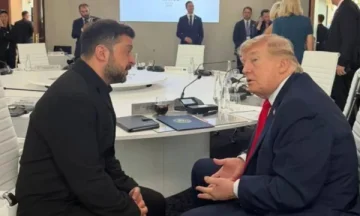
Such a situation had further set fire to a letter by US President Donald Trump, who had addressed Thaci and Vuciqi, which required the signing of an agreement described as historic.
I urge you and Kosovo leaders to use this unique moment, to speak with a single voice during peace negotiations, and to refrain from actions that can make it difficult to reach the agreement. The United States has invested heavily in Kosovo's success as an independent and sovereign state. We want your country to continue developing. We are willing to help you in your efforts to reach an agreement, which reflects in a balanced way the interests of Kosovo and Serbia. Such an agreement is within reach. I expect at the White House to welcome you and President Alexander Vuciq to celebrate what will be a historic agreement”, said in the December letter Trump had sent to President Thaci.
Following this letter of Trump, where a quick Kosovo-Serbia deal was required, negotiating discussions with borders and a tax that had blocked the negotiation process, German Chancellor Angela Merkel, who opposed the touch of Western Balkan maps and aimed at unblocking the situation. On the matter of touching borders, Merkel wanted France's president, Emmanuel Macron, to support her.
Merkel in co-ordination with France and the United States of America had organized a Sam, held in Berlin on April 29, 2019.
Several leaders from the Western Balkans, including Albanian Prime Minister Edi Rama, had attended this meeting in Germany, led by Merkel and Macron.
After the meeting, Haradinaj had remained steadfast in the tax decision, even in spite of the pressure of Macroni and Merkel and the clashes he had had had inside with Edi Rama, since the latter had taken care of to do more pressure to remove the tax. These developments in Berlin continue to remain collision points to this day between Rama and Haradinaj.
Since nothing concrete had been achieved in Berlin, Merkel and Macron had agreed to continue their initiative and attempt to unblock the Pristina-Belgrade dialogue. So the two leaders had set July 1st as the date for their gathering back to Paris.
Later developments had prompted the French Summit to be cancelled, as Pristina and Belgrade did not move at all from their positions. Haradinaj called for mutual recognition from Serbia as counterweight for the removal of the tax, meanwhile, Vuciq and Brnabiq in the dialogue said they returned once the tax is lifted.
Throughout this period of blocking dialogue, Thaci-Vucciq's efforts for border corrections had waned, even experts who recognise the Western Balkans argue that such an idea had died at the Berlin Summit.
Seeing this in the European Union's bid to return the parties to the table of discussion, the United States of America had seen the need to blend directly, as the Trump Administration was busy in Iran and North Korea until then.
On August 30, 2019, the U.S. State Department had appointed Matthew Palmer as Special Representative for the Western Balkans and for dialogue between Kosovo and Serbia.
This Washington movement was supposed to unblock the situation. Palmer after his appointment had visited Pristina and Belgrade, and it was thought that dialogue could potentially resume in late November or early December. Haradinaj's resistance to removing the tax, however, made impossible any effort to restore the parties to the dialogue.
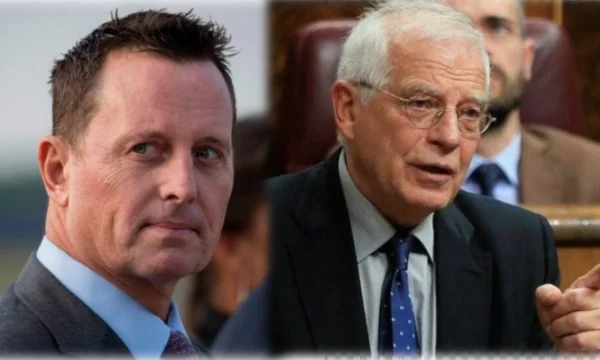
After Palmer's appointment in August, US President Donald Trump had gone a step further. On October 4th, 2019, he had appointed US Ambassador to Berlin Richard Green as Special Presidential Representative specially for Kosovo-Serbia dialogue.
This appointment was seen as US commitment to the region and to resolving the problem between Kosovo and Serbia that would give a long-term stability to the region, while some analysts also viewed it as a strange decision.
After the appointment, Grenelli had immediately travelled to Pristina and Belgrade. On 9 October in Pristina, the special envoy of Trump for the Kosovo- Serbia had met with Kosovo President Hashim Thaci in Pristina.
Of all Yerenelli's visit to Kosovo, it was implied that the United States was seeking the achievement of a quick deal. Months of February-March 2020 were cited as the time when the issue between Pristina and Belgrade would finally be closed.
Amid Palmer-Grenelli efforts for continuing Kosovo-Serbia dialogue and reaching a final agreement between the two states were introduced the two US senators, Chris Murphy and Ron Johnson, who remained during September in Kosovo.
“The sacrifice required for the final Kosovo-Serbia agreement” was their joint position said by the US Embassy in Pristina during the visit September 4th, 2019.
Meanwhile, along with all this time the dialogue was on the blockade because of the tax, the idea of moving borders had been completely dimmed, until Vuciq himself had accepted it at a news conference that such an attempt had died.
However, political developments in the country, Ramush Haradinaj's resignation from the prime minister's post following the invitation he received from the Special Court, the remains of the tax in power, and the new elections have marred all Western mathematics for quick return to dialogue and for the possibility of reaching a final agreement between the two states.
Already Kosovo is found in a period of formation of new institutions. Despite the fact that nearly 3 months have passed since holding the 6 October elections, the country continues to be without institutions.
The EU already with a new chief of diplomacy, Josep Borell, expects the new government to resume efforts to restore the parties to the dialogue, since Albin Kurti, who is expected to be Kosovo's prime minister in the event of a coalition agreement with LDKQA, has warned the removal of the tax and the deployment of reciprocity with Serbia. If the dialogue is resumed, it remains to be seen what Borelli's approach as chief negotiator and how he will co-operate with Germany, France and the two US representatives will be towards reaching a Kosovo-Serbia final agreement.
And while Kosovo is making efforts to establish new institutions, Ram-Wuciq and Zaev have embarked on a new initiative called “Mynisgen”, which is also being rejected by official Pristina. Such an initiative has overwhelmingly supported the US, however, say such a project cannot be realised without Kosovo.