6 minutes ago
Research and innovation in Kosovo is underdeveloped

Periskopi(7 years ago)
(7 years ago)Research and innovation in Kosovo is underdeveloped and faces a series of challenges. The efficiency of the Research and Innovation System is hampered by various factors, ranging from the lack of implementation and monitoring mechanisms, insufficient financial means dedicated to development of research and innovation, weak human resources that affect the absorption [...]
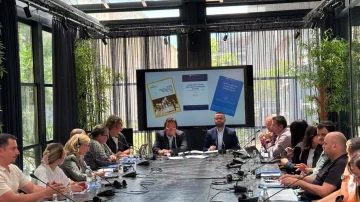
There are these main findings that were introduced to the table with the “theme. Kosovo Research and Innovation Development Status: Ideas about the future of K&I in Kosovo”, organised by the Ministry of Education, Science and Technology and supported by Project H. ERAS (Higher Educaitton, Research and Appeal Sciences), which is supported by the Government of Austria.
The Research and Innovation Rating Report, where the author of this report Hamit Qeriki, said one of the main challenges is not functioning of the State Council of Science.
He said that failure to function this Council has produced negative consequences, where he said priorities in the field of research and innovation have not been updated and clearly identified.
The non-function of this Council is seen as one or produced some negative consequences, since the National Council of Science one of the mandates has also established national priorities in the field of science and research, these priorities have not been updated, they have been in 2010. Its failure to function has an impact even on the lack of funds, both national and local, both regional and international, Qeric said.
He said investment in research and innovation is extremely low, he even said that if regional comparison is made, Kosovo ranks at the bottom of the list of Western Balkan countries.
According to him, the lack of funds makes it difficult to carry out adequate research and innovation activities, and affects the quality of research and innovation activities.
“Fofdes is a matter that even under the law for scientific activity is set at 0.7 per cent of the annual report, but according to various reports this percentage is low compared to the region and not to speak to other countries. However, there was no clear calculation of how it came to this calculation. According to the latest progress report, 2019 says the access funds are 0.1 per cent of the product's value or gross domestic output, because one of the indicators is the gross product. This index is more or less forwarded to many other reports, somewhat less so, but all reports bring it down below the level of all countries in the region”, he said.
Curriqi said research-scient infrastructure and research capacities are very weak, insufficient existing objects according to him are outdated and are not suitable for research purposes. He even said they are still far from international standards.
Austria's ambassador to Kosovo Christoph Weidinger, who declared that the country representing him for 20 years supports the development of higher education and the search for innovation in Kosovo through various projects, has also participated.
“In higher education Austria is the largest donor after the EU, the largest donor in higher education. So this made me happy because higher education, research and innovation is the focus of economic development and economic growth prospects. I have worked in Japan, where the main source is people and the high level of education, so all of you here are showing that research and innovation is the right path to the future and in Europe has been given great importance to co-operation in the field of research by many EU member states, and that is a story of success and such an event as today will help provide Kosovo on this road to Europe. As you know Austria is our hope to help Kosovo on this road to Europe”, he said.
Weideger said Austria has supported Kosovo in higher education for 20 years and will continue to do so in the future.
While, MAST Secretary General Ekrem Kastrati said they remain committed to fully engaging in the successful realisation of the Heracs project in Kosovo, with the goal of developing research and innovation in Kosovo.
“Research and innovation in Kosovo have been one of the most important challenges in MAST, which has been faced in a continuous manner with extraordinary challenges since the war. Not only is the definition of the clear framework of support schemes of research and innovation necessary, as is the functioning and implementation of them. We are aware of the financial challenges that have been delivered to us in the past, but also consistently, which challenges have been nearly insufficient with financial projects for organising scientific research and advancing our educational system”, he said.
He said the Kosovo government and MAST are aiming to further strengthen the dedication and effort in Kosovo's full integration into the European Research Zone and the European Higher Education Zone.
Meanwhile, project leader “Heras” As close to Emurli, said there is for the first time a report giving recommendations for Kosovo institutions on how to handle the question of research and innovation.
In the last year alone, the ministry has raised the budget for 1m euros for science and innovation, but what is difficult to understand and as a result requires immediate action by us as a project so that this can be handled by different prospects, from the perspective of research and university. Of course we are here today, for the first time we have a document on the status quo for research and innovation, there is a 60-page document, a document concept that scans the situation and stresses important issues and gives conceptual recommendations to the ministry and other activists”, he said.
Table with theme “Kosovo Research and Innovation Development Status: The idea about the future of K&I in Kosovo” is organised by the Ministry of Education, Science and Technology supported by Project H. ERAS (Higher Educaitton, Research and Appeal Sciences), which is supported by the Government of Austria.