7 minutes ago
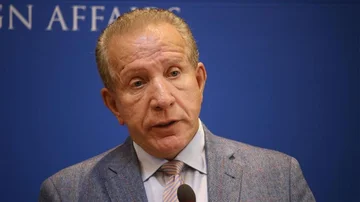
Berisha today criticises Balkan Schengen, when in power worked for the Balkan Union with Serbia, without Kosovo

Periskopi(7 years ago)
(7 years ago)From the Adriatic Doci Government Berisha supported the Western Balkans Outcome project at the meeting in Montenegro before leaving power, the project was rejected by Kosovo, Croatia and the talks were interrupted when the SP came to power, why Berisha speaks to New Yugoslavia today. The three Balkan leaders, Prime Minister Edi Rama, counterpart [...]
The Berisha government backed the Western Balkans Outreach project at the meeting in Montenegro before leaving power, the project was rejected by Kosovo, Croatia and talks were interrupted when the SP came to power, why Berisha speaks to New Yugoslavia today.
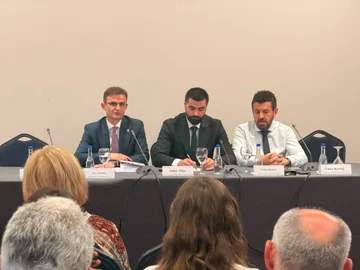
The three Balkan leaders -- Prime Minister Edi Rama, counterpart Zoran Zaev and President Aleksandar Vucic -- decided at the Ohrid Summit the adoption of an action plan for deepening regional co-operation, in terms of the implementation of four European Union freedoms in the Western Balkan region, Freedom of the Movement; Goods; Services; Capitals. Prime Minister Rama named this co-operation as “The Secret of the Western Balkans” that will facilitate interoperability among the countries of the region. Opposition President Lulzim Basha has described the Ohrid Summit as anti-European propaganda, saying that European integration failure with the Balkan Schengen cannot be replaced.
What has the Democratic Party done when in power in this regard? The government Berisha supported and worked in secret for the project proposed by Montenegro, with Serbia's consent, for the establishment of the Western Balkan Union, known as the plan (Universal Balkans), part of which it was projected to be: Albania, Bosnia and Herzegovina, Montenegro, Kosovo, Macedonia and Serbia. The project discussed in secret until 2013, when the DP fell from power, envisioned Serbia-based joint parliament, where each member country is represented by 10 deputies, joint Balkan police, joint economic policies, co-ordination in educational systems, joint fight against corruption and organised crime, plans to preserve regional market, financing projects of regional interest, energy co-operation, unique areas for exchange of people and capital, simplifying procedures for border crossing, hey passports, etc.
The project had some positive aspects like the removal of passports or unique areas for the exchange of people and capital, which are now reflected in the Balkan Schengen, but very suspicious was the proposal for common parliament based in Serbia. At the time, the US-EU has remained indifferent to this plan, while Kosovo has denounced it as a dangerous project behind which the revival of Milosevic's Yugoslavia is behind. Enver Hoxhaj, Kosovo foreign minister at the time, has indicated that “We have maintained that this initiative is not decision-making and that there are no institutions that would leave the impression of a timely integration of these Western Balkan states. All projects are concentrated mainly in Montenegro, Bosnia and Herzegovina and in Serbia”.
The first discussion on the idea of former Montenegrin Foreign Minister Igor Luksic, who has proposed the formation and establishment of a “Balkan Union”, was held at the SEECP summit in Ohrid on 1 June 2013. A special meeting for this initiative is organised by Montenegro's Foreign Ministry on 16 July in Perzhno, attended by representatives of the foreign ministries of Serbia, Montenegro, Macedonia, Bosnia and Herzegovina, Albania and Kosovo at the level of political directors. At that time the DP was still in power, as the rotation occurred in September 2013. According to the official communiqué, published for this meeting by Montenegro's MPJ on its official page, representatives of the six participating states have expressed the consent of the respective states to create this “The Balkan Co-Western Union”. Kosovo has represented Sami Ukelli, general director of Foreign Ministers and Syla Ukshi, director for the Balkans in the same ministry. In the transcript of this meeting, it is said that in principle participants in the meeting have confirmed readiness for, reportedly, co-operation in the given format of regional co-operation, whose main goal is to integrate them into the European Union. The EU delegation chiefs in Montenegro, Ambassador Mitika Drobnic and Council for Regional Co-operation Secretary-General Goran Svilanovic were at the meeting.
At the time, former Foreign Minister Arta Dade raised questions about this project. I don't know if this is an initiative that comes from Montenegro or has even broader support, and this should be seen. I think he'll see with the right seriousness. I find that it should not be hasty to give an answer, because ultimately any initiative would be welcome, but it depends on whether there is room to consolidate current initiatives or new initiatives should be undertaken. Parliament and the Foreign Commission will take another role. Regional cards should not be dimmed over Albanian state foreign policy. Understandably, Albania has had an extraordinary role in playing on the regional plain. We will retake and consider this role on the regional plain”.
While former Montenegrin Foreign Minister Igor Luksic has stressed that his plan has been misinterpreted as allegedly targeting the re-array of the new Yugoslavia. “I am misunderstood and the interpretation of some media has been wrong, as it were, of restoring Yugoslavia or something similar, which is a completely wrong topic”. On the other hand, Croatia has rejected this project. Former Croatian President Stipe Mesic, in an interview with the “Anadolus Azhans” on September 21st 2013, declared: “A new Yugoslavia is an illusion. We had two experiments with Yugoslavia, the first and the second Yugoslavia, and both ended up in blood. In terms of a political association, Luksic's initiative makes no sense. If the Western Balkans are interested in establishing concrete and beneficial co-operation, let's do it with joint economic and infrastructure projects, with common gas pipelines and oil pipelines, with highways and joint Interconnection lines, with railway networks and joint energy production, etc. As for new political, institutional and organisational unions, Balkan states have their starting point, which is the EU”.
Discussions about the proposed project by Montenegro, strongly supported by Serbia, were interrupted after the political rotation in September 2013. However, for the Ohrid Summit, Sali Berisha, two days ago, the Ohrid Meeting -- the success of Serbia-Serbian Vucic in creating New Yugoslavia with the help of the Zographer Bis -- said. Friends, with the Nis pact, in an anti-national disuniting act, Zegraf Bis reiterated by point the Tito-Ever pact of the customs union under Albania's conversion to Yugoslavia's 7th republic”./Albanian. com