6 minutes ago
Gerjaliu shows who is damaging Kosovo economy

Periskopi(8 years ago)
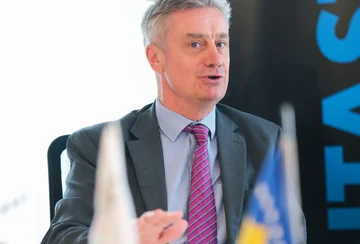
(8 years ago)The busy political agenda in Kosovo has been overshadowed and obstructing the country's economic development, says in an interview for Radio Free Europe, Safet Gerjaliu, chairman of the Kosovo Economic Ode. Among other things, he says the Kosovo business community has asked the Government to remove non-professional people [...]
Rel: Mr. Gerjaliu, the Government of Kosovo, had pledged that it would cost great importance to economic development, or specifically, the private sector. What is the intensity of executive commitments in this regard?
Safet Gerjaliu: Definitely, the political agenda that is dominant in Kosovo is damaging such an advance and planned agenda by the Government of Kosovo for economic processes. But the truth should be emphasized that the private sector is making much faster steps for economic processes than politics, and in this respect, I believe that in recent years it is characterized by intensive public-private dialogue.
I'm still saying that if someone deserves the preference of post-war heroes in Kosovo, it's not politicians who waste time trying to enhance the past, but the business community that builds the future, because it creates new jobs, generate budgets and, above all, accelerates integration processes and improves Kosovo's image.
Rel: According to the Kosovo Economic Ode, what is the state of the private sector or what barriers is this sector facing?
Safet Gerjaliu: I am starting to answer that question at the last meeting we had with Kosovo Prime Minister (Ramush) Haradinaj, where I was with nearly 80 businessmen and their request has been: Mr. Prime Minister, we don't ask for help, just don't bother us. If you think you can help us, then eliminate bureaucracy and don't let ignorant people be placed in key positions, because they generate corruption, they generate bureaucracy, and by this bureaucracy, damage local business and at the same time damage to Kosovo's image, while demotivated foreign investors.
In this direction, I believe that if we think about the future and that the economy really is a priority for the current government, then rule of order and law should be a priority, because we can talk about reforms, strategies, but if we don't have rule of law and law, we don't have personnel education in public administration, in advance we'll be tried to fail.
In this direction, I believe that it is the time for scientific expertise and rule-of-law rule to be priorities, for Kosovo to really step up with countries in the region and beyond. If you analyse the countries of the region, they are making really big reforms, reforms which are being concreteised with foreign investments of international interiors, which unfortunately in Kosovo are not occurring.
We're turning friends into enemies.
Rel: Mr. Gerxhaliu, are these reforms being hampered by political agendas, specifically by demarcation, affecting the country's economic sphere, the result to foreign investors?
Safet Gerjaliu: If appeals were to be made in Kosovo's most hostile circles and an appeal to draft a strategy to destroy Kosovo, I believe they would not know how to do worse than the current Kosovo political garrison is operating.
There are three phenomena that have actualised this category of politicians in Kosovo. The first, international agreements have turned into power and war for position and opposition. The second is the officialisation of violence and the third, which is more disturbing, has faded and there have been no red lines with Kosovo's friendly embassies, both Quint's, in particular, the US Embassy. In the past, when a decision has been brought to support Kosovo, it has truly been a final word of these embassies, and this political garrison no longer appreciates the recommendations of friendly states, in particular the United States of America, which is a huge damage.
In contrast, other countries in the region also try to make friends. We will turn friends into enemies and adversaries, knowing that it is great harm. The words that have dominated most in the past three years have definitely been the word demarcation, the word Association and liberalisation. But the fate of these three problems has far more been in the hands of deputies, who speak in the name of the people, but at least act in the name of the people.