8 minutes ago
The day Ismail Kemal was buried

Periskopi(8 years ago)
(8 years ago)With a grand ceremony on February 12, 1918, Ismail Kemal was buried. The entire population of Vlora had gathered in skel. At 10:00 a.m., the lifeless body of Ismal Kemal, from the “Base Novale” was placed on the ballbed. From there the great chorus departed [...]
The entire population of Vlora had gathered in skel. At 10:00 a.m., the lifeless body of Ismal Kemal, from the “Base Novale” was placed on the ballbed. That's where the big choir headed.
From Peru, Ismail Kemal's lifeless body, which immediately died embalming, accompanied by his sons, headed for Brindisi. It was placed on the Italian battleship “Alpino” and arrived in Vlora on the evening of February 10, 1919. That night, the coffin was placed in Italian military command in the quay. He stayed there two days.
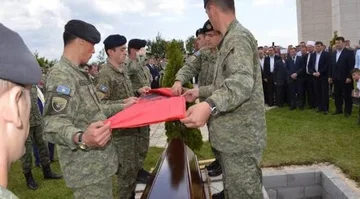
The funeral ceremony took place two days later on Wednesday, February 12, 1919. The conveyance of the body from the scaffold began at 10: 00 a.m. It was home to the entire population of Vlora, as well as Italian military departments and their musical band. Cortenzha was led by 12 crowns of flowers sent by the people of Vlora, district and district organs, primary schools in the city, the town of Fier, the society “One of the wreaths was of the newspaper “Conquest”, in which it said: “Ismail Kemal Vlora! Diplomat value”. Even in this form, Italian censorship was seen, which allowed Ismail Kemal to be honored not as a patriot, not as the Father of Albania's Independence, but as the “diplomat of value”.
When the procession left for the city, members of the society “The boys of Vlora” held crowns at the top. Other “members came after the crowns. Boyfriend” Next came the military band, which executed the latest melody “Jone” of Italian composer Petrella.
Furthermore, a group of soldiers from the 86th regiment as well as an Italian cervix department. After them came the chariot carrying the coffin wrapped in the national flag. Six brown horses pulled the cart. Anna's chariot was running two lines of soldiers. Then came the hojaries. After them, the three boys from Ismail Kemal. Then came General Setimito Piacentini, anti-admiral Lubet, the province's military and civil authorities, city and district leadership, citizens, elementary school students of the city, and a bunch of cavalry soldiers.
Walking slowly, the next procession reached the city. That day, says newspaper correspondent “Location”, Vlora was in mourning. The market was closed. Subsequents of black beltd necrology were attached to shops, where it was written: “The nationalZ for the great patriot Ismail Kemal.” It seems that the national flag banned from the occupation command, citizens replaced it with honour through necrological pronouncements for Ismail Kemal, the great <x4patriot”.
Through the doors and windows of the houses, the correspondent wrote, women and girls had emerged, to honour Albania's “Place”, some of which had been recognized in their youth. When he reached the city market, the procession stopped. Two uplifting talks were given there. On the funeral ceremony, we have two historical sources, one of the Italian military occupation authorities, the other from the memories of citizens of those days.
Regarding this ceremony, General S. Piacentin reported to the Roman Foreign Ministry that evening: The warship “Alpino” arrived at the stage on Monday night on February 10, 1919; that on February 12, 10:00 a.m., the burial ceremony was performed; that the coffin with the body of Ismail Kemal left the wharf at 10: 00 a.m; that according to the scheduled program, the Italian Army infantry battalion attended with music and flags.
He underlined that there were no non-Albanian flags, except for one covering the coffin. Two speeches were delivered by Albanian elites, which, the Italian general stressed, had become known to me earlier (certainly to censor F. B.). The attendance was great. The rule was maximum. There was no incident. ”
Author R. Fallaschi, who published the C. Piacentini, in turn, notes that <x0-commercis with grief over the burial of Ismail Kemal, when he thinks that in his hometown, only six years ago the great patriot declared Albania's independence with the enthusiasm of the nation and with Italy's consent, he was now honored not by his country's soldiers, but by Italian troops and that the only Albanian flag present was the one covering his coffin.” Part of the Italian Command journal in Vlora.
Although the Albanian army was missing there, at the time of the burial, the entire city and district was lined up by the side of the road from the stage in Kanini where the coffin would pass, while the villagers filled the hills. Eyewitnesses from the villagers ' swarm of hills looked like hives of bees.