18 minutes ago
Parliament violated the Law on Gender Equality, no woman was voted into Negotiator Team

Periskopi(8 years ago)
(8 years ago)PDK deputies, AAKA, PSDA's NISMAs violated the Law on Gender Equality when they voted the Negotiator Team with nine men. The law guarantees equal participation for women in decision-making positions. Sociologist Sbel Halimi explains for Express why power continues to remain in the hands of political men. Only 7 women have deputy ministers [...]
PDK deputies, AAKA, PSDA's NISMAs violated the Law on Gender Equality when they voted the Negotiator Team with nine men. The law guarantees equal participation for women in decision-making positions. Sociologist Sbel Halimi explains for Express why power continues to remain in the hands of political men.
Only 7 women hold deputy ministers' positions from 79 such positions in Government. Even worse at the highest government positions. Of 21 ministries, only one is a woman. In even higher state positions, only men, including the position of Chief of State, Government and Parliament, continue to hold.
Kosovo has no mayor in municipalities. No public university is led by women. Public television is guided by men. KEKAun leads a cousin of the President. The PTK was led by an AAK militant and now continues to be led by a man. Basri Sejdiu leads. Kosovo Archive Rame Manaj. One man.
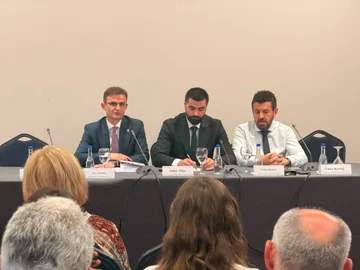
The same bad trend for women in decision-making has continued on Saturday, when the Negotiator Team for Dialogue with Serbia was voted in. Nine men were appointed there.
Lists lead Fatmir Limaj, Shpend Ahmeti, Enver Hoxhaj, Avni Arifi, Behgjet Pacolli, Mahir Jagcilar, Dardan Gashi, Visar Ymer and Dukagjin Gorani.
Sociologist Sbel Halimi, in a written reply, has said that the Parliament violated the Law on Gender Equality when it voted a team excluding politicians.
“... even with the composition of the negotiating team, where the ruling parties have not been willing to respect either the Law on Gender Equality, where Article 6 and Article 815, provides a 50 per cent representation of each gender at the highest level of decision making”, has concluded Halimi.

According to her, such an act tells of the masculist and Mysoginist spirit of politicians in Kosovo.
For the decision of the Kosovo Assembly, no association fighting for gender equality in Kosovo reacted. Even organisations that receive hundreds of thousands of euros on behalf of projects on this field have reacted. The reactions of these organizations are usually made when their funds are spent.
Even so, Sübel Halimi predicts the poor trend of women's involvement in decision-making will continue further as primitive thinking cannot be changed.
Because of the circumstances Kosovo finds itself in, we will need to have an advantage of women's involvement in important processes, including Dialogue. The legacy of thinking and discurs versus woman's identity is hard to change quickly! ”, she added.
Sbel Halimi, which is active in protecting women's rights, the guilt why even in dialogue, Government and other institutions are populated by men and women of political parties.
“... when this situation joins the non-active role of women in political parties to eradicate discrimination that is being done to their gender, even through a unifying voice to change this practice”.
Halimi has returned to the political parties' campaign to show an example of why women do not have decision-making positions in any relevant institutions and process for the State. It says that the pre-election process was organised in Oda, where the woman was mostly disfellowshipped.
A campaign developed mainly in oda, of course it can produce another result. For this reason women in politics should reflect on their involvement in political parties”, she has praised.
It gives bad predictions about the position of women in decisionmaking if not certain affirmation forms are implemented to place women in various leadership positions.
The implementation of the affirmation mechanism is a small, extremely necessary contribution to women's representation, as the oda mentality is not being exceeded, but is returning under modern clothes”, Sable Halimi predicted.