3 minutes ago
Regon Thaci: Read the speech, negative criticism for Germany cannot be attributed to me

Periskopi(8 years ago)
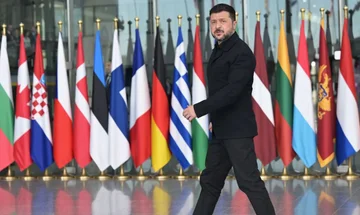
(8 years ago)Kosovo President Hashim Thaci has reacted after reporting that he has joined the criticism of Serbian Prime Minister Ana Brnabiq to Germany after rejecting the idea of changing the borders between Kosovo and Serbia as the final solution in Brussels' dialogue, Periscopi reports. Thaci has published the full speech he has delivered at his next welcome lunch [...]
Thaci has published the full speech he has delivered at the previous luncheon of the Munich Security Conference é the Meeting at the Minsk, Belarus, as evidence that he has not mentioned Germany's position at all, so negative criticism of Germany cannot be attributed to him.
For public opinion clarification, below find my full speech at the Minsk Security Conference. Germany is a strategic ally of the Republic of Kosovo. I believe, today, as I have always believed, that there is no and there can be no lasting solution in the Balkans without even Germany's support. Berlin is the gate of Kosovo and the region for EU integration. The negative criticism of Germany cannot be attributed to me. HTH”, Thaci wrote on Facebook.
On the other hand, however, there was former Germany's ambassador to the United States, Willfng Ischinger, who had announced that Thaci and Brnabiq had the same critical attitude towards Germany, only because it spoke out against changing borders between the two countries.
The renowned diplomat, Germany's once secretary of state, has written on his official account, on the social network Tateter that the German government's “presence has been criticised by Thaci and Brnabiq as very negative”.

Whether this was Thaci's only statement at the Munich Security Conference is unknown, since there has been discussions on the issue of dialogue between Kosovo and Serbia reportedly during this conference.
The following is a full speech published by President Thaci:
The world has changed. A “political world” is dying and a new “political world” is still in an embryoal phase, which must be born. Europe is at a crossroads, with many developments raising questions about the future. The Western Balkans have remained dependent on oblivion.
In this reality, Kosovo and Serbia find themselves seeking to reach a final peace agreement. We're exploring all available possibilities.
As for the deal, we haven't heard about anything yet.
The agreement between Kosovo and Serbia is the most sensitive step for the Western Balkans. And this process is not to require that one party necessarily be a loser.
Is that possible? Very difficult. Or, almost impossible.
But even under these circumstances, I see light at the end of the tunnel. Why?
At first, both states I'm convinced of that they can't go on the way they are today.
The current status quo, in both countries, cannot be maintained. The current frozen conflict harms both countries, in all areas of life... in the economy, in development, in security, in integration...
The dialogue has received support, but also some criticism. In our societies and internationally. I don't mind that. It was expected.
It is even healthy for general debate, but for the process itself. Especially for a greater transparency and responsibility of leadership, both countries.
But in this process, the easiest thing is to criticize. And the hardest thing to do is find a way to get to the deal.
By reaching agreement between Kosovo and Serbia, we will have few populations in our region. Less nationalism. Less voices for war and tragedy. Less hatred and revenge.
What is the main purpose of the dialogue process?
1. A final peaceful agreement for full normalisation of relations and reconciliation. Between both countries and between two peoples.
2. An agreement which is internationally legally binding.
3. A comprehensive agreement, which implies mutual recognition between Kosovo and Serbia. Without recognition, this and any other agreement will make no sense. An agreement on all issues... missing persons, displaced persons and refugees, property, community rights, election rights, education and health care, the Serbian Orthodox Church, economic co-operation and so on.
4. The deal must be final, not temporary.
5. There will be an agreement that will bring more comfort to our neighbours and the entire region.
6. There will be no boundaries along ethnic lines.
7. There will be no exchange of population between countries.
8. We will preserve the soul and multiethnic reality of Kosovo and Serbia.
I hear some are mentioning peaceful ethnic cleansing. This is ridiculous. We heard the same in February 2008, just before Kosovo declared independence. That Kosovo Serbs will leave Kosovo in columns. In reality, no individual Serb family issued Kosovo when we declared independence.
In Kosovo we were and determined to build a civic democracy in our country.
Some of my friends, diplomats, analysts and academics have mentioned Pandora's Box. The Kosovo case will neither open nor close Pandora's Box. The box is already open. But the agreement between Kosovo and Serbia will help start closing the Pandora Box in the Western Balkans.
And nobody can draw parallels between Kosovo and Bosnia. Only if we allow the establishment of a Republika Srpska in Kosovo will we parallel between Kosovo and Bosnia. I won't let that happen. We must not allow this.
Time is running out. Now is the moment, now is the moment to act. To reach agreement.
What benefits will the agreement bring to the two countries and beyond?
Kosovo and Serbia will recognise each other. The two countries will have a clearer and safer European perspective. We will produce more peace for the entire region. Our energy will focus on development, on reforms, economies, education, integration and cooperation.
Kosovo will be recognised by the five EU states that do not yet recognise it. With real potential for full membership in the United Nations. When Serbia recognises Kosovo, no one will be able to become more Serb than Serbia and continue not to recognise Kosovo or block Kosovo in the Security Council.
The EU wins with the deal. And the United States. So did Russia. Kosovo is not an enemy of Russia. We want recognition from Russia. We want to have fair and constructive relations with Russia. But above all, the winners are our respective places.
We need everyone's support if we want to make this a success. Now is the right time. We have the leadership, both in Kosovo and Serbia, who wants a peace agreement. We have an EU that wants and works towards a peace agreement. I here express my gratitude to Mrs. Moghrin for her role in this process.
We must now, without speculation, move forward. / P ERISCOPIA