18 minutes ago
Pronto justice- These are the scandals that followed 2017.

Periskopi(8 years ago)
(8 years ago)The year 2017 was filled with scandals confirming increased citizens' doubts that the justice system is closely linked to politics. “Kadale, don't be hasty, because that man cares so much for us” These are the words Kadri Wessel had spoken to him about Chief State Prosecutor Alexander Lumez during a telephone conversation with Adam [...]
The year 2017 was filled with scandals confirming increased citizens' doubts that the justice system is closely linked to politics.
“Kadale, don't be hasty, because that man cares so much for us” These are the words Kadri Veselin had spoken to State Chief Prosecutor Alexander Lumez during a telephone conversation with Adem Grabovci in 2011. This conversation was made while consulting for Lumez's possible engagement, then Pristina District Prosecutor's chief prosecutor at the Democratic Party of Kosovo. The best “The Veselin-Grabovci talks, along with those of Grabovci and President Thaqi and PDK MP Besim Beqaj, were published a short time ago by Kohavision, in the new set of wiretappings that appeared in public, dubbed “Proto 3”. The hearings are clearly part of EULEX's investigative file, covering 2008-2012 of the investigations that were then under way about Fatmir Limaj in the “case. MTPT” As is the “Pronoto 1” of “Proto 2”, these also testify to the manner of informal and often against rules, procedures and the laws of party leaders until later in Kosovo.
In the case of “Proto 3” a suspected link between Lumez and PDK's high structures, which also questions his integrity as head of the highest justice institution. And so questioning the integrity of the entire prosecutorial system, writes Koha Ditore.
Chief Prosecutor
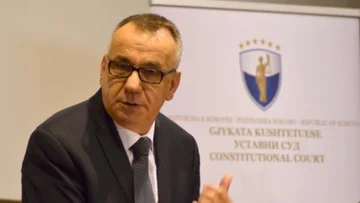
Chief Prosecutor Lumez was on the verge of this year's next major scandal: allegations of forging a lawyer's test. A statement by former Constitutional Court Chairman, who publicly accused Chief Prosecutor Lumezi that his file was forged and that he did not pass a jurisdictional exam, was cancelled by KTV and the “bet on justice”, which by days have published evidence suggesting that something was not in order with the exam Lumez insisted he had given, but that he had the flawed file and manipulated. Based on the statement, Zymer Krasniqi from Decani is the name on which the name Lumez is marked in the chief prosecutor's file, which was found in the UP. His name is seen in light. After presenting this fact Lumez presented the certificate of the jurisdictional exam, which he writes on April 25, 1991. And to prove the authenticity of his certificate, Lumez came out and said he had obtained a confirmation from former district secretary of administration and Judicature, Djordje Aksic, who was appointed to this position during the time of violent measures, following the expulsion of Albanian workers. Investigations into allegations of counterfeiting the law-test file were conducted by prosecutor Kujtim Munishi, who turned out to have been adviser to chief prosecutor Lumezi. The investigations were said to be conducted under EULEX supervision. For a short time they closed. The prosecution found that the Lumez file was not forged. And the public remained with many unanswered questions.
The person who first accused the chief prosecutor of falsification did so on the day he himself was convicted of corruption and sentenced to a prison term on bail.
Former head of the Constitutional Court, Enver Hasani, along with Hakif Veliun and Albert Rakipi, have been found guilty of changing the contract, titled “Translation of English-language books for the needs of Pristina University”, which was signed between the UP and the Institute for International Studies in Tirana in 2008. At the time of allegedly misappropriation, Hasan was the UP's reactor, while the signed contract had caused the University damage worth 70 thousand euros, Periscopi broadcasts.
21 years in prison for “terrorists”
But the case that mostly aroused public attention seems to have been a 21-year prison sentence for the 4 activists of Vetevendosje Movement, accused of attacking 2015 with rocket launchers at the Kosovo Assembly facility.
The burned motorcycle, phone, and bought card, some video recordings, as well as electronic addresses, turn out to be the main evidence supported by the Court, which, on the other hand, did not take on excusing evidence, such as prosecutor's and police experts, from which it turned out that the accused had no burden on guilt. The court sentenced VV deputy Frasher Krasniqi to eight years in prison, while activist Father and Arifi to six years in prison. Another activist, Egzon Latifi, has been sentenced to prison for five years and six months. Meanwhile, activist Adea Batusha has been sentenced to two years in prison.
The decision was announced two days before the second round of local elections was held.
But four convicts were not the only VV to have clashed with Kosovo judiciary.
Albin Kurti, who emerged as the most voted MP in Kosovo, was arrested for failing to appear in court and has been held in custody for more than a month. In custody for the same reason, another VV deputy, Donika Kadaj-Bujupi, ended up in custody. Kurti and Qadaj-Bujupi have been released from custody, while being assigned freedom protection measures. The judgment against them (with Faton Topalli and Albulen Haxhiun) has reached an end: it remains only the presentation of the final word as well as the proclamation of judgment.
Another event that was closely followed was the release of former KLA commander Sami Lushtaku after the Supreme Court rejected the sentence on war crimes charges against him, Lushtaku had been sentenced to 12 years in prison by the Constitutional Court in North Mitrovica, and then 7 years later by Apel. In contrast, former Commander Sylejman Selimim has remained in prison, as well as the other indictees in the “Drenica 1 and 2” case.
This year the marathon judicial process against Fatmir Limaj and other accused of organised crime ended, in the case known as “MTPT” Limaj along with the four accused, Andrew Shala, Nedzat Krasniqi, Telaku Rescue, as well as Florim Zuka, were acquitted. Unanimously, the justice panel led by EULEX judges came to the conclusion that the accused's actions do not constitute criminal acts, as there was no evidence incriminating.
This same year, investigations were launched against Limaj's co-party, Kosovo Initiative MP Milaim Zeka, concerning criminal acts of participation or organisation of the criminal group, fraud and tax evasion. Investigations began after media reporting on the fraud of 920 Kosovars, for employment visas in Germany.
Shukri Buya, the only high profile suspect during 2017
A single high profile indictment is the balance of state prosecutor's work during the 12 months of the year we are leaving behind. The former leader of Lipjan, Shukri Buya, is the only senior official who was charged with corruption in 2017 and continues to face justice. In fact, the prosecution also filed two high-level charges, but in order to know they were knocked down by the court.
The indictment against former Gjakova leader Pal Lekaj, and the indictment against former Minister for Communities and Return in the Government of Kosovo, Dalibor Yevtic, were rejected by the court without being treated with any argument that the State Prosecutor had not argued they had performed the works as allegedly in the indictment.
Fifteen other charges filed during 2017 belong to the lower or middle level.
Former head of the Constitutional Court, Enver Hasani was acquitted of prosecution for corruption while at the helm of the Constitutional Court in early 2017. Second and trithol levels came to the conclusion that the indictment against him is unfounded. Unbashed was the indictment against Mitrovica chairman Agim Bahtiri. He was never tried on charges of corruption, since the indictment against him was rejected and criminal proceedings against him were violated.
The indictment was also dropped against former Education Minister Rame Bouja, as well as other corruption indictees. Always with the same reason.
The same <x0fat” had the indictment against Gjilan chairman Lutfi Haziri, as well as corruption. The court also rejected him, considering him baseless.
Other charges, although described as acceptable to be judged, did not end with condemnation. Last two years acquitted former chief of staff PTK, Shyqri Haxha, former chairman of Drenasis, Nexhat Demaku, Malisheva chairman Ragip Begaj, former leader of Obilic, Mehmet Krasniqi, Bakija Hope, former head of the Constitutional Prosecutor Gjakova, Mazum Baraliu, former director of the Prizren Public University. The court also freed the two former culture ministers, Astrit Haraqija and Valton Beqiri.
Another strange case from 2017 is that of Driton Gashi, whose Pristina Constitutional Prosecutor had filed suit since 2016, but withdrew from her seven days before his appointment at the head of the Kosovo Intelligence Agency (AKI). Reason: Lack of evidence. Gashi was accused of misusing the official duty at the time he was leading the position of MPB secretary. Before that position, he was close to the PDK. His appointment at the helm of AKI sparked the reaction of civil society. Organization “Grid” said “The PDK through the appointment of the AKI director is controlling institutions”.
Kosovo Police Seker, Corruption Contagion
In May 2017, “Koha Ditore” revealed the next scandal in the law sector. The paper reported on a sexist in the Kosovo Police, who had collaborated with police on closing cases. Former Kosovo Police Economic Crimes Director Emin Beqiri was also involved. The paper published video-incident division, where it was viewed as the Hasani sexier, accepting money from parties involved under investigation in order to close cases against them. Beqiri had assured the leaders of the Centre for Avokim and Diplomacy (QAD) that, together with sexist Hashimi, would close the case. Besides being aware that the sexist in the name of the police was asking people in the preliminary phase of the information collection, he had also ordered them to do as the beat said, Hashimi, who had just started collecting the information for 100 thousand euros, broadcast Periscope.
The next unpleasant surprise was the release of Enver Sekiraca from custody, sentenced by the first-instance court to 35 years in prison for inciting police murder Trium Riza. A few weeks before his release, he had offered to the Court of Appeals as a guarantee all his property, including his home and establishment, only to be released from custody. However, the escape from Sekiraq prison did not last more than 24 hours, after violating the provisions the court imposed on him when he appointed the measure of house arrest. He was not permitted to meet anyone except his close family. The night he was sent home, dozens of people were waiting for him the next night, the police put him back in chains and sent him to the High Security Prison. A hearing was held before the court on the case. Sekiraca said that the court's order was unconsciously violated, since he had not read the verdict on the night of his release. However, his prayer and reasoning did not suffice. The second-instance court decided to leave him in custody and authority further exceeded the first degree when the retrial of the case begins./Periscopi/




![About 50 pounds [18 kg] of marijuana confiscated, two arrested in Kacanik](/cnt/019ee57a-a005-7817-acc4-545a84abc5c1__s.webp)