6 minutes ago
No Catalonia should be equal to Kosovo, all cases held apart

Periskopi(9 years ago)
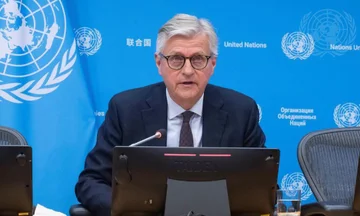
(9 years ago)Former UN Prime Minister in talks on Kosovo's final status, Austrian diplomat Albert Rohan, has said that cases of drawing Catalonia and Kosovo should be assessed separately, thus stressing that it opposes this draw with the cases of the independence referendum. Former UN special envoy for talks on [...]
Former UN Prime Minister in talks on Kosovo's final status, Austrian diplomat Albert Rohan, has said that cases of drawing Catalonia and Kosovo should be assessed separately, thus stressing that it opposes this draw with the cases of the independence referendum.
Former UN special envoy for Kosovo status talks Albert Rohan estimates that, in the case of the referendum on Catalonia's independence, separatist tendencies in different European countries have completely different preconditions and rates.
In the context of events in Spain, the question arises why different aspects of independence in Europe are deemed otherwise. Because contrary to the rights of the peoples for self-determination and the principle of territorial integrity of states, international law does not have standards that approve or prohibit secession” says Roan in an article published in Vienna daily “Day Presse”, transmits voice.info
Roan notes that for this reason each case should be assessed separately, where, in terms of the right to secession, it should be initiated by whether there is a minority in its own country that is substantially discriminated against.
“Kosovo has been stripped of broad autonomy”
Kosovo in Yugoslavia had a double status ʹ autonomous province and subjects of the Yugoslav federation, with similar rights like the six republics. Federal status disappeared with the breakup of Yugoslavia and broad autonomy was abolished in 1989”, Roan said.
He cites the referendum, which was held by the Albanian majority population in September 1991 with an 87 per cent turnout, with 99 per cent support for independence, and adds that the Serb minority and the government in Belgrade rejected the referendum, and as a result was followed by a massive crackdown on Kosovars and an armed struggle against Serbian authorities.
Serbia's military operation followed, and then the international community decided in 1999 to conduct military intervention.
“Under UN auspices in 2006 have begun negotiations in Vienna on Kosovo's final status, and with UN special envoy Martti Ahtisaari's proposal, Kosovo in 2008 declared independence, which Serbia did not accept, but the International Court of Justice at the request submitted by Belgrade, praised that the declared independence was not in conflict with international law”, Roan recalls. None of these circumstances, as it underlines, have anything to do with Catalonia.
“Around 40 percent of the Catalans support secession”
With its own language, identity and history, this region belongs to Spain's <x1-directional historical “is highly developed and has full autonomy in law-making and management. If, in spite of this, part of the Catalan society demands independence, the causes may be the high transfer of financial means to the Spanish state, the growth of the Catalonian national consciousness, and feelings that are not properly respected by Madrid”, Roan is convinced.
He said that, according to the polls, about 40 per cent of the Catalans support independence from Spain, which corresponds to the outcome of the referendum, in which turnout was 42.5 per cent and support for independence of 90.9, which according to him, meant that 37.8 per cent of the total number of voters voted for secession.
“Based under the chaotic circumstances in which the referendum was held, and the brutal action of the Spanish police cannot be made credible conclusions about the Catellans' stance. It cannot be estimated that this represents a step for unilateral secession with catastrophic political and economic consequences for the region. It is now necessary for both sides to reign in the de-exception of emotions, and the leaders of Catalonia must be aware that for secession it is necessary to make legal changes in the Spanish Constitution, which can be implemented only with the Parliament's decision in Madrid and referendum throughout Spain”, Roan considers.
“Disconnected from Great Britain, 55 percent of the Scotsmans”
The Spanish government, he adds, has shown no sensitivity to Catalonia's demands and should not leave the problem in the hands of the judiciary and police, but must try to reach a political solution.
He says the Spanish government should offer regions a complete reform of the state in the federal sense and therefore the secession trends of “take the wind”.
“The EU must give up support and assist both sides in launching dialogue,” said Roan.
Scotland is also part of a democratic and EU legal state, as well as a high degree of autonomy, but there is still a part of the population supporting independence. “However, Scotland, under an agreement with the British government, held a referendum in 2014, in which, with a high turnout, about 55 of the population voted for secession. Currently, this issue is in a number of places, because of the Brex decision, and perhaps it will depend on the terms for withdrawing Great Britain from the EU if sponsors of Scotland's independence will again try to start the topic of secession”, Roan concludes.