32 minutes ago
From road to Google: How did online assessments turn into weapons of protest in Albania?
Periskopi(an hour ago)
(an hour ago)Tens of major businesses in Albania became the object of an unusual form of protest.
Not stoned or colored, but with thousands of negative estimates on Google, accompanied by calls for boycotts on social networks, reports REL, broadcast Periscope.
Within days, online restaurant, companies and media profiles were filled with comments with a star, significantly reducing their public assessments.
For businesses, this translates into a direct blow to the reputation and confidence of customers.
For protesters, it is a way of putting pressure on companies that have taken advantage of their proximity to power.
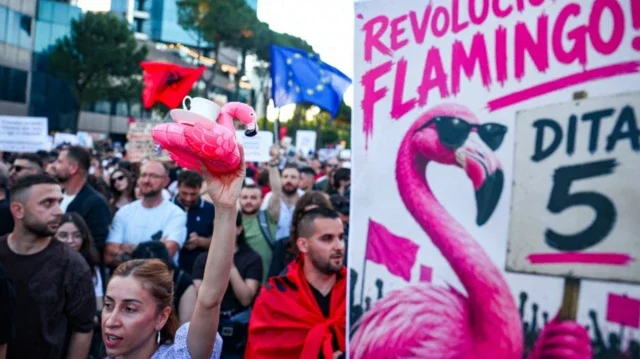
The campaign began under protests known as the Flagingo Revolution.
Initially, he targeted artists, singers and prominent figures of showbiz, which protesters accused him of supporting power or of choosing to remain silent in the face of political developments in the country.
Soon she changed her course. The targets also became large companies that, according to protesters, have benefited from government decision making or have built privileged relationships with power.
Calls for boycotts first appeared on the social platform, Reddit, and then spread to Facebook, Instagram and other platforms, where users were encouraged to leave estimates with a star on Google Reviews for dozens of companies and media.
Google Reviews is one of the most widely used business rating platforms, and for many companies, online reputations directly affect customer confidence.
For this reason, a number of them addressed the authorities in a row.
State police said they have identified about 10,000 accounts allegedly involved in this highly co-ordinated online activity and added that verifications are under way.
Prime Minister Edi Rama called on the prosecution to act on what he described as <x0).
From “1 euro contracts” to Google campaign
Among the businesses found at the centre of this campaign is the one also of entrepreneur Gjergj Luca, known for his activity in the fish processing industry and for the “Rozfa Fish City” in Elbasan.
Protesters targeted him, claiming to be one of the businessmen who took advantage of the power.
They refer to, among other things, the Council of Ministers' decisions, under which, since 2015, his company has acquired five state assets with a symbolic one-euro fee under the state scheme to promote investment and employment.
The company itself says contracts have been granted in line with this state scheme and that investments have brought economic development and jobs.
Within a short period, Luca business profiles at Google Reviews faced a wave of negative comments and, according to public data on the platform, some fell from about 4.5 stars to about 2.
Luca described the campaign as an attack on work built over the years.
“I don't get hurt, but it pours mud on people who worked on sacrifice”, he publicly said, while in reactions to social networks, protesters called “fasists”.
Radio Free Europe asked Luca whether his businesses have suffered concrete damage from this campaign, but he declined to give additional comments, saying his stance remains what he has already publicly expressed.
For protest organisers, Luca is just one example.
Gent Progny, part of the “Revolution Co-ordinator of Fleming”, says the campaign is not intended to hit private business as such, but companies that, according to him, have been enriched thanks to privileges created by power.
The citizens are sick of people who, just because they're close to power, take property with one euro to get rich... Everyone is free to respond and express their opinion”, Progny says.
He adds that the campaign is inspired by similar initiatives in other countries, where social networks have been used as a means of pressure on companies or public figures.
Freedom of expression or coordinated attack?
For Albanian authorities, it's not just about negative internet comments.
State Police Director Skender Hitaj said late last week that about 10,000 accounts on social networks are suspected to be involved in the event.
According to him, cases have been identified when the same account has published -- within a very short time -- negative assessments of businesses in different cities in the country -- a model that police say raises doubts about a co-ordinated event.
Hitaj said authorities are co-operating with online platforms and international partners to provide evidence and identify those behind these actions.
“Every person who results in this illegal activity, regardless of its location, will face law enforcement”, he said.
Police statements were immediately rejected by protest organisers, who described them as trying to intimidate citizens.
Gent Progni says no one can be investigated just because he left a negative assessment on an online platform.
There is no legal basis to investigate or stop someone for a negative review. Citizens are expressing their opinion of businesses. This campaign goes to the benefit of other businesses, perhaps working honestly and not as businesspeople associated with power”, he says.
The debate was joined by the opposition.
Democratic Party Chairman Sali Berisha said each citizen has the right to express his opinion about a private or public service.
However, he distinguished between sincere criticism and the use of false accounts to publish evaluations of services never received, saying it undermines honest competition.
At the same time, he accused Government of preparing to limit social networks.
On the other hand, Prime Minister Rama described this form of protest as a <x0 criminal” and said that, with the help of Google company, business profiles are returning to estimates that, according to him, “with jobs possible”.
He argued that online attacks do not only harm affected companies, but also Albania's image as a safe place for investment and tourism.
“Proteta fuels the negative and false perception of an environmental, inhospitable country for foreign and uncertain investment for tourists”, Rama said in an address to the media this week.
Free Europe Radio contacted Google Company to ask whether it has noticed any unusual activity in Albania and, if so, what measures it took but did not get answers.
Albania's constitution guarantees freedom of expression and thought.
If fraud or coordinated activity is proved, the issue may no longer be treated as freedom of speech but as a criminal offense, depending on concrete facts.
The Penal Code itself does not have a specific article for “review bombing”.
How is “review bombing” handled in other countries?
Campaigns co-ordinated with negative assessments on the internet are not a new phenomenon.
They are internationally known as <x0view bombing” and, in recent years, have been used as a form of protest, political pressure, but also blackmailing businesses.
One of the best-known cases was recorded during the war between Israel and Hamas A group declared terrorist by the United States and other powers in the 1920s-2024s.
Restorents, cafes, and small businesses in various countries faced thousands of comments with one or five stars from users who in many cases had never been their clients.
Google intervened by removing some of the assessments, since it considered them false or the result of unusual and coordinated activity.
In most similar cases, the first reaction was not by police, but by online platforms themselves.
They have removed estimates that they have considered false or coordinated and suspended accounts that have violated the usage rules. /Periscope/