16 minutes ago
The Guardian: The Messy World Cup story ends with a functioning Argentina in the final
Periskopi(a day ago)
(a day ago)The biggest player in football history will not see his legacy tarnished by losing to Spain, but his team's performance destroyed the match.
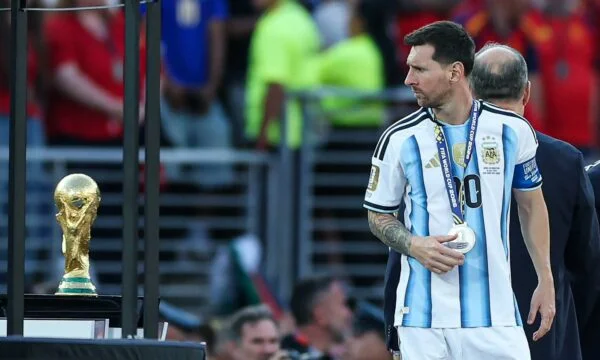
Playing for the last time on the biggest stage of sports, Lionel Messi seemed almost destined to donate even a memorable last moment to this World Cup final.
However, as the sun was behind the western school of the New York New Jersey Stadium on Sunday, it became increasingly clear that Argentina had lost the magic it had accompanied throughout the tournament. And while Spain gradually took control of the game, it was just left to face reality: Mess and Argentina had finally been out of the way, as they had long surrendered to their worst instincts in loss 1-0.
This finale presented a sharp contrast to Argentina and the Messinʹ we had seen at each other tournament match. Almost without exception, “La Albiceleste” was the most fun team of the tournament, not so much for the way it scored goals, but for the moment it marked them, giving a true lecture of dramatism at the right time. Twice it was close to eliminating from prominently inferior opponents, results that only motivated it even more.
Finals are often forgotten matches that fail to entertain, but according to that low standard, the pace of this challenge seemed terrible. Spain was muffled in defense, and after a first part without much to remember, it finally took full control in the second 45 minutes, finding the ongoing goal, as expected. Argentina? It became the first team in the nearly a hundred-year history of the tournament, which did not record any hits during the regular time of a World Cup final. Even when he was given an extra half hour, he could never risk it.
What about Messy? To this final, he had given viewers one of the rarest opportunities in the professional sport: to witness greatness without the weight of results, completely without any real pressure to perform. At 39 years of age, Mess has already made history, and no one can criticise his collection of trophys in both an individual and a national respect. This loss does not tarnish a clean heritage; a victory would only strengthen his claim as the greatest football player in history. For some Argentinans, victory over England in the semifinals probably has almost as much weight as the triumph would have had in the finals, writes The Guardian.
However, it should be said: Messy was rarely involved in the match, far away from the player who had in some cases held the team on his shoulders during this tournament. Much of this, of course, is attributed to a masterful presentation of Spain in defense. That alone is not always enough to stop the short - lived captain of Argentina. But Spain deserves all the credit: It dominated Argentina in every way, neutralizing the Messiah himself. In the end, Argentina became what many had labeled from the beginning, sometimes unjustly - subtle, harsh, and desperate.
Time has almost always been insignificant to the Mess in the field, because he has so often bowed it down according to his desire to save the defenders. The way he plays at 39 years of age creates the same effect, cutting his own time and turning viewers into his glorious days at Barcelona and elsewhere. Time has not left him behind as long as he has walked by her, sometimes one or two steps back, but always getting him back.
Now, however, we have to face the undeniable reality that Mess has closed the World Cup chapter. It is noteworthy that the same was said even after he led Argentina to its first World Cup after nearly four decades in 2022, as well as in 2016, when Messie temporarily withdrew from the national posthumously in the Copa Americaa final. It was then said that he would never play for Argentina as he had played for Barcelona, and there were even rumours that the Mess was not enough of the Argentineans, since he had spent most of his life in Spain. Both claims seem ridiculous 10 years later.
It remains to be seen how Argentina's performance in the country will be perceived, where expectations were, rightly, very high. Coach Lionel Scalon, even Messy himself, had spoken in front of the finals about everything they had already accomplished. They implied that the outcome of this finale would do very little to dull that sense of accomplishment.
Of course, that was before they went down to the field and, more or less, destroyed the game. Scalon's legacy, like that of Messy, was safe even before this final, as he had brought Argentina a third World Cup and two Cup titles to Copa America, but it was a lost opportunity to strengthen it further. Two things can be true simultaneously: Scalon is almost without a doubt the biggest coach in Argentina's history, and this was one of its worst results and presentations.
What feels much more real, however, is the feeling of loss and frustration after this criminal appearance in the finals, which gave Argentina and Mess the perfect opportunity to seal their tale. Instead, they converted from heroes into antagonists and completely unnecessary. /Periscope