a minute ago
The fall of Germany: Did he lose his football identity?
Periskopi(an hour ago)
(an hour ago)When Germany set up the World Cup trophy in Rio de Janeiro in July 2014, Newsweek hailed this as the dawn of a"German success match"
For players, experts and politicians alike, this moment was considered a critical point, after which Germany's domination of sports - and in a host of other arenas - would be unmatched within the continent, as its technocratic model of problem resolution became a model on the world stage, reports the U.S. Newsweek, broadcast Periscope.
"In 2014, Germany was in the middle of a stable economic growth phase, the decline in unemployment and the decline in government debt, and its economic and political position seemed secure", said Clemens Fuest, president of the Ifo Institute for Economic Research with headquarters in Munich.
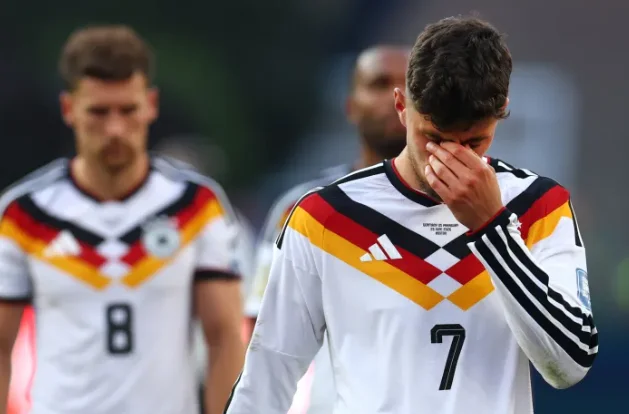
But the country has just been eliminated early by another World Cup, losing 4K3 to Paraguay after 1st draw. This marks the first penalty loss in a World Cup and comes at the end of a difficult period for"die Mannschaft". Between 1954 and 2014, Germany reached the World Cup semifinals in 12 of its 16 presentations, but has not won a World Cup preliminary match since their triumph in 2014 and suffered eliminations at the group stage in either 2018 or 2022.
This last humiliation is a sign of a broader and infallibility that extends beyond football.
Germany's Kai Havertz #7 reacts after losing in penalty shooting during the 1/16 World Cup round match FIFA 2026 between Germany and Paraguay in Boston... Read more Robert Cian float/Getty Images
Germany's excitement in 2014
After winning 1-0 against Argentina, which came after a 7-1 strong victory over Brazilian natives, the observer consensus was that the team had set the standard for technical skills that would determine international football from then on.
And this was not considered just a question of sports skills, but rather an emblems of the country's reputation as a well-cattered model of order in an undisciplined world.
Even the World Bank joined the praise, calling their success a"triumph of the"strategy and viewing the victory as a microcosm of its national planning ownership"hiperetics".
Meanwhile, Germany had cemented its status as a powerful economic power, supported by a powerful export sector, labour market force and leading development experts in the world.
Politically, within Europe, Germany had served as the main mediator of the European Union during the Eurozone debt crisis and enjoyed high levels of understanding with Brussels, as well as Washington.
And its then leader, Chancellor Angela Merkel, was widely described as the most powerful woman in the world and was considered, by some as the de facto leader of Europe”.
The national team's last “competed with the appearance of a new Germany - optimistic about the future”, said Suda David-Wilp, senior associate at the German Marshall Fund of the United States.
“German took advantage of globalisation and was not concerned about rising geopolitical risks”, she told Newsweek. “German was extremely popular with then Chancellor Merkel at the helm, and her diverse football team gave the country the license for national pride, usually taboo because of its dark history. ”
Newsweek cover for 2014, where it said the World Cup triumph could mark the beginning of"a century of German success", so far it has not proved accurate. (Newsweek)
But while 2014 was viewed as an example and a calcium of its status as one of the most respected and economically dynamic powers in the world, the past 12 years have eroded greatly by the success supporting such assumptions. And the nation state, like its athletic incarnation, has tried to regain the aura of inevitability that once made it Europe's undisputed flagkeeper.
As Fuest tells him. Newsweek , the football team's"reflects the decline of economic performance and political cohesion in Germany".
An Economy That Is Lossing Growth
For most of the 21st century, Germany's"Modull Deutschland"was built over industrial force and the dominance of exports.
But today this pattern is under pressure.
“Since 2019, the German economy has stopped growing”, Fuest said. “Patt some ups and downs, but GDP today is at 2019 level, private investments have even fallen back to the 2015 level. ”
"In this direction, Germany has spent a decade lost. "
Official forecasts from the EU show that Germany is slowly emerging from a period of stagnation and recession, with a projected increase to only 0.6 per cent in 2026 after years of poor performance.
Germany's Bastian Schweinsteiniger holds up the World Cup trophy during celebrations to mark the team's victory at Brazil 2014 World Cup. ) Alex Grimm/Reuters
“Since the COVID-19 pandemic, Germany has recorded one of the worst recoverys among advanced economies”, according to a May report by the EU, which noted that Chinese competition and American tariffs, along with rising energy prices, have resulted in a wide “
And hopes of a recovery after the pandemic were further extinguished by Russia's invasion of Ukraine in 2022. Germany was previously supplied with over half of natural gas and about a third of Moscow's oil, and the loss of these resources forced it into a costly transition that increased industrial input prices and eroded competition on the global scene. Local Chinese production replaced German imports in key sectors, while the country struggled with stronger competition in previous fields such as machinery, chemicals and high-level production.
In the mid - 2010 ' s, Germany was viewed as Europe's main supplier of industrial equipment. And while it remains necessary in certain areas, it is no longer the intensible supplier and now stands behind the U.S. and China in terms of motor exports.
Deindustrisation Pressures
Nowhere is change clearer than in Germany's main industries.
Sales in stagnation and market decline have left the country's automobile sector, which has long been considered the backbone of its prosperity in crisis.
Car production has been on a drop trend, falling from a peak of 5.65 million vehicles in 2017 to a forecast of 4.1 million in 2026.
At the same time, the switch to electric vehicles marked by strategic curves was provided by the country's leading car producers has exposed structural weaknesses, leaving old producers busy between high costs and falling demand.
And noting the continuing losses in critical markets like the United States and China, EY analyst Constantin Gall told Reuters this month that, for Germany, "2026 will be another year of crisis for the auto industry".
Political Framework and Social Tentage
This economic shift has been associated with political fragmentation.
Building Alternative for Germany ( The far-right AfD has reformed the country's political landscape, with the party reaching record levels of support and announcing victory in regional elections.
Polls show that the AfD now leads to voting goals in Bundestag. British broadcaster John Kampfner has described the party as"ready for power"and said their victory in the September regional elections would prove"a critical crossroads for extreme right-wing populist movements across Europe".
Migration has become a political defining line, cutting beyond the traditional borders of parties and contributing to the collapse of what appeared in 2014 as a high degree of political consensus promoted by"The Great Coalation"CDU/ CSU of the centre-right Merkel and the centre-left SPD.
The 2015-2016 refugee crisis “transformed domestic policy”, according to Hans Kundnan, a senior research associate at the Royal Institute of International Affairs in London who told him Newsweek that the continued AfD growth shows “mass reaction against non-white immigration”.
And this political fragmentation extends beyond the borders of the country.
In 2014, "The calculations of German arrogance"caused many people to suffer from the belief that Europe could be"led by Berlin".
As a result of reducing its influence on European counterparts Kunnan, author and The German Power Paradox ” (2014) said that this always false notion of a “hegemon” continental is now visible “to more people than it was at that time”
“Germania within Europe is in a much weaker position than in 2014”, he said, noting the country's increased respect for France in terms of defence and economic issues since 2016 in particular.
A Warning Stories
Germany is still a rich and well developed country with exceptional strengths: a qualified workforce, strong institutions and deep industrial expertise.
It remains the world's third largest exporter and economy, according to GDP - even passing Japan into the last category since 2014. - as well as the most influential EU member state and the closest thing the continent has with a leader.
And the country is “alert to geopolitical realities and has significantly increased investments in its military”, according to David-Wilp, who said the recent increases in defence spending prove that Germany “is no longer intact to become a military leader in Europe”.
But the contrast to 2014 remains pronounced.
Economic woes, industrial division, political fragmentation and an apparent decline in football luck all point to a country facing a world that has changed faster than its institutions.
And as Jonathan Tah's penalty went over the railway in Boston, ending another World Cup campaign, the symbolic was hard to ignore: a nation once determined by precision and inevitability, now faces uncertainty and, more and more, doubt.

![Infraco with automatic washing on Kosovo Fushe line: Do not approach the tracks less than 10 feet [3 m]](/cnt/019f223c-db35-796e-8465-caa488405a08__s.webp)