7 minutes ago
Old thermals in the Western Balkans pollute 6.6 times over the allowed limit
Periskopi(an hour ago)
(an hour ago)Eight years after the entry into force of standards for controlling air pollution under the Energy Community Treaty, emissions of pollution in Kosovo, Bosnia and Herzegovina, Northern Macedonia and Serbia are 6.6 times higher than the allowed level, Bankwatch's new report said.
Bankwatch is the largest network of environmental organisations and human rights associations in Central and Eastern Europe.
The report, titled “, matches or shuts down”, was released on June 23rd and deals with the failure to implement the laws for sulfur dioxide emissions (SO₂) from outdated coal power plants in the Western Balkans, which, last year, have exceeded legal limits.
At the same time, pollution from dust has increased, reaching the highest level since the actual regulations were introduced in 2018.
Coal thermos in Bosnia and Herzegovina have been the biggest issuer of SO2, with 196,940 tons, which is 12.7 times over the allowed border.
Next, Serbia ranks 177,756 tonnes, or 5.1 times above the permitted level.
Throughout the region, SO2 emissions have been down exclusively since 2018.
The emissions limits in 2025 have become even more strict than in previous years, which has led to even greater violations, says Bankwatch's report.
SO2's largest potential in absolute value remains the Uglevik thermal power plant in Bosnia and Herzegovina, even though it has equipment for desulpation.
Emitations in 2025, with 115,079 tons, have been the highest since pollution control regulations in 2018.
Dust pollution has been 2.9 times higher than the level allowed in 2025, reaching the highest absolute and relative level since the beginning of the rule enforcement in 2018.
This has been driven mainly by a major increase in the monastery thermal power plant in northern Macedonia, which has doubled emissions compared to 2024.
It alone has named more than 7.094 tonnes over the permitted border for the entire region.
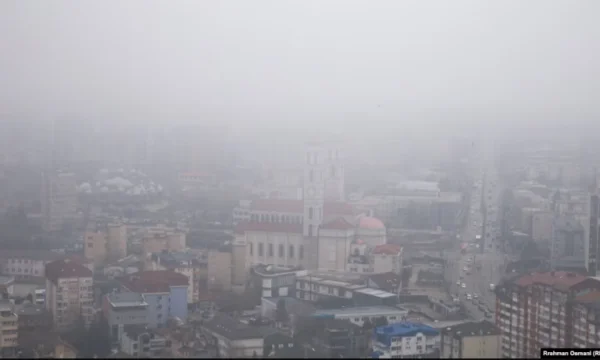
Pristina citizens in trouble with air pollution
Gacko in Bosnia and Herzegovina also remains the largest relative dust issuer. Despite a slight decline compared to the year 2024, it has labeled 15.1 times the level allowed.
As in 2024, total emissions of nitrogen dioxide from thermal power plants in 2025 have been 1.4 times over the permitted border.
Kosovo, Bosnia and Herzegovina and Serbia have exceeded legal boundaries, while Nikola Tesla B's biggest issue in Serbia has been 11.247 tonnes.
The thermal power plant at Plekle in Montenegro has gone through a reconstruction in recent years and most of the year 2025 has not worked.
However, there is no evidence that it is in line with the pollution standards that would allow for continued operation.
The Energy Community Secretariat has opened several cases of violations against Western Balkan countries, confirming the illegal functioning of their coal-related thermal power plants.
However, no government has imposed fines on these thermal power plants and has no clear, up-to-date and realistic plans for complying with their rules or closures.
By January of this year, the EU Mechanism for Enhancement of Carbon Emissions (CBAM), which increases the cost of electricity exports and makes production even less profitable from coal power plants. / REL




![The decision of VV attempting to provide 75 acres [75 ha] of state land to a newly created company](/cnt/019ef3e2-3ceb-749f-8366-8ac9058c9b10__s.webp)