3 days ago
Serbian myth about Kosovo Battle (1389) and its instrumentisation in relation to Albanian issue
Periskopi(25 days ago)
(25 days ago)It says: Ethem Ceku
The Kosovo Battle of 28 June 1389 represents one of the most important events in medieval history in the Balkans.
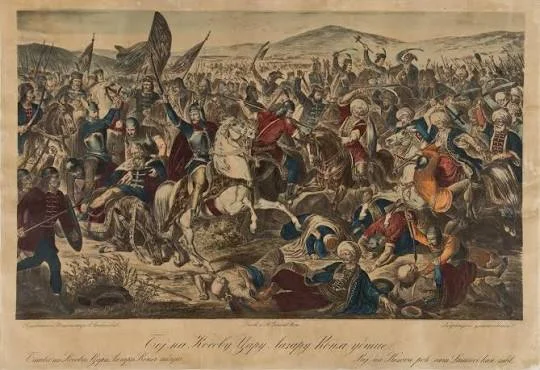
In time, however, it ceased to be only a historic event and became the foundation of a political myth, which deeply influenced the formation of Serbian national identity and the construction of the Serbian state's territorial claims on Kosovo. In this process, a Middle Ages event was revised and instrumentalised to create the idea of a historical continuation between the medieval Serbian state and the political objectives of modern Serbia.
The construction of this myth was especially shaped during the 19th century, in the terms of European romance and the Serbian National Renaissance. Through the system of oral tradition and the so-called “Cikli of Kosovo”, the figure of Prince Lazar became a symbol of national sacrifice, while the Kosovo Battle was interpreted as a heroic act for the protection of Christianity and the Serbian state. These stories are important for studying Serbian collective memory and political culture, but they cannot be identified with historical fact, as they represent an ideological construction of later periods and not a direct reflection of the contemporary sources of 1389.
An important part of contemporary international history has questioned the traditional Serbian interpretation of the Battle of Kosovo and its use as the basis for historical and territorial claims. Scholars such as Noel Malcolm, John V. A. Fine Jr., Thomas A. Emmert, Maria Todorova and Ivo Banac have argued that many of the elements making up the so-called “of Kosovo” are the result of a subsequent process of building Serbian national identity rather than of direct evidence of the sources of 1389. Contemporary Ottoman, Racus, Byzantine and western sources testify that the battle was not an exclusive Serb-Serbian conflict, but a confrontation in which various political and military formations of the Balkans, including Albanian, Bosnian and Vlach nobles, participated. As a result, its interpretation as an exclusive symbol of Serbian national history does not rely fully on the historical evidence of time.
This historical interpretation was closely combined with Serbian state political projects during the 20th century. The programmatic document Narcetania (1844), drafted by Ilija Garašani, conceived Serbia's territorial expansion south as a state strategic goal. In this context, the myth of the Battle of Kosovo was turned into one of the ideological pillars for legitimising claims against Kosovo and other Albanian countries, exercising direct influence on official history, on political discourse and on Serbian state programmes during the XIX and XX centuries. The story, in this case, served not only to interpret the past but also to justify the political and geostrategic objectives of the Serbian state.
In the same line was Serbian nationalist historians, who presented Kosovo as the “age of the medieval Serbian state”, downplaying or denying the historic presence of Albanians. For this reason, Albanian Illyrian background, Ilio-Albanian continuation and their autochthonia were questioned in Kosovo. Part of the Serbian authors supported the theme that Albanians settled in Kosovo only after the Ottoman occupation, mainly during the XVXVII centuries, a thesis that has no scientific support and conflicts with the Corps of historical, archaeological, linguistic and documentary resources that testify to the early presence and the continuation of Albanians in Kosovo. These interpretations became part of a historical turquoise aimed at presenting Kosovo as a historic and politically exclusive Serbian space, bypassing the real historical developments and the multiethnic composition of the region.
The instrumentisation of the myth of Kosovo did not remain only on the historical level. After the Berlin Congress (1878), during the Balkan Wars (1912)1913), in the period of the Serbo-Croatia-Slovenian Kingdom and later Yugoslavia, it was used to legitimise the conquest of Albanian territories, colonisation of Kosovo, agrarian reform, expropriations and discrimination policies against Albanians. His political triumph reached the myth with Slobodan Milochev's speech in Gazimestan on June 28, 1989, when the symbol of 1389 was used to mobilise Serbian nationalism and justify the regime's policies towards Kosovo.
Therefore, the Kosovo Battle should be treated as an important historical event of the Middle Ages, but not as the basis for political and territorial claims of the modern era. The difference between historical fact and political myth remains essential for an objective interpretation of Kosovo's history and Albanian-Serbian relations.
In this context, the scientific, academic and cultural institutions of Kosovo and Albania must intensify co-operation for study, documentation and promotion of Albanian history, supporting research based on archive sources, contemporary methodology and international standards of history. Only through such work can it be contributed to the enlightenment of historical truth and to the scientific opposition of ideological interpretations that have accompanied the Albanian issue.