5 hours ago
Are you making us less mentally skilled? Study Raises Concerns

Periskopi(4 days ago)
(4 days ago)One of the main fears born with the development of artificial intelligence is that it can reduce certain human cognitive skills. And more and more new studies indicate that this is already happening.
Brain is like a muscle.
It's a well-known fact that we gradually lose skills that we don't use. For example, if we do not use a foreign language, we will become less skilled in it. Numerous neuroscient and psychological studies have shown that the brain functions as a muscle according to principle “Use it or lose”.
Dennis Bratko, professor at the Psychological Department at NFFG, says we're talking about biochemical incentives.
“While signal travels, nerve cells release neurotransmitter. The more incentives there are, the more neurotransmitters are secreted. Another nerve cell on the receptor accepts these neurotransmitters. The more there is, the more sensitive it becomes. Thus, a certain nervous course is developed through repetition through the process of using neurons. On the other hand, if they are not used, such nerve routes are weakened”, he explains.
55% less activity
New research shows that when artificial intelligence takes on part of mental work, people often think less, control less information, and rely on their own reasoning.
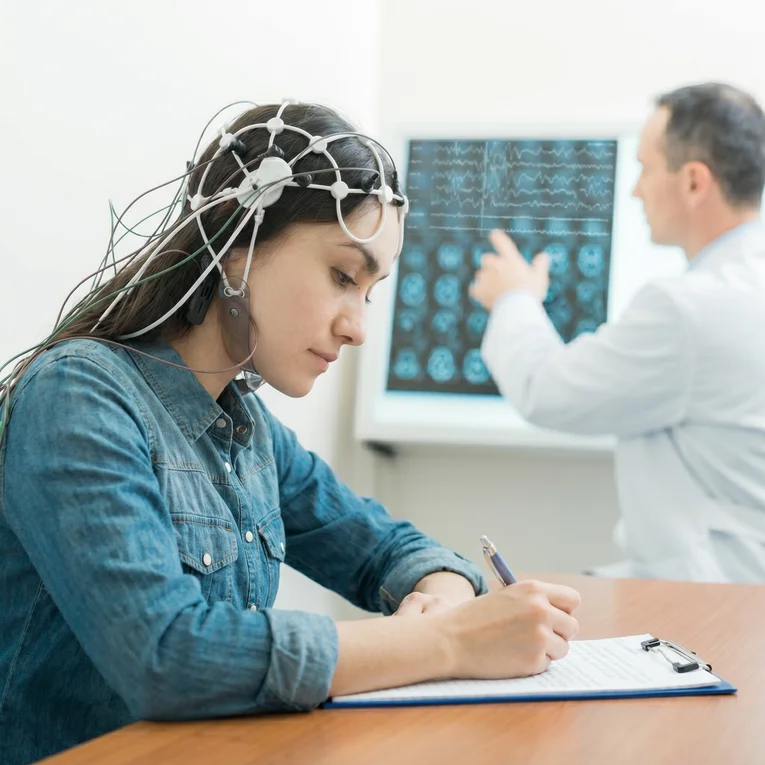
The latest study in this regard has attracted the greatest attention, Your “Time on ChatGPT “, carried out by Natalia Kosmyna and his colleagues at MlT Media Lab. In it 54 participants between the ages of 18 and 39 were divided into three groups and wrote essays. Some used Chat GPT, others a search engine like Google, and the third were not allowed to use any tools. Scientists used EEG to measure electrical patterns that show how different parts of the brain “communicate” with each other.
The results were clear. The group that wrote without the help of digital tools had the strongest and most common link in the brain. The group using a search engine was in the middle, while the group that ChatGPT used had the weakest link, on some networks up to 55% lower than the group that wrote without means. Their EEG showed much lower connections to networks involved in attention, planning, memory and language processing.
Non - Personal Work
In the new study, the MlT team appreciated participants' essays by two writing teachers, who did not know which group the authors belonged to.
They did not know that these participants were from the LLM group, but called them the essays of participants using LLM-pa spirit; it was a literal quote”, Kosmyna said.
The essays of participants using LLM also had fewer stylistic and less diverse variations in choice of words. The teachers appreciated them as an average and wondered if they could have been written by the same student.
The problem is even bigger.
But what happened after the test is even more important.
Participants who used ChatGPT had the worst memory of their texts and found it more difficult to quote accurately the sentences just written. They also had the worst sense of “ownership” of essay. In other words, some participants did not perceive the text they created as a result of their thinking.
Finally, at the end of the experiment, subjects in the LLM group were asked to write essays without any help. These participants still showed a weaker link of the brain than participants who did not use LLM during the study.
If this result is confirmed in further research, it may significantly influence the question of when and how to introduce artificial intelligence into teaching.
Kosmyna warned Tech & Learning that this discovery should not be translated into a claim that artificial intelligence is causing <x0 cell brain neurox1>. Some people thought it was about measuring IQ or something like that, but we didn't measure it. IQ in our study”, she said.
Loss of Important Medical Skills
A similar problem has been observed more and more recently in the workplace. In a Study published in the magazine The Lancet Gastroenterology & Hepatology, Scientists analyzed the work of 19 experienced endoscopists at four centers in Poland.
All were performed more than 2,000 coloscopes “at their feet”. After centers introduced the discovery tool of artificial - intelligence polyps, doctors still performed coloscopes from time to time without the aid of artificial intelligence.
But it turned out that in 1,443 such coloscopes without artificial intelligence assistance, adenoma detection rate, or increases that could precede colon cancer, fell from 28.4% before the introduction of artificial intelligence to 22.4% after months of working with artificial intelligence. This is a relative decline of about 20%.
The research co-acautor, Marcin Romańtzzyk of the Academy of Silesia, told The Lancet that, according to his knowledge, this is the first “testation suggesting a negative impact on the regular use of artificial intelligence in the ability of health care workers to carry out an important task for the patient in every field of medicine”.
“Results are disturbing because artificial intelligence is expanding rapidly in medicine, so there is an urgent need to investigate how health care workers are affected by”, he added.
This is a particularly serious example because it is not a school essay but a real medical procedure. A coloscope involves more than watching a screen. The doctor should carefully direct the instrument, discern questionable changes, evaluate what he sees, and not rely heavily on the relief system.
Poorness of Critical Thinking
A study by Microsoft Research and Carnegie Mellon University on the use of an IA generator at work showed a similar model.
Researchers surveyed 319 knowledge workers and collected 936 concrete examples of IA's use. They found that the biggest faith in the IA was associated with less critical thinking, while the user's greatest faith was associated with more control and reflection.
Knowing Relief
A Study published in 2025 in Societies magazine, conducted with 666 participants, showed that the most frequent use of artificial intelligence is accompanied by weaker results of critical thinking and that this relationship can be partly explained by so - called cognitive relief. It's a technical term for leaving mental work an external tool.
Some experts believe that in an era of overloading with information, delegateing certain tasks to artificial intelligence can be positive and meaningful.
Bratko says that it is clear that relief from one side of the burden allows us to engage on the other. But he points out that it's important if IA is going to relieve us of the simplest task or the most complex ones we've considered exclusively human, and if we're going to use IA so we don't have to do anything.
It's okay if simple cognitive tasks such as meeting and landing are left to calculators and use cognitive skills to think strategically more complexly. However, if we use it IA just to make things easier and to get less work, then no new skill will come from it. In a new job by MlT scientists, relief is not presented as something positive”, he notes.
Google Effect
Earlier studies have shown that cognitive cargo changes what we remember and practice. In 2011, Betsy Sparrow, Jenny Liu and Daniel Wegner described the so - called Google effect in the magazine Science
Same thing happened with GPS. A study published in 2020 Scientific Reports Link the most frequent use of GPS with a weaker spatial memory during independent navigation. If the device constantly guides us to a turning turn, the brain has less practice in creating its own map of space.
Effects on Education
Bratko says he is more afraid of the consequences this will have for education. “I no longer allow students to do seminars outside the classroom because I can't understand whether they wrote them or if they wrote artificial intelligence”, Bratko says.