6 hours ago
The scandal is deepened: According to Gashi's exhibition, from 5 March to 7 March 1998, only 37 civil Albanians were killed in Prekaz
Periskopi(3 months ago)
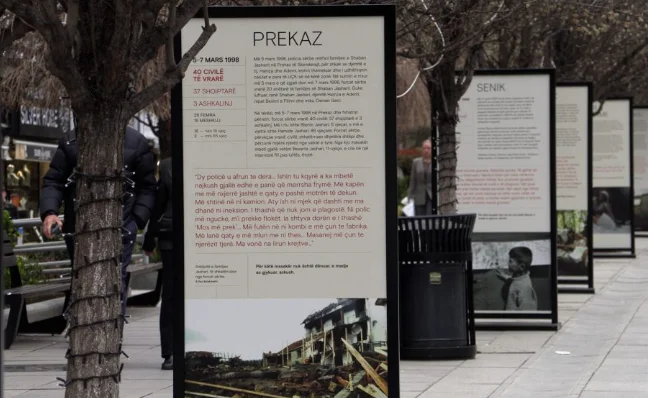
(3 months ago)According to the exhibition, which is open in the “Square, Mother Teresa” in Pristina, based on Shkelzen Gashi's book, between March 5th and 7th March 1998, 37 Albanian civilians were killed in Prekaz. Gashi, in his book, which he also used for the exhibit at “Mother Teresa” in [...]
According to the exhibition, which is open in the “Square, Mother Teresa” in Pristina, based on Shkelzen Gashi's book, between March 5th and 7th March 1998, 37 Albanian civilians were killed in Prekaz.
Gashi, in his book, which he has also used for the exhibit at “Mother Teresa” in Pristina, has shown that only 37 Albanian civilians were killed in Prekaz.
Historian Durim Abdullah explained Gashi's anomalies on the subject.
What Abdullah wrote:
The biggest drawbacks of the book “Mascurat in Kosovo 1998-1999” is the case of Prekazi. In the text to Precazin, it was written that “From HLC data, it turns out that Serb forces on this offensive have killed 59 people in Prekaz, three in Polac, two in Lausha, two in Turicec, one in Buroja and one in Tusilla, a total of 68 people, out of whom 40 civilians were unarmed”. In view of this logic, the number of people killed in Prekaz has been marked down to 40 on the table with the tables of massacres. In this case, the author has divided the dead from 68 total to 28 armed and 40 unarmed civilians, of whom only the latter have been named victims of a massacre. According to this criterion, it is concluded that Adam and Hamez Jashar and their sons, who fought in their homes on March 5, 1998, were killed as warriors, while other family members, women, and other children killed beside them, and in the same homes were victims of a massacre. Or that Kaytaz, Faik, Sheriff of Ali Jashar, who fought with them and others that day were also killed in combat, while their relatives and cousins killed on March 5, 1998 were simply killed by a massacre committed by Serb forces. The same logic leads to the equally irrational conclusion that Sala and Hamit Jashar who fought in their homes those days were killed, while other family members and other relatives in the neighborhood were victims of the Precas massacre. This division of those killed in Prekaz to 40 civilian victims as victims of a massacre of others who were armed as two separate categories, the least is ignoring the context of Serbia's police and military operation in Prekaz during those days of March 1998. The events of the Prekazi case do not meet one of the key conditions in the way the massacre has defined even the entry author himself, who killed “are not involved in the conflict as fighters”. Those killed in Prekaz were inexplicably involved and knowingly in armed and organised resistance. These include boys and girls under the age of 13 and 18, such as Faith, Victory, and Deception, but others who were involved in combat that day. Particularly after the attack by the Serbian police six weeks earlier, January 22, 1998, since the entire Jashari neighbourhood and Prescazi residents were generally organised in armed guards every night, between 9:00 and 6: 00 a.m. So the above criteria cannot serve to divide those killed in two and outline them into two categories, since the term “masacre” is based only if it can be referenced to the general circumstances of the case and not by selecting and taking those killed separately.