7 hours ago
Miscalculator That Can destabilise Balkans
Periskopi(4 months ago)
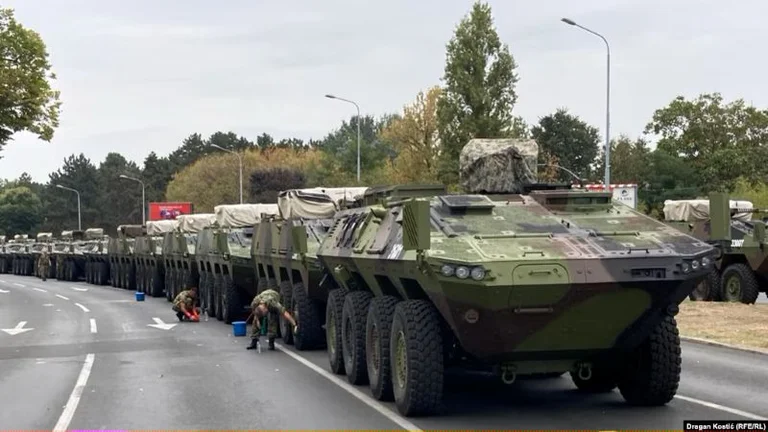
(4 months ago)The arms race has existed for centuries, but after World War II, it took on global and systematic shape, especially between the United States and the Soviet Union during the Cold War. Nuclear weapons, ballistic missiles, and warplanes transformed the way power was conceived in the years that followed. Today, in the Western Balkan region, Serbia's movements [...]
Nuclear weapons, ballistic missiles, and warplanes transformed the way power was conceived in the years that followed.
Today, in the Western Balkan region, Serbia's moves send serious warnings.
This country's partner NATO and the European Union membership candidate bought supersonic ballistic missiles from China for its air force. Thus, the first power in Europe equipped with CM-400 air-earth missiles AKG, according to Serbian President Aleksandar Vuciq.
We've successfully integrated Chinese missiles into fourth-generation Russian MiG-29 aircraft. These are today among the best planes in Europe maybe even in the world. Air-earth missiles mean hitting targets on the ground and having devastating powers”, Vuciq said on 12 March.
Reactions were numerous from neighbours who fought against Serbia during the Yugoslav wars of the 1990s.
Croatia today, a NATO member and the European Union, viewed the purchase of Chinese missiles as a threat to regional stability and a sign of increasing the arms race in the Balkans, while Kosovo accused Serbia of hegemonistic tendencies towards neighbours.
These two countries, along with Albania, signed an agreement for co-operation in the field of defence and security in March 2025, which Vucinq sees as a direct threat to Serbia's security Atje “there is no other reason for their union, only Serbia”.
We are preparing for their attack. They are not determined to defend themselves but to attack. They are forming a military alliance to attack us”, Vuciq said as he spoke of Chinese missiles at Serbia's Radio-Television.
He presented no evidence of these claims, which Zagreb, Pristina and Tirana constantly reject. He only said the Serbian Armed Forces have other sophisticated weapons available, which cannot be made public.
For connoisseurs of military and security issues, these messages send out fear and uncertainty signals to the region, increase the perception of the threat, and push neighbouring countries towards strengthening defence capacities. This dynamic, they say, could easily turn into a new spiral of arms, with each action producing counteraction and tensions only increasing.
Redion Kyriazi, a security expert in Albania NATO member country, says the Chinese missiles give Serbia new opportunities to design power and change the balance of security in the region; they are not just protections like the buyer claims but extend military capacities at a distance.
China's <x0). A disturbing feature of them is the high speed of 4 to Mach 5 or up to 6 thousand miles per hour that puts them in the category of difficult missiles to intercept”, says Kyrizi for Radio Free Europe's Expose Programme.
In the Balkans, Serbia maintains open tensions with Kosovo, to which there are territorial claims -- with Croatia and occasionally with Montenegro. Its relations with Albania and Northern Macedonia are calmer, while its connection with the Republika Srpska in Bosnia and Herzegovina remains a special case, differing from the rest of this state.
Chinese missile purchases, according to Kadri Kastrati, military expert from Kosovo, clearly show Serbia's tendency to position itself as the most armed and dominant actor in the Balkans and to keep the region always on the edge of destabilisation.
“All this weapons, Serbia is buying to enter the race, primarily Croatia. Following Croatia's supply of Rafale planes from France, Vuciq made arrangements with France's president, Emmanuel Macron, for the purchase of such aircraft. So, there's a race between them”, says Kastrat for Expose.
Although claiming military neutrality, Serbia is the most expensive army in the Western Balkans. In 2024 alone, he spent $2.2 billion more than Albania, a NATO member and second country in the region for military spending, according to Stockholm Institute for Peace Research data (SIPRI).
Serbia spends significantly more than Croatia, which is also a NATO member. According to SIPRI, the gap in defence spending between the two countries totals hundreds of millions of euros annually.
After the Russian invasion of Ukraine, Serbia changed its weapons sources, addressing China for combat fears and anti-aircraft missile systems. FK-3, but did not stop buying from the West, such as the United States and France.
In his statements, Vuciq pays particular attention to Croatia's military force. In 2024, when Serbia bought multifunctional warplanes, Rafale, from France, it inaugurated by saying that when Croatia does the same, it is “good news for the region”, and when Serbia buys them, it becomes “traged”.
We do not create problems anywhere, nor plan them, nor do we target them. This is a major signal of confidence between France and Serbia. We just want to keep our country”, Vuciq said.
Katarina Djokic, a researcher at the Stockholm Institute for Peace Research, says comparisons between Serbia and Croatia should be viewed carefully. Croatia, as a NATO member, plans its military capacities within the alliance and follows respective tasks, while Serbia acts outside this mechanism.
Gjokq says there is a tendency of political elites to look across the border and use neighboring weapons as alibi to justify expanding their power.
What is disturbing is when it comes to Serbia, Kosovo and Croatia is the irresponsible dictionary of political elites, which increases tensions, rather than exploit existing regional mechanisms or create new people for communication and resolution of problems. Simply, there is a tendency to go towards increasing tensions, which can be dangerous, because even in citizens, there is a sense of uncertainty and fear of what can happen, Djokovic says about Expose.
Kyriaz warns that such a climate of tension and distrust could lead to wrong interpretations on the other side, prompting quick and uncontrolled reactions.
This increases the risk of escalation even without a direct purpose for conflict a situation that Kyriaze defines as bad “; whose estimate is”.
We've seen this in the last conflict between Iran, Israel and the United States, where the argument is that we have evidence that Iran would attack first, so we hit. Or, in the case of Iraq, he told them that Saddam Hussein would create nuclear weapons and use against allies in the region, so we will act. This is that security anchor and scaling”, Kyriazi explains.
In response to the purchase of Chinese missiles, the European Union -- where Serbia intends to join -- said the country must make clear strategic elections on its integration path. Meanwhile, NATO, a partner of Serbia, did not respond to Radio Europe's free interest in the way Belgrade and Beijing continue to co-operate.
In May, the Western alliance will hold joint military exercises with Serbia at the Borovac range, near the border with Kosovo.
In a post on social networks, NATO Joint Forces Command in Naples said the exercise would be conducted at Serbia's invitation. According to her, it strengthens practical co-operation and supports stability in the Western Balkans.
For Kyrizin, this proves that Serbia follows the strategy of “Games with several portals”. On the one hand, it opens the door to China to increase its influence in the region, and on the other, it co-operates with the West to create a kind of mutual dependence.
This strategy has also been characteristic of the former Yugoslavia with Tito, as it held partnerships and alliances with many different strategic actors, in order to create an addiction of these superpowers to this country”, Kyriz says, REL, broadcast Periscope.
According to him, this approach gives Serbia more maneuvering space and places international actors in a more complicated position in the event of possible conflict. The chest agrees, but points to another aspect:
One of the reasons many countries provide weapons from China is that they are cheaper. Serbia's case is a little more specific on geographical terms, because it is located in Europe and there are other expectations of”.
I, for example, deal with West Africa and I know that there are many countries there that have great relations with the EU and, at the same time, provide weapons from China, because it is cheaper”, Djoq says.
Vuciq did not reveal CM-40 Chinese missile price 0 AKG, which may carry up to 200kg of explosive material, but described it as highly expensive “”.
According to the latest SIPRI report, arms purchases in Europe have increased significantly, making the continent the largest importing region ) by a 210% increase between 2016-2020 and 2021-2025.
The United States, on the other hand, has increased dominance in arms exports with Kosovo one of their many clients.
Kosovo Defence Officials stress that arms purchases are made exclusively by NATO allies. /Periscope