7 minutes ago
The renowned architect hands over the license: Albania Has No Value
Periskopi(5 months ago)
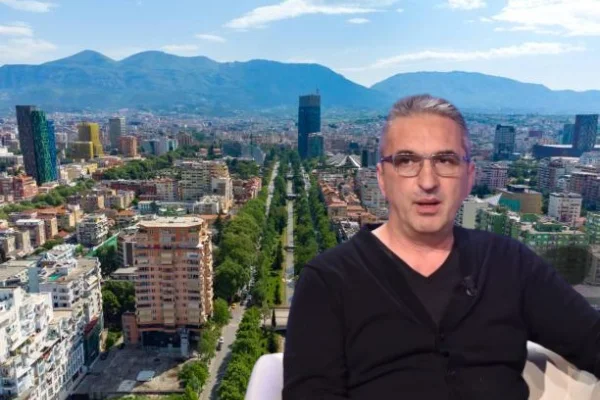
(5 months ago)One of the well-known names of Albanian architecture, Astrit Nidza, has decided to hand over his professional license in an act he has described as a position of dignity and civic responsibility. With a 30-year career and valued at several international awards, Nijza has been conducting the architecture studio Anarch for over two decades, with activities [...]
One of the known names of Albanian architecture, Astrin Nija, has decided to hand over his professional license in an act he has described as a civil dignity and responsibility attitude.
With a 30-year career and valued at several international awards, Najja has been conducting the architecture studio for over two decades Anarch, with activity on Pristina i n Tirana.
His decision comes in a context he considers exclusive to Albanian architects, who, according to him, are left de facto out of competition for important architectural projects in the country. In public statements, he has raised concerns about a practice that, according to him, has dominated the last decade, where almost all public buildings and a considerable part of those private buildings are designed by studios selected outside an open race, Periscope follows.
According to Nidja, there is an unwritten “law conditioning the granting of construction permits with the commitment of a particular study, personally defined by the prime minister Edi Rama. He has described this reality as humiliating to the profession and as a deforming of free competition in the field of architecture.
The handover of the license by Nija is considered a rare act in the Albanian context and has sparked reactions in the professional community, reopening the debate on transparency and equality in selecting architectural projects in the country.
I'm not a designer. I am unwilling to accept a role in which the local architect is a formal firmist of imported projects, while politics negotiates interests without including domestic professionals. It is the denial of false role within a show that has been going on for years: the show where politics plays the architect's role, the economy plays the urbanist, and the architect is pushed to the bottom like “visual”... I don't have the luxury of changing society alone; nobody has it. But I have an obligation not to deceive myself, not to pretend to be an architect in a system where the architect is treated only as a technical hand.
Below is Astria Nage's complete writing for Lapsy.al.
Somewhere in one of those turbulent years of World War II, following Italy's surrender, the Germans entered a city of Albania at the time. Classic scene: armed soldiers, men lined up, fear, fog. The commander orders to gather all men and divide them by nationality. But there were no prisons; the commander ordered large wooden barrels of wine in the suburbs.
The Jews, the captain said, we put them in this barrel.
- Shut them up and nail them so they don't leave, commander ordered.
Serbs, we have them in the other.
- These too, seal them up and nail them.
Croatians, too. And these with the lid and nails.
- What about these guys in the last barrel? - Commander asked.
- These are Albanians,- the captain answered.
The commander smiled easily:
- This one's got no cover. These guys are grounded in time. Even if anyone wants out, the others don't.
Battuta's durability is sharp, but painfully functional as metaphor. That, rather than take down the lid together, we deal with what's going up the barrel's lip: where's this going? Who gave him the right why not me? Why not my friend? In the meantime, time goes by: punishment, burden, dive...
For this year I have made a simple but serious decision: I don't sit with people who don't tell them “the work of all” and, also, don't sit with people who say the “of all”. Those first aren't working; they're parasites that live like usuys, clinging to the bodies of others. The two are people who don't put up with another person's work: they don't know him, they don't respect him, but they always have time to insult him and insult him.
These are men who don't produce, but they comment. They don't build, but they tear down with words. They don't have expertise, but they think about everything; they don't have a project, but they have prejudiced on every project.
When Deception Becomes a Moral Standard
In our society it's been installed, step by step, the moral level of fraud. It is no longer exception; the rate has been set. To soften the word “Misuse of duty, misuse of funds, misuse of competencies... If the word was milder, even crime would be easier.
For this very reason, in this text, I am using a new word - haemorch. It is an acronym that gathers three different behaviors into one word, but with the same moral foundation: Ha-ha. MA-Ball and KEC- abuse. So when I say <x0 malmachar”, I mean that profile man who steals, cheats and misuses at any size and level.
But basically, there is no great moral difference between that negative “=x1> 1 euro, and that “hamazi” 100,000 euros. The first has no access, the second is possible. It's the same moral principle; only the amount changes. If tomorrow the person who holds 100 million dollars in cash would be without power, he would be the same man who ate 1 euro in the market. The character does not change; only the scene changes.
Faces appear in the mind that in Albania tell them to be “resurrected”, of those who are now in position with tie and platform- and in another reality would just be pocket thieves in the marketplace. The difference is only in clothing; not in morals.
Politics as shelter for indictees
Let's ask ourselves: how are positions won in Albanian society? Ask someone on the street to mention five academics of the Academy of Sciences and Arts; five Albanian architects; five composers, five engineers, five scientists. Most will hesitate. But if you ask five politicians, they'll ask you: “Which party...”
The position in our society comes from no professional value, no responsibility, no license. He comes from the party. Consequently, those who retain political power automatically retain both social and professional status - doctors, engineers, architects, artists. And here comes the paradox:
- To become a doctor takes years of study, specialization, evidence, license.
- To become an architect or an engineer takes years of study, work, experience, professional licenses.
To run a vehicle requires theoretical and practical tests.
But to replace “is to protect” a state, a city, an economy, a territory, neither compulsory schooling, nor professional experience, nor ethical licenses. Politicians call themselves professionals but are not subject to any professional market and no minimum standard. This turns politics into housing for those who failed to succeed in other professions -- often in a country where the losers of different fields gather, but with great power appetite.
Albanian architect, from author to designer
In this reality, Albanian architect has gradually lost his natural role in society. The architect is not just someone who screens building”; he is the professional who reads the needs of society and translates them into habitable spaces, healthy cities, where life is dignified. The architecture is not just shape; it's morality built in concrete, glass and light.
But in our society, politics has gone so deep into every port that even this profession has turned it into something else -- the licensed Albanian architect, for years of study and experience, with legal responsibility over the head, is turning it into a visager for the sake of others.
I'm taking advantage of the visit of 80 architects to Zrinec for investment. For those who do not know the details: the way relations are built reduces licensed Albanian architects to sign drawing projects conceived elsewhere. To put it straight: it's like giving an Albanian painter the drawings of Salvador Dalít and saying: “Ngjiros, but you have criminal responsibility if you get off the lines”.
No, I'm not saying that we're better than others, nor have we a monopoly of talent; but we have the right not to be despised, not to settle at the end of the verse, not to be treated as the technique that only sign the signature. The local architect cannot be a spectator on his territory with taxes on his own.
Albanian barrel, licence delivery
I return to the Albanian barrel without a cap. Instead of viewing it as an annex to laugh at ourselves, we should read it as an indictment - we are inclined to pull down what is trying to get out. We do this with professions. The architect talking about space quality is named “nob”. The one who speaks of cultural heritage is called the unemployed “”. One who opposes a brutal intervention over the city is labeled “preventing development”.
In this climate, in this national barrel without a cover, the architect's role has become almost unintelligible to the public. Many see only the facade of the building, but not the process, the conflict, the responsibility. Nobody asks who signed the morale of what we're building. In the face of this, my decision is personal, but I believe it speaks of a collective situation.
After all this, I am solemnly handing it back to the Albanian state:
• Licence A.0951/1 on design, and
• MK3867 for monitoring and collusion work.
I'm not a designer. I'm not someone who paints other person's drawings, holding all the legal and moral responsibility on me. I am not willing to accept a role in which the local architect is just the formal firm of imported projects, while politics negotiates interests without including the country's professionals.
This is not a theater. It is the rejection of the false role within a show that has been going on for years: the show where politics plays the architect's role, the economy plays the urbanist's role, and the architect is pushed to the bottom like <x0-visual”.
The role of the architect we love and the society we have
Albanian society needs architects who think, not only draw. There's a need for professionals asking: What city are we leaving our children? What will life be like between these buildings in 30 years? Are we building only for today, or is it tomorrow?
But to have these architects, society must recognize and respect them as such. I need to understand that the architect is not a decor; he is one of the main filters between power, capital and everyday citizen life. If this filter becomes a designer, who protects the city?
I don't have the luxury of changing society alone; nobody has it. But I have an obligation not to deceive myself, not to act as an architect in a system where architect is treated only as a technical hand. So this is a personal act of opposition: not against my profession, but against the way he is being treated.
At the end of the day, our role as architects is not measured by the number of buildings we have drawn but by the quality of life that those buildings produce.
And for that, we need to get out of the barrel first. Or at least refuse to be the ones who drag others down. © pens.al
Astrit Nija is an architect and project manager with experience over three decades in Kosovo, Albania and abroad. Graduated at the Faculty of Construction and Architecture at the University of Pristina, he was founder and director of several architecture offices, among them “anarch”, where he worked as the main designer and manager of major public, cultural, commercial and residential projects