5 hours ago
REL: Kosovo outside American FARH, without lobbie contract for nearly two years
Periskopi(6 months ago)
(6 months ago)In the absence of official lobby in the United States, Kosovo President Vjosa Osmani appeared in recent months as one of the most active figures in the international arena. Her participation in the signing ceremony of the Gaza Peace Board Charter and meetings with US President Donald Trump with handshakes and [...]
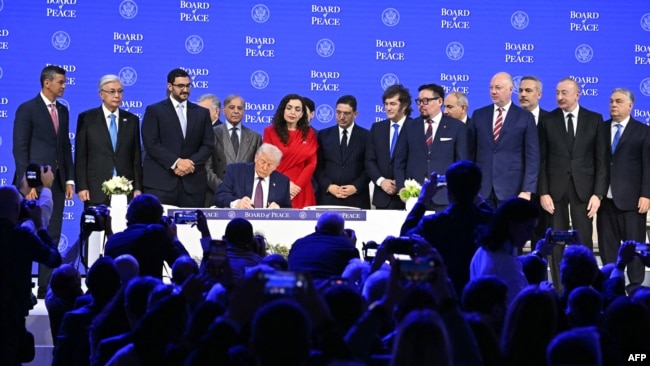
In the absence of official lobby in the United States, Kosovo President Vjosa Osmani appeared in recent months as one of the most active figures in the international arena. Her participation in the signing ceremony of the Gaza Peace Board Charter and meetings with US President Donald Trump with handshakes and close-hearted talks caught international media attention. The country of about 1.5 million people indicated that active diplomacy could keep it visible.
The “is a historic initiative, with a clear vision: to bring more peace and security to the world”, Osmani said after signing the Peace Board Charter on January 22nd.
This initiative was not expected without dilemma. Democracy like France and Germany rejected participation in it, warning that it could weaken the role of the UN and open the door to figures like Russian President Vladimir Putin.
Even in Kosovo, reactions were split: for some, turnout is a step towards increasing the country's international weight, for others a dangerous lineup to authoritarian regimes, including Belarus.
Thus, the debate over the Peace Board overshadowed another crucial issue: the absence of Kosovo's state lobbie in the US.
Donika Amyni, a connoisseur of political developments, says Kosovo, for nearly two years, has had very few active voices in Washington for no topic, but for lack of structure. The country has no active lobbie contract in the US Department of Justice Foreign Agents' registry, known as FARH, since June 2024. This, despite such lobeing, allows every foreign state to attempt to legally influence US policies.
According to Emin, the lack of this mechanism weakens Kosovo's ability to communicate its interests, because, as it says, an official's individual commitment cannot replace a professional lobby facility especially in the US.
It's really disturbing, because the US doesn't function like the European Union. With EU countries, with Brussels itself, you can manage bilateral relations yourself, through official channels, state representatives. That platform [works] in the U.S. FARH and that opportunity, because everything is done through lobe. Nothing is random”, says Emini, of the Balkan Policy Consultative Group in Europe, for Radio Free Europe's Expose programme.
Since the early 1990s, Kosovo has paid numerous U.S. lobbie companies, hundreds of thousands of dollars, to promote its international agenda. The contracts are bound by state institutions with known American names, such as Podesta Group and Ballard Partners.
In the last five years, during the power of President Osman and Albin Kurti's government, only three lobbiing contracts have been signed in 2023 - one short term and two that expired a year later.
Radio Free Europe has requested clarifications from the presidency, the Government and Ministry of Foreign Affairs and Diaspora concerning the reasons why Kosovo, currently, has no active lobbiing contract registered at FHARE. So far, neither institutions have returned the answers, leaving questions open about the lack of a clear strategy, institutional planning and co-ordination.
In one of the rare lobbi statements, Foreign Minister Donika Grovalla has now said that “is considered” continuing contracts with the two companies contracted in 2023 Avni Mustafaj and Venus Rakipi. But almost a year and a half later, that did not happen. Gervala has declared that she is satisfied with their work, even though most of their expenses have gone to lunch, travel and meetings in Pristina.
There are no concerns over these contracts. The two work together in the realisation of their” tasks, Gervalla said at the time.
According to Emin, Kosovo gets to maintain US political support, without understanding the drastic changes of political elites that have occurred there.
We're not in the 1990s. We don't have a political elite in the United States who knows the Balkans in detail. We don't have lobbyists, senators or congressmen as we once had, who had the political cause of advancing the Balkans”, says Emini.
Vesko Garchevic, professor of International Relations Practice at Boston University, says that without lobbyists providing inside information, Kosovo risks mistaking US priorities, drafting policies that do not match Washington's expectations and, as a result, receive little support. In this way, Kosovo is conditionally saying that it risks even the “being forgotten”, giving space to others to create the sodium for it.
Serbia, in particular, has invested enormously, both financially and through its connections, in building the lobby network. So if I were in the country of the Government of Kosovo, I would do the same. I would think of engaging someone influential who represents Kosovo's interests outside the diplomatic office Kosovo has in Washington”, Garchev says of Expose.
Serbia, currently, has six active contracts on the Foreign Agents Enroach Act. One of them also includes avocation before the U.S. Congress and its departments.
Of other countries in the region, Bosnia and Herzegovina has 14 active contracts, most of them linked by Republika Srpska; Albania has four, while Montenegro and Northern Macedonia have none.
Garchevic, former Montenegrin ambassador to several European countries, says lobbies compensate for a country's limited diplomatic burden. Unlike large countries, small states like Kosovo and Montenegro have no major economic, military or strategic impact, so they do not automatically draw Washington's attention. He explains that the continued lobby has led the US to perceive Montenegro's candidacy for NATO positively, and has played a crucial role in achieving success.
Long before the decision was made in 2017, we found a very effective lobby group, which worked in favour of Montenegro. When we started the membership campaign, NATO has not been eager to accept new members. This has changed over time, and I can say that lobbyists have played an important role in this” process, Garchev says.
Under the circumstances where Kosovo is located, open issues with Serbia and outside NATO and the EU, lobbiing in the US is not just an image issue. It is also a key tool for protecting civil security and to ensure that the US remains committed to the country's stability and defence, according to Garchevic.
So don't let others shape the way the United States approaches you. You need to be active, because this also helps you to understand better what is thought of inside. People you hire to work for you can give you real insight into what's going on on the other side and how they see the situation”, he says.
Emini adds that the political reality in Washington has changed significantly and that decision-making today is conducted in a much more fragmented environment. According to her, the new Kosovo government, which is expected to be formed again by Albin Kurti, should invest in building long-term US lobbie networks rather than relying on sporatic communication or only on official visits.
Kosovo is a small state and as such survives in the alliance. Even if it were complete citizenship, even if there were armies and it would be part of NATO, alliances are necessary”, Amy says.
Relations between Kosovo and the United States have passed periods of tension over the past two years. Some decisions have been made by the Government of Kosovo, which Washington has deemed harmful to the Serb community. The clashes have culminated in public warnings from American officials for worsening reports and with the introduction of punitive measures against Kosovo, though Kurti's government has insisted that these differences are part of a normal dynamic among allies.
This month, Kosovo was included in the list of 75 countries whose US citizens have temporarily suspended issuing immigration visas. Official reason: Prevention of misuse of social aid. All Western Balkan countries, except for Serbia, have been included in this list, which, according to reports by some media, has also benefited from intensive lobbies.
However, the US State Department has clarified that the measure is aimed at those who “use American social aid at unacceptable times”.
In a Washington where attention is bought, won or lost, the challenge for Kosovo now lies not only in preserving friendships but also in listening ability.
In the words of President Osmani, after signing the Peace Board Charter, “when America leads, peace is always safer”. But it remains to be seen whether Kosovo will succeed in turning this moment into real impact beyond the devices and titles in the media. / REL/ Periscope.