4 minutes ago
In the dark, Kosovo loses way to renewable energy
Periskopi(6 months ago)
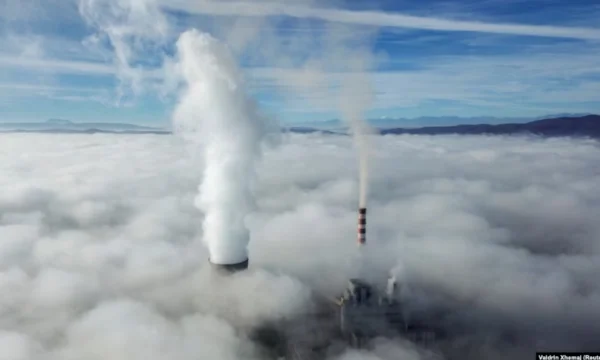
(6 months ago)Six hundred thousand tons. That's how much coal comes out of the Kosovo Energy Corporation (KEK) per month. But, this amount extracted and processed and transformed into electricity has not sufficed in recent winters to cover consumer needs in Kosovo. This, since almost the entire burden of electricity supply is carried [...]
Six hundred thousand tons. That's how much coal comes out of the Kosovo Energy Corporation (KEK) per month.
But, this amount extracted and processed and transformed into electricity has not sufficed in recent winters to cover consumer needs in Kosovo.
This, as almost the entire burden for electricity supply, carries the two outdated thermal power plants -- Kosova A and Kosovo B -- on their shoulders.
A KEK engineer told Free Europe Radio that, despite whether more coal is extracted from billions of tons in disposing, the two thermal power plants have no capacity to produce more electricity.
About two decades ago, Kosovo was planning to build a new thermal power plant, New Kosovo, to increase production. But following the World Bank's withdrawal from the project in 2018 and the failure of the deal with the Countour Global in 2020, this project was not realised.
For Faruk Foniqi, environmentalist and expert in the Sustain Security Leadeship Kosova organisation, Kosovo must already aim at rehabilitation by coal dependence.
He reasons this request with the consequences for public health, air pollution by releasing tiny particles and greenhouse gases, pollution of agricultural lands, underground waters, and so on.
This is an outdated model of energy, which is highly polluting and harmful”, says Foniqi for REL.
In line with this, in 2020, Kosovo became one of the countries that signed the Declaration on the Green Agency, pledging that by 2050 it would be fully designed ) so to produce energy only from renewable sources, such as wind, sun and water.
But, attracted by the project for a new coal thermal power plant and saw projects for significant growth of renewable energy capacities, Kosovo currently relies on imports to cover the requirements.
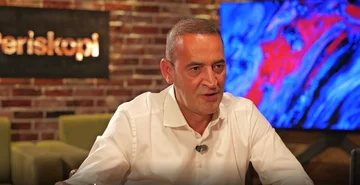
This, according to Dardan Abbas, from the Institute for Development Policy (INDEP), is not necessarily problematic.
We're not enough for tomatoes or potatoes or oil. We're not even going to be up for energy”, he says about the REL.
According to Abbas, the problem lies with dependence on one energy producer: KEK.
He says Kosovo must move beyond the idea of the state producing, distributing and billing energy itself.
“Operator for electrical power supply (KESCO) offers an extraordinary advantage KEK and no other supplier can actually enter the market”, Abazi says.
Thus, it proposes a kind of liberalisation of the energy market and integration into the regional and European energy market, where a treaty for co-operation with Albania can be reached.
Albania, which produces energy only from renewable sources, is largely dependent on hydropower.
Of the entire Western Balkans region, Kosovo is mostly dependent on coal.
Foniqi, geographer, shows that Kosovo has the main potential for solar energy production in areas where agricultural lands are of a lower quality.
It also sees potential in the production of energy through wind turbines, but it points out that major areas with the greatest capacity for production are those where national parks lie. He says, however, this should not impede the development of wind parks.
Kosovo has carried out only one auction through which it has targeted the realisation of a solar park with a production capacity of 100 megawatts per hour at Kramovik in Rahoveci, south of Kosovo. The project has not yet been finalised.
Meanwhile, two wind parks -- in Kamenica and Bajgora -- have been finalised, while potential has also been seen in Cychavica, Zatriq, Budakov and Kozica.
But that's not enough to drive towards defuelisation in 2050, according to Abaz from INDEP.
It requires that the Energy and Climate National Plan be drafted and adopted in the Creature Centre and approved.
Initially, he emphasises, the Government of Kosovo should have a clear plan for deadlines towards that goal.
We can't think about going to 2050 with coal and then waking up on a Monday morning, and say from today we're going to use coal”, Abazi says.
Radio Free Europe has sent questions to the economy ministry, under which the Department of Energy functions, but has not received answers.
Now one year, Kosovo functions with government in office, led by Albin Kurti of the Vetevendosje Movement. The early parliamentary elections of December 28th last year again won LVV, with support of over 50 percent.
The economy ministry has subsidised electricity bills for families that are considered vulnerable and for those who have spared, but statistics show it is a small part of consumers who spend a large part of the energy, without saving it.
This minister published firsthand some information showing that in January 2025, about 30 percent of all consumed energy in Kosovo was spent by 9 percent of consumers.
The key problem continues to remain warming during the winter months, as much of Kosovo's citizens depend on heating through electricity.
According to Abaz, this means that state investments should initially be focused on energy efficiency and, then, private consumers will be involved in energy production themselves.
How can this be done? For example, by installing solar panels that transform sunlight into electricity, the roof of homes.
Hasim Gashi, from the Muqa Solar Company company, shows that many consumers who produce the energy they use through solar panels at home, especially during the summer, only pay the 3 euro fee for locks on the power grid.
During winter, he says that for businesses and individuals with whom they cooperate, the coverage of consumption through energy from solar panels behaves about 50 percent.
In recent years, when the price of electricity has steadily increased, the Kosovo Ministry of Economy has offered coverage of some of the cost of installing solar panels around the house.
There was a “, but it's just too small and fancy values. Even there have been some obstacles during obtaining permits and licenses. It has been worked on, but not enough”, Gashi says of the REL, highlighting bureaucratic obstacles in the process.
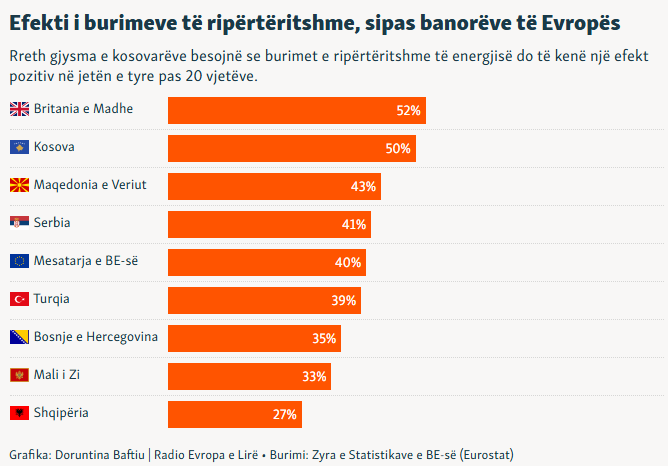
According to European Union Statistics (Eurista) data from October last year, only about 18 per cent of Kosovo's citizens say they are informed of the problems related to climate change.
Although this is lower than the European Union average (23 per cent), Kosovars are more willing to focus energy on renewable sources.
Among renewable energy sources is the one produced by hydropower plants. However, this source has encountered more resistance from local residents and environmentalists.
The main polls are driven by damage done to rivers and areas surrounding constructed hydro power plants. The case of the plant built in Decani had gone as far as the Constitutional Court, due to irregularities in operating permits.
Xhevat Ahmetaj, general manager of the hydropower plant at Radac in Peja, says Kosovo's capacity to produce energy from the plants is low.
However, he adds, citizens must have one thing in mind: that hydropower plants should be allowed to operate by respecting operating rules so that the environment can be protected.
According to him, the production of power through hydro-power plants should be seen simply as some “some shovels less coal in thermal power plant”.
Kosovo's “is mainly used by the water of the rainfall and when the snow melts. We see these waters only by flooding into the cities. It is water that should be used for energy production”, Ahmetaj tells the REL.
But, Foniqi, who has analysed the rainfall data in Kosovo, says most rivers in the country do not have a constant sufficient flow for energy production, because the rainfall is now inporadic.
For this reason, he stresses that the focus should be on solar and wind energy.
“Hidroergy can be viewed as a source of assistance, not as the main solution to the energy system. It has priority because it produces energy with low emissions and helps stabilise the network, but at the same time Kosovo is home to sensitive and unstable water resources”, Foniqi says.
He adds that how hydropower plants can function, at low capacity, only some of those with greater water level, such as Radac's.
For Abasis from INDEP, the important thing is that there is a concrete strategy and adequate investment, since, as it says, the “energy component cannot be developed through armaments”.
We've been plunged into energy poverty, and this comes from a deadlock from investments in efficiency, which would lower demand, to investment in production, which would decentralise production”, concludes Abazi. / REL/