14 minutes ago
KB: Blokades on borders and EU regulations are costing transport, endangering supply
Periskopi(6 months ago)
(6 months ago)Kosovo Business Alliance Chairman Agim Sahini has warned that transport protests in the Western Balkans and the European Union's new restrictions on driving stances are causing major economic losses, expensive transport and risk of lack of products in Kosovo and the region. Sahin for Online Economy said the decision that [...]
Sahin for Online Economy said the decision that drivers from the Western Balkans will not last more than 90 days in every six months in the Schengen area -- a total of 180 days a year -- has treated them as tourists and has sparked revolts in the transport sector.
The “Blokades, which are organisational by Western Balkan carriers in relation to the European Union's decision that drivers have no more right to stay in the European Union than 90 days in the first quarter and 90 in the second six-month, a total of 180 days, have revolted and raised uncertainty in international transportation, because drivers are already treated as tourists”, he said.
According to him, carriers are demanding special permission for drivers to be treated as workers and not as visitors, following the implementation of the EES system that registers EU access.
And this has led to these being raised fairly to request special permission so that they are not treated as tourists, but treated as workers not to limit entry after last year's application of the EES system, which counts the days of entry of every person from the Western Balkans going to Europe. This is creating a huge toll, creating financial losses, lack of products, and stopping and analyzing them, about 20 thousand mountains that are already blocked between the transport of the Western Balkans and Europe, totaling a daily cost of about 1 billion euros of imports and exports the European Union has with all Western Balkan countries, and that is a huge loss”, he said.
He called for regional governments to react immediately to Brussels.
Therefore, all Western Balkan governments will have to address the European Union to give drivers an opportunity, companies, businesses, transporters, that their drivers will not be counted days of stay in Europe as tourists, but that they have the right to remain dependent on the” situation, he said.
Taking an example of Kosovo, Sahin stressed that about two thousand Maunas transport goods to EU countries and that time restrictions make it almost impossible to carry many trips within three months.
“Kosovo has about 2 thousand menus carrying various goods, according to an evidence that may be plus-minute. If a driver with a truck leaves to send a shipment of goods to the European Union countries, to the depths of it, somewhere in Scandinavian countries where he has to travel more than 7 days because of the restriction of road flow, they have no right more than 9 hours of drivers to walk, but they have to make stops and those stops are big”, he said.
According to Sahin, the absence of drivers, the demand from Germany and the blockades have already increased to 15 to 20 percent.
The companies need to find new workers; new workers don't, I always talk about drivers. Germany is looking for countless drivers and very large salaries, so these will go in favour of drivers who are in the European Union. These days that we are talking about, international transportation in relation to the Western Balkans has grown by 15 to 20%, which amounts to 300 to 500 euros more expensive transportation due to blockades”, he said.
He warned that if the situation continues, Kosovo, which according to him covers about 90 percent of consumption through import, could face shortages and price increases.
And if this continues, there will be a shortage of products in the Western Balkans, and especially in Kosovo, where we have imported 7 billion or 90% of consumption from import last year. We're going to start missing products, and we're going to start getting expensive products. Therefore, the rapid response of all Western Balkan governments is needed here in relation to the European Union. We are always talking about two blocks -- the bloc of the European Union and the bloc of the Western Balkan countries -- which are not in equal treatment of workers, especially drivers” he said.
He added that the new EU decision is affecting drivers and businesses in all Western Balkan countries.
“And these losses are and are being created in the report between two blocs that are unfair, and drivers and businesses of all Western Balkan countries including Macedonia, Serbia, Montenegro and Bosnia that mostly use these vehicles or businesses, these drivers are either hit by this new order or by this new decision that started late autumn of last year to apply to all Western Balkan drivers<1>, he said.
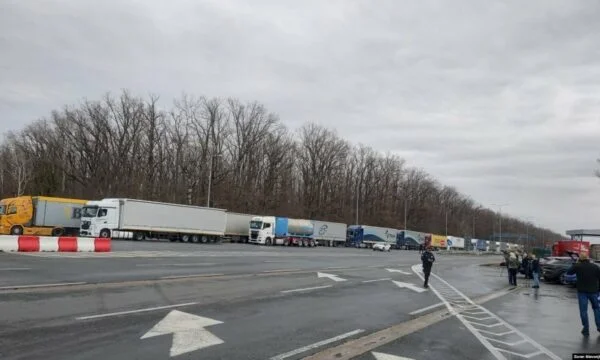
From Monday, cargo carriers have organised co-ordinated protests at border points in northern Macedonia and the region, including Serbia, Bosnia and Herzegovina and Montenegro, warning of traffic jams of transport vehicles.
The Macedonian Transport Association “Makam-trans” said in a statement that the protest opposes the new system for registering days of residence of transport professionals in the Schengen area. According to the warning, the flow of goods will be banned, while passenger vehicles and buses will move over and over.
Organisers warn that the protest could last up to seven days, with the possibility to stop earlier if the reasons for which it is being organised are exceeded.