a few seconds ago
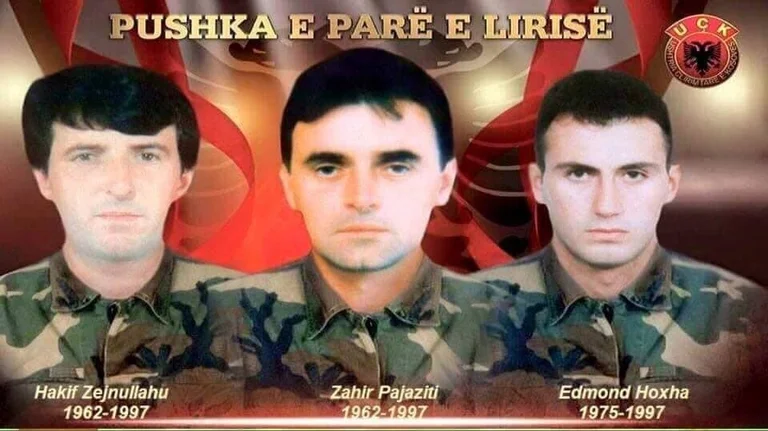
29 years after the fall of Zahir Pajazit, Edmund Hoxha's Hakif Zajah
Periskopi(6 months ago)
(6 months ago)On January 31, 1997, one of the first major battles of Kosovo Liberation Army members took place. The three strategists -- Zahir Pajaziti, Hakif Zejnullahu and Edmond Hoxha -- were traveling from Pristina to Vushtrri, until their group was discovered by Serbian security, which had been ambushed in the village of Pestovo, where all three [...]
Military activities Zahir Pajaziti started during the 1990s. Under circumstances created during the general strikes in Kosovo held on 3 September 1990, Zahir and other activists began working to establish a security network in Kosovo.
As a result of this job, Zahir and Orlan's activists set up the Guerile Unit House in Orlan. In 1991, after illegal affairs begin in Kosovo to be co-ordinated with the Zahira law goes to Albania for military purposes.
Upon returning to Kosovo in 1992, his group is unveiled, and Zahir has to go underground for several months. Until 1992, he contributed to the weapons supply of headquarters created in the district of Orlan.
During 1994, Zahir began to commit to other parts of Kosovo for the establishment of the KLA. Thus, he is one of the founders of the KLA's General Staff and his first member, from where the co-ordination of political and military activities begins to become.
Zahir is noted at this time as the great organizer and implementation of guerrilla attacks on Serb forces in Kosovo, but especially in the Llap region.
For all of his activity, his cousin Fadil Pajaziti, who was a businessman and almost all of his financing, had it.
On 31 January 2008, on the 11th anniversary of the fall, Kosovo President Fatmir Sejdiu awarded Zahir Pajazit Kosovo's highest state award, Kosovo Order “Hero”.
Zahir was the leader of one of the major branches of war, which then, naturally, has been merged into the Kosovo Liberation Army. Being the leader of one of the major branches of war, he was also one of the co-creators of the Kosovo Liberation Army.
Edmond Hoxha was the union who intended to create new dimensions of his family or Kosovo tradition. Since he was six years old, when he was still a child, he had seen his older brother Xavit's imprisonment, seeing that he had suffered pain but had no fault, he had decided to become a pillar of failure, no matter how painful that had been.
Edmond was the student of a desire to become a soldier and a man of science, the young man who had chosen to live a different life, yet very young; perhaps more than anything, he would start a path that his men had opened, despite the pain she had carried, despite the bloodshed they had experienced and would experience.
Hakif Zamenu has a contradiction between his silence and his work done. If silence is remarkable, the work is also remarkable. It's one of the most special cases of war, when an important figure like him has stood, with a deep nature, in the place he was assigned, as deputy to Zahir Pajazit and his assistant, and all this was very silent.
Hakif and Zahir were not just grandsons and uncles but had all virtuous things in common.