3 hours ago
Renowned French magazine: I want Lipa, diplomatic and pop weapon that makes Kosovo shine
Periskopi(10 months ago)
(10 months ago)French magazine “Le Point” has dedicated a text to singer I want Lipa and her connection to the country of birth, Kosovo. By “Le Point”, phenomenon I want Lipa continues to trace to the world scene. And because it exalts the countries that shaped her identity, they give her back. Kosovo recently honored [...]
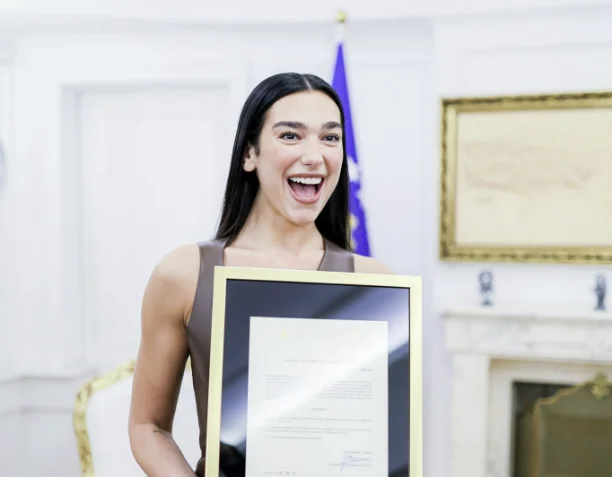
By “Le Point”, phenomenon I want Lipa continues to trace to the world scene. And because it exalts the countries that shaped her identity, they give her back. Kosovo recently honored it by granting it citizenship.
On July 31st 2025, Kosovo President Vjosa Osmani signed a decree formalising this recognition. The ceremony was held the following day, August 1st, in Pristina, where the head of state officially declared I want Lipa citizens of Kosovo.
Symbolic Justice
This very symbolic gesture seals a long and strong relationship between the artist and the country of her family's origin. “One of the most cultural emblems in our country's history”, the president said in her X account, emphasising the singer's great influence on Kosovo's international image.
A thought shared by 39-year-old Kosovo musician Genc Salihu in an interview with Le Monde: our “Populsia is new, ambitious, safe and increasingly progressive. I want to be the general prosecutor of this campaign. It is our greatest source of pride. ”
This is the third citizenship of London-born artist, after the United Kingdom and Albania, which she received in 2022, in recognition of her role in promoting Albanian culture worldwide. Enhancing Kosovo citizenship thus reinforces a deep and stable relationship with the land from which it comes.
Example for Young People
Born in London in 1995, I want Lipa owns a generation of children's exiles marked by wars in the former Yugoslavia. Her parents, originally from Pristina, fled Kosovo in the early 1990s and rebuilt their lives in the United Kingdom, where their three children were born.
In 2006, I want to experience the emotion of independence, which was declared two years later. But at the age of 15, convinced that the small Balkan republic did not offer the same prospects for a musical career like London, she convinced her parents to let her go back just to attend her singing and theatre studies. However, it preserves a deep relationship with Kosovo, which will remain central to its identity and artistic travel.
“The Kingdom of Kosovo”
Kosovo remains one of the poorest countries in Europe and the Western Balkans. Known by 103 UN member states, including France since 2008, several countries, including Serbia, Russia and Spain, still refuse to recognise its independence.
Diplomaticly, Kosovo is still trying to deploy on the international stage. However, its cultural impact continues to grow, driven by diaspora figures like I want Lipa and Rita Ora. This soft power, where culture precedes politics, gives the country unprecedented visibility beyond its borders. It has to be said that I want Lipa's fame is enough to change the scale: with 88.1 million followers in the Instagram and 65 million monthly listeners in Spotifi, pop star attracts many more people than there are residents in Kosovo: 1.87 million.
Its attitude towards its ties with Albania and Kosovo has sometimes triggered controversy. In 2020, it caused a stir by sharing a map called “Greater Albania” on social networks, which its critics perceived as nationalist. She defended this gesture as a cultural holiday, revealing in this process her relationship with both Kosovo and Kosovo, which shares a language and culture with Albania, but has declared its independence both with Albania, which she also claims has roots.
Since its debut, I Love Lipa has used her reputation to promote Kosovo culture. In 2018, she cofounded the “Festival. Sunny Hill” with his father, Dukagjin Lipa, who in just a few years has become one of the main music events in the Balkans. Each summer, it draws top international artists, such as Shawn Mendez and Fatboy Slim, as well as thousands of participants in the festival from across the region.
In a country still in the suburbs of European tourist and diplomatic circles, this success is seen as a dynamic window for Kosovo youth. Like Halleyu, the German “Vala” that brought South Korea to prominence thanks to K-pop and TV series, I want Lipa's career illustrates how a pop star can become a country's cultural ambassador and place it on the global map.