15 minutes ago
Bardoni: KFOR is concerned by the institutional vacuum in Kosovo, ready to face any possible threat
Periskopi(a year ago)
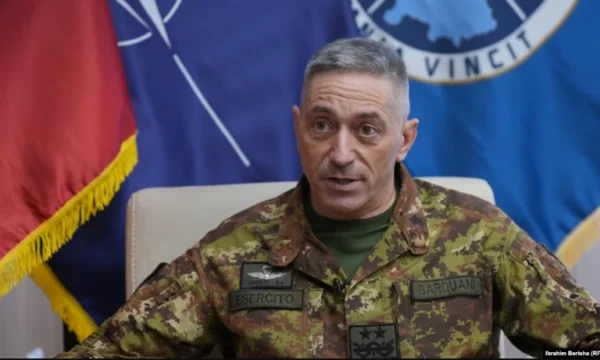
(a year ago)The commander of the North Atlantic Treaty Organisation (NATO) in Kosovo KFOR, Major General Enrico Bardonini, has declared that, despite the ongoing political blockade in Kosovo, KFOR is not concerned about any immediate security threat and remains fully prepared to face any attempts at destabilisation. [...]
The commander of the North Atlantic Treaty Organisation (NATO) in Kosovo KFOR, Major General Enrico Bardonini, has declared that, despite the ongoing political blockade in Kosovo, KFOR is not concerned about any immediate security threat and remains fully prepared to face any attempts at destabilisation.
In an interview for Radio Free Europe, Bardon stressed that election periods can create space for poor-minded foreign actors, but that KFOR views the current situation in Kosovo as part of normal democratic processes.
“KFOR is not worried”, he said. “We are well equipped and positioned to face any potential security threat. ”
More than a month after the certificate of the results of the February 9th elections, Kosovo has not yet managed to form new institutions.
Eleven attempts to consolidate Kosovo's Parliament failed, while in this situation it still cannot be continued with government formation.
Speaking of the wider security landscape, Bardon reminded two major incidents in northern Kosovo ʹ of the armed attack on Banjska in September 2023, and of the attack on the Iber-Lepenc water channel in November 2024.
He stressed NATO's quick response to the 2023 violence, when additional 1,000 troops were deployed to strengthen KFOR's presence, especially in the north.
“Situata remains calm, but sensitive to the unexpected escalation”, Bardon warned, citing outstanding issues as the cause of lack of progress in the European Union-brokered dialogue between Pristina and Belgrade.
For the attack on Iber-Lepenc's channel, Kosovo institutions accused Serbia of being guilty of the incident, but the latter denied it had anything to do with the case.
Asked about the danger of future attacks, Bardon avoided speculation, but stressed KFOR's continued readiness. “We maintain a fast, flexible and visible presence throughout Kosovo, and we are willing to act if necessary”, he said.
KFOR commander placed particular emphasis on co-operation with the Kosovo Police and with the European Union's Mission for Ending Law in Kosovo (EULEX).
“We develop joint patrols, training exercises, and maintain continued contacts”, he stressed, adding that quick communication by Kosovo Police during operations in the north is essential to avoiding misunderstandings and unnecessary escalation.
Relations with Serbia's Armed Forces were described as stable and transparent. Bardonini confirmed regular meetings and continued communication with the Serbian military leadership to ensure monitoring activities near the administrative border.
“We have every reason to expect continued co-operation”, he said, citing synchronized patrols and joint monitoring as key means for preventing smuggling and strengthening stability.
Despite the strong military presence, Bardon reiterated that peace in Kosovo and throughout the Western Balkans cannot be achieved only by military means.
“KFOR and NATO can only do what is possible militarily. The long-term solution is political”, he stressed, expressing full support for the EU-brokered dialogue between Kosovo and Serbia.
He welcomed the appointment of EU special representative for dialogue Peter Sorensen, with whom he has already held meetings, confirming KFOR's support for diplomatic efforts.
“To advance this dialogue, both sides must show flexibility, make necessary compromises and focus on long-term benefits”, Bardon said.
Speaking of the future, Bardon praised Kosovo's co-operation with NATO and voiced support for the country's Euro-Atlantic aspirations.
THE entire Western Balkans should have access to the Euro-Atlantic zone as part of Europe”, he said.
The key to resolving the remaining issues in the region is the will of all actors to embrace diplomacy, reject violence and work for compromise”, Bardon concluded. / REL/Periscopi/