a minute ago
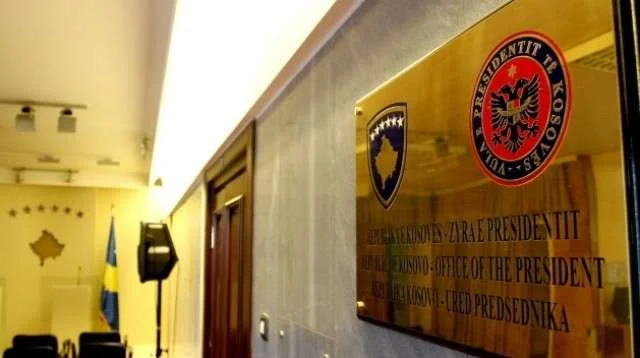
The president's post could become part of “patars” for the new government
Periskopi(a year ago)
(a year ago)The preliminary results of February 9th parliamentary elections in Kosovo do not create opportunities for any political party to form the only government. Contacters of political issues say the eventual coalitions after the elections could also include the issue of the Kosovo president's position. The mandate of the current president, Vjosa Osmani, ends on April 7th 2026. [...]
The preliminary results of February 9th parliamentary elections in Kosovo do not create opportunities for any political party to form the only government.
Contacters of political issues say the eventual coalitions after the elections could also include the issue of the Kosovo president's position.
The mandate of the current president, Vjosa Osmani, ends on April 7th 2026.
Given the preliminary results, published by the Central Election Commission, the Vetevendosje Movement, which has received the most votes, has secured 47 seats in the Kosovo Assembly, while it needs at least 61 for forming the government.
The Democratic Party of Kosovo has secured 25 seats, the Democratic League of Kosovo 20 and the Alliance for the Future of Kosovo 8.
Out of the remaining 20 seats in the Assembly with 120 total, ten are guaranteed for the Serb community and ten for other minority communities.
President's case, in two of the three scenarios for government
Analysts and political issues consider that the final outcome of the elections could be changed minimally, following the counting of votes outside Kosovo and conditional ones.
But, based on the current results, they say there are three scenarios for forming the new government.
The first scenario implies a government formed by the Vetevendosje Movement with non-Serb communities, a representative of the Serb community and any MP from the three up-to-date opposition parties.
A coalition of Vetevendosje Movement with one of the current opposition parties, the Democratic Party of Kosovo or the Democratic League of Kosovo, as well as the non-Serb communities, is seen as the second scenario for forming the new government and creating the parliamentary majority.
And as scenario three is considered a coalition among the three political parties P. DK, LDK, AAK and non-Serb communities.
Demush Shasha from the Kosovo Institute for European Policy says that, in the event the Vetevendosje Movement manages to form the new government with non-Serb minorities, the issue of the Kosovo president's post will not be on the table of “political parties”.
But in both other scenarios, it will not be able to be avoided, according to him.
“in these other two scenarios, the Vetevendosje Movement will be along with another Albanian party, or opposition all together. Here, then, the post of president is also involved in discussions. Simply, because there will be more actors involved and everyone, with the right, will look for their own piece of the cake”, Shasha tells Radio Free Europe.
However, he stresses that the post of president of Kosovo will not be the primary interest of political subjects in the calculations to be involved in forming the new government, but rather part of meeting an eventual agreement.
Their primary interest will be executive power. It seems to me that the president's case will be handled more like those benefits of the second rank”, Shasha estimates.
Presidential selection as “leves” to go to new elections?
Rather, you see the situation Belgzim Kamberi from the Institute for Social Policy “Musine Cocolari” in Pristina.
According to him, only “a major coalition” could be made because the issue of the country's next president is included as part of a political agreement.
The president's election, the Kosovo Assembly, should vote by two-thirds of the 120 deputies' votes as total as it does. If the presidential candidate fails to get these votes in the first two places, in the third round it will be elected with the votes of half the MPs.
If the Parliament fails to elect the president even in the third round, then it is distributed and announced new elections, which should be held within 45 days.
Kamberi stresses that, if the new government creates Vetevendosje Movement with non-Serb minorities or opposition parties currently with non-Serb minorities, the votes necessary for electing the president are uncertain.
The failure of one or two deputies of power on that occasion, according to him, would fail the election in the third round of voting.
He estimates that the president's post issue is unlikely to become part of any coalition agreement after the elections, unless any “concialisation is reached”.
The president's “, at this facility, only resolves a major coalition for the government. When I say great co-ordination, I think of Vetevendosje with PDK or Vetevendosje with LDK. This, actually, seems less likely, unless any major international pressure occurs, in this case by the US administration”, Kamberi says of Radio Free Europe.
In the past four years, the Vetevendosje Movement has governed with non-Serb minorities.
After the February 9th elections, Vetevendosje, The PDK and AAK have claimed to rule out the coalition's possibility between themselves. Before the elections, the coalition's possibility with Vetevendosje has also rejected the LDK.
Kamberi sees all political subjects as unhappy with the results achieved in the February 9th elections, because, according to him, neither the mandate for prime minister from Vetevendosje nor the opposition could create a stable government.
According to him, “patari” for the post of president would become an obstacle rather than a tool for forming the new government.
Furthermore, he says, political parties will preserve the issue of electing the president for later, as a lever for possible political action after a year.
It seems to me more than we are in a situation where parties will do their calculations for a short electoral, one-year political term, until we come to the situation for electing the president and, only then, to calculate what suits them most. So whether to take the country to elections or to give Kosovo a new president or new president”, Kamberi says.
With the Kosovo Constitution, the country's president enjoys a five-year term. His post is largely ceremonial, but plays a leading role in foreign policy and as commander of the armed forces.
Kosovo's current president, Vjosa Osmani, received the mandate on April 4th of 2021, following early parliamentary elections held on February 14th of that year.
With her party Guxo, who has been on a joint list with Vetevendosje, Osman was the most voted person in that election, with over 300 thousand votes.
She was elected president from the Kosovo Assembly in the third round of voting, after receiving 71 votes from 82 MPs while attending her election session. /REL