13 minutes ago
Kosovo 17: Citizens Between Past Hopes and Today's Challenges
Periskopi(a year ago)
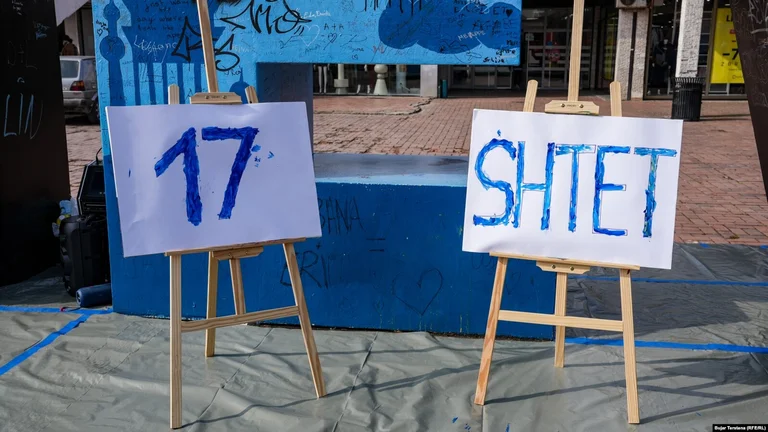
(a year ago)On February 17th, 17 years ago, freezing weather in Kosovo. The afternoon temperature marked about minus 11 degrees Celsius. Pristina's streets were packed with thousands of citizens, who had reached from all parts of the country but also abroad. The facilities of Kosovo institutions, the Government and the Assembly, were heated inside. Enormous session [...]
Pristina's streets were packed with thousands of citizens, who had reached from all parts of the country but also abroad.
The facilities of Kosovo institutions, the Government and the Assembly, were heated inside. The extraordinary parliamentary session.
At 15:39 minutes, institutional leaders declared Kosovo independent and sovereign state.
The Declaration of Independence voted the 109 deputies present at the session, who placed their signatures on a parchment where it was written.
Within the Government building, artists and institutional directors were co-ordinated for that night's festive concert.
Part of that organisation was Kosovo actor Fatmir Spahiu, now 43-year-old.
He recalls that immediately after the solemn moment of declaring independence, he ran toward his home in Pristina to take his son, then ten months.
He says he wanted to materialise the memory of the moment for both generations.
I went to get my son, just to take a picture so I could remember him with my baby boy. That was one way I tried to manifest all that joy”, Spahiu says about Radio Free Europe.
Spahiu adds that, at the time, expectations for the country's development have been great, but, according to him, have not been fully realised.
The “those who will read the history of Kosovo will say: "As soon as possible, what good development, what a change." For those of us living this period, however, there are problems. Economics are still on the ground, health is catastrophic, the educational system leaves much to be desired. We don't have substantial apparent advances”, Spahiu says.
In the town of Ferizaj, 17 years ago, Albulen Avdyl's family had gathered in front of the television screen to see the direct broadcast of the moment of the country's declaration of independence in the Kosovo Assembly.
Albulen tells Radio Free Europe that everyone had experienced intense emotion of joy.
It's been a very good feeling, because most have experienced it as something memorable, like something that doesn't happen to... They have experienced a dream that was coming true”, she says.
In the next 17 years, however, it says that the country's progress has been limited. According to her, politicians express ambitions for the country's development only in election campaigns.
And then they stop them, they don't have much ambition like before the election. I'm hoping that in the future more” will work, she says.
Kosovo's declaration of independence on February 17th, 2008, Sheriff Krasniqi, now retired, recalls that he received it in Pristina's main square, along with thousands of other citizens.
That's when he says he's been waiting all his life.
It's been very divine for us. We have thought that for a very short time we will become the most coveted country for all”, Krasniqi says.
But that is not what he believed. He expresses disappointment with policymakers, who, he says, have given priority to the power struggle prior to the country's development.
“I'm not satisfied, for a reason. I have a son. It took me 15 years ago to say, "Take the world in front of your eyes and live your life," because I've seen that those who caught the chairs don't let go. Fight with them, we can't”, says the Sheriff for Radio Free Europe.
For Nazlie Bala, political activist from Pristina, the sense of joy she experienced 17 years ago, at the moment of Kosovo's declaration of independence, it is unfathomable.
For me, the important thing is freedom. For me, it's the State. Of course, society promotes the country. Neither then nor now do I expect more than real steps, pragmatic policy and social development”, Bala says.
In the post-independence years, according to her, there have been many positive changes in the country and in them, as Kosovo society itself says, has influenced politicians and institutional leaders.
This is our common home. Where each member of the family contributes to the development, emancipation and education of the house, there is prosperity”, Bala says.
Along with Albanian deputies 17 years ago, Kosovo's declaration of independence also signed those of non-partisan communities, in addition to the ten deputies of the Serb community who boycotted the February 17th solemn session, 2008.
What do members of non-communist communities say?
For Millijan, a member of the Serb community, which lives in Gracanica, February 17th, 2008, when Kosovo's independence was declared, means the worst “”.
According to her, the position of Serbs has only deteriorated over the past 17 years. In this context, it cites the removal of the Serbian dinar from the use and closure of Serbian institutions operating under Serbia's system in Kosovo, steps taken by Kosovo authorities in recent years.
Everything changed for the worse and nothing for the better. First of all, we have nowhere to withdraw money [in dinars from Serbia's budget]. We go to Serbia, we pay our own trip and we find ourselves. Life here is horrible”, Milliyana says.
She adds that even freedom of movement is not “for praise”. In Kosovo, it says it sees no perspective, but it has nowhere to go.
Otherwise Orhan Llopar thinks of Prizren, a member of the Turkish community. For him, Kosovo today is a better country than 17 years ago, when it was declared an independent state.
However, he adds, his community could develop even more within the state.
We are partly satisfied because, unfortunately, in some situations we are losing what we are guaranteed by law, because some Albanians do not want it. They need to know that this is a multiethnic state and that it's not just Albanians here. If it were not multiethnic, Kosovo would not be what it is”, says Llopar and adds:
I like the [Kosovo] flag. What I don't like is economic”.
The Kosovo flag, in its blue background, holds the yellow-coloured Kosovo map and six white stars on it, symbolising communities living in the country.
Ismail Ramovic of Prizren, a member of the Bosniak community, says that today's Kosovo, in some respects, is what it thought 17 years ago, but not at all.
Kosovo's “state has done much for the Bosniak community, in the legal protection segment. This is important”, Ramovic says.
He recalls that the Bosnian community has a guaranteed education system from the pre-school to university level, as well as is represented in state institutions by law.
All of this gives him the chance and opportunity to be affirmed within Kosovo society. As if we've taken advantage of this, this is the next” account, he says, criticising Bosnian politicians that “has not been effective to influence the development of the Bosniak community in Kosovo”.
Osman Osmani from the Roma community says that with Kosovo's declaration of independence, he has expected major positive changes.
In the Prizren municipality where he lives, Roma is official.
This is one of the positive things”, he says.
But there are many things that would have to change: the social standing of the Roma community, education, employment, health. All these issues continue to be very important for resolving the position of the Roma community”, according to him.
The 17th anniversary of independence mark, Kosovo finds it with functional governments, but on its way out following the February 9th parliamentary elections.
Although the current government, led by Prime Minister Albin Kurti, emphasises that there are good relations with its Western partners, these have frequently criticised him for actions co-ordinated in Serb majority municipalities, such as the removal of the Serbian dinar or the closure of Serbian institutions, from which the community has, for years, received different services.
Because of these actions, Kosovo is even under some punitive measures from the European Union, which include suspending some funds and high-level meetings.
During 17 years of independence, the country has managed to become part of several international organisations like the World Bank, the International Monetary Fund, the European Bank for Reconstruction and Development, the European Federation and the World Football Union, but has failed in the U. NESTO, Interpol of the Council of Europe.
Today, it is the only country in the Western Balkans that is not a candidate for membership in the European Union.
It is recognised by some 117 countries in the world, but not by the two countries in the region, Serbia and Bosnia and Herzegovina, nor by five EU countries: Greece, Spain, Cyprus, Slovakia and Romania.
With 1.6 million people, Kosovo has an unemployment rate of around 10 per cent, apparently lower than 17 years ago when it was over 47 per cent
Economic growth remains below 5 per cent, while the average salary in the country is around 570 euros. /Radio Free Europe