3 minutes ago
Over 10 earthquakes per hour, what is happening in Greece?
Periskopi(a year ago)
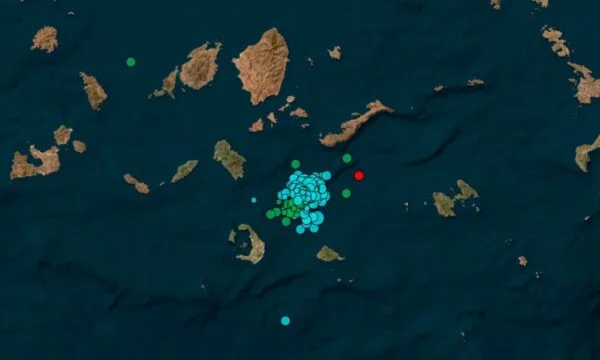
(a year ago)Seismic fuels have intensified, reaching up to 10 earthquakes per hour (with up to 12 quakes recorded between 2 and 3am this morning), in the sea area between Santorini and Amorgo. During the period from 09:36 to 10:26, five quakes of magnitude above 4 were recorded, the strongest [...]
Seismic fuels have intensified, reaching up to 10 earthquakes per hour (with up to 12 quakes recorded between 2 and 3am this morning), in the sea area between Santorini and Amorgo.
During the period from 9:36 to 10:26, five magnitude earthquakes were recorded on four sides, the strongest one reaching the 4.7 magnitude at 10:26, with a 20 - mile [20 km] episode southwest of Ambson in Amorgos.
This has also caused concern in Turkey, where seismologists have warned residents of coastal areas such as Bodrum, Mugla and Aydin to be careful about the possibility of a tsunami.
The seismic sequence under way north of Santorin has a tectonic origin, which was triggered by a volcanic activity that started on August 2, 2024. This is an ongoing phenomenon in the Thira-Coloumbo volcanic complex, which is being monitored and measures are being taken to cope with possible scenarios,” said Athanassios Ganas, director of research at the Athens National Observatory Geodynamic Institute.
Ghana added there could be a series of magnitudes up to 4.7, or there could be a stronger earthquake that could cause a tsunami and volcanic eruption. He said they are preparing for both scenarios and monitoring the situation.
In Annafi, one of the affected islands, the deputy mayor said that residents are experiencing difficult times because of continued earthquakes. “Hear a thunder and after it a shake, every 5-10 minutes we have an earthquake,” he said. However, he added, they are maintaining calm, stressing that <x2 we have stones stronger than Santorini. ”
Following seismic activity, videos different from residents of Turkey's coastal areas, such as Izmir, have distributed images that seem to have drawn away, asking whether this phenomenon is related to seismic activity in the Cyclades.