2 minutes ago
Two years after Brussels Agreement, Kosovo, Serbia in reverse
Periskopi(a year ago)
(a year ago)Instead of the peaceful resolution of disputes, the armed attack on Banjska; instead of accepting national symbols and respecting territorial integrity, Serbia with its reserves; instead of Kosovo's unhindered membership in international organisations, the task force for its obstruction; instead of resolving the position of Serbs in [...]
Instead of the peaceful resolution of disputes, the armed attack on Banjska; instead of accepting national symbols and respecting territorial integrity, Serbia with its reserves; instead of unhindered Kosovo membership in international organisations, the task force for its obstruction; instead of resolving the position of Serbs in Kosovo and financing from Serbia, abolishing the dinar and closing Serbian institutions.
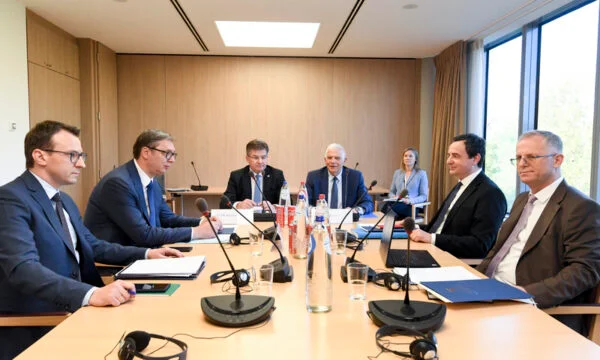
All these are steps towards violating the Agreement for the Normalisation of Relations between Kosovo and Serbia, which was accepted two years ago on February 27th, 2023 by Kosovo Prime Minister Albin Kurti, and Serbia's president, Aleksandar Vuciq, in Brussels.
The document, which was also recognised as “Plan Franco-German” and had US support, had to lead to a comprehensive agreement on normalising relations between Kosovo and Serbia.
It was agreed on ten years after the two sides signed the first Brussels Agreement. And to reassure “that it will be implemented, they also agreed to the Implementation Annex during a meeting in Ohrid, North Macedonia, on March 18, 2023.
“We have an agreement”, then EU foreign policy chief Josep Borrell said enthusiastically.
At the time, US special envoy for the Western Balkans Gabriel Escobar said it was a <x0-> a difficult but necessary”, which “would open the region's doors to enter a new era of peace”.
With the agreement, Kosovo, among other things, was obliged to form the Association of Serb majority municipalities, while Serbia did not block Kosovo's membership in international organisations.
The agreement also envisioned equal rights for Kosovo and Serbia, respect for territorial integrity and invisibility of borders, recognition of state symbols and the opening of diplomatic representations of Kosovo and Serbia in the headquarters of governments of these countries.
During the past two years, however, almost the opposite of implementation occurred on the ground.
Radio Free Europe addressed the Government of Kosovo, the Office for Kosovo in the Government of Serbia, the Presidency of Serbia, as well as the European Union, which mediates dialogue between Kosovo and Serbia, with the question of who is responsible that the agreement has remained only one <x0ger dead on paper”, but no institution received answers.
German Embassy: The deal is not expired.
The German Embassy in Kosovo said the Agreement for the Normalisation of Relations between Kosovo and Serbia and the Annex for its implementation cannot be outdated.
According to her, documents remain binding for both sides and grounds for further negotiations.
“We expect full implementation”, the statement provided by Radio Free Europe.
The German Embassy acknowledged that in the past two years, there has been “limited progress” in dialogue, but that this “in no way reduces mutual achievements and understandings, defined with the Ohrid Agreement”.
Serbia and Kosovo have reaffirmed their commitment to the Ohrid Agreement in the context of the EU Growth Plan. We believe there is new momentum in dialogue under the leadership of the new European Commission and its senior representative, Kaya Kallas, along with newly appointed EU Special Representative Peter Sorensen”, says the German Embassy's statement.
REL also contacted US, French and United Kingdom embassies on the subject, but no response was received.
<x0)
Instead of “all disputes between Pristina and Belgrade being resolved exclusively by peaceful means and exercising restraint from threats and use of force”, as envisioned in Article 3 of the agreement, a armed attack by Serbs occurred in the Zvecan Baniskka, which killed a police officer.
Three Serb attackers were killed in the subsequent armed clash.
The event took place on September 24, 2023, about six months after the agreement was reached.
Serbian List deputy leader Milan Radociq, who later resigned from office in this party, the largest of Serbs in Kosovo, took responsibility.
Kosovo authorities brought charges against more than 40 people in the Banjska case in their midst, and Radojic, believed to be free in Serbia.
Kosovo named this attack a terrorist and accused Serbia of standing behind him, which Belgrade strongly denied.
The international community strongly condemned the attack and demanded that participants be brought to justice.
“We think there have been some financial and organisational ties with the state of Serbia, but we are investigating it as a whole”, Escobar said in an interview for Radio Free Europe in March 2024.
The US Assistant Secretary of State's deputy added that the US does not require Serbia to investigate this attack, but to take responsibility.
Serbia's reserves on agreement
In Article 1 and 2 of the Agreement on the Path of Normalisation of Relations, the parties are said to develop normal relations and good neighbourly relations, recognise each other's national documents and symbols, and respect their independence and territorial integrity.
But in December 2023, then Serbian Prime Minister Anna Brnabiq sent her a letter The EU, in which Serbia expressed reservations to its agreement and annexes of implementation.
In that letter, she stressed that the agreement is considered “acceptable only in a context that has nothing to do with de facto and de jure recognition of Kosovo”.
The then EU's representative in Kosovo-Serbia dialogue, Miroslav Lajcak, said in September 2017 that Serbia has withdrawn the letter.
Meanwhile, Kosovo Prime Minister Albin Kurti insisted on signing the agreement as guarantee of its implementation.
But, the European Union, in some cases, stressed that it is legally binding for both sides, even though it has not been signed.
Kosovo blockade at Council of Europe
Article 4 of the Road to Normalisation of Relations stipulates that “Serbia will not oppose Kosovo's membership in any international organisation”.
Serbia's President Aleksandar Vuciq and other officials of this country said on several occasions they would never allow Kosovo to become a member of the United Nations.
On 5 April 2024, on the order of Vuciqi, the task force for co-ordinating state organ activities was formed in connection with Kosovo's “accession problem” at the Council of Europe.
He demanded that the main argument against Kosovo's accession to the Council of Europe be the fact that Pristina has not formed the Association of Serb majority municipalities, not that “Kosovo is not a state”, because, as he said, it would have no effect, since most EU member states have recognised Kosovo.
On 16 April, the Parliamentary Assembly of the Council of Europe approved the recommendation for Kosovo's admission to the organisation, but countries like France and Germany conditioned its admission to the establishment of the Association of Serb-run municipalities.
Since Kosovo rejected this requirement, its membership in the Council of Europe did not enter the committee of ministers of this body on 17 May, 2024.
Kosovo's refusal to take steps towards forming association
Article 7 of the Agreement on Normalisation of Relations envisions that the Serb community in Kosovo is provided with the necessary <x0-level self-aware and the ability to provide services in certain areas, including access to financial support from Serbia and a direct channel of communication with the Government of Kosovo”.
In October 2023, envoys from the Grand Five Union, the United States, France, Germany and Italy presented a draft state for the Association of Major Serb municipalities in Kosovo and Serbia.
But, Kosovo Prime Minister Albin Kurti refused to send that draft status to the Constitutional Court, which was the first step towards establishing association.
Instead of Association, closure of Serbian institutions, removal of dinar
The Serbian majority municipalities' Association statute envisions solutions to the position of the Serb community in Kosovo, regulates protection of its rights, as well as financing from Serbia.
Although it was not formed, Kosovo, in December 2023, adopted a regulation prohibiting payment transactions in dinars, which hit the Serb community, which accepts various payments from Serbia's budget ) from salaries to additions for children.
By January 2024, meanwhile, Kosovo also began closing down institutions operating within Serbia's system, with the reasoning that their work was illegal.
These decisions of the Government of Kosovo were met with sharp criticism from the international community, which described them as unilateral and uncoordinated “.
Western countries criticised Kosovo for offering no alternative solution before abolishing the dinar and closing Serbian institutions.
Disrespecting other agreements reached
In the past two years, the European Union reiterated that Kosovo and Serbia have not observed any other agreements, even though Article 10 of the Road to Normalisation of Relations defines that “both sides confirm their commitment to implement all previous agreements in dialogue, which remain valid and binding”.
Kosovo's government said in mid-July last year that it aims to open for traffic the main bridge over the Iber River in Mitrovica, which divides the town into Albanian-inhabited south and in the predominantly Serb north.
This idea was strongly opposed by the EU and Quinn countries ( The US, Germany, France, Great Britain and Italy, which said the bridge should be opened exclusively in line with relevant agreements reached within the dialogue for normalising relations between Kosovo and Serbia.
Kosovo and Serbia agreed to the opening of the bridge on Iber in 2014, but in 2016 a new implementation plan was agreed on, with the aim of overcoming disputes over different interpretations that were made to previous conclusions.
The bridge was to be opened in 2017, but it never did.
Peacekeeping Mission NATO, KFOR, whose members are on the bridge, also said the decision to open the bridge for trafficking should be made within dialogue.
The Kosovo government, in the end, gave up its goal.
On the other hand, the Government of Serbia, on October 28th last year, proposed to Parliament for adoption the law envisioning judgment for all previous acts with the Criminal Code, which were carried out after Kosovo's February 2008 declaration of independence, as well as the law on Kosovo's territory to declare a special social protection zone.
The European Union named this initiative by the Government of Serbia as violating Brussels' agreements and called on official Belgrade to reconsider the warned adoption of laws.
He recalled that the obligations of Serbia and Kosovo regarding the jurisdiction of judicial authorities have been clear since the signing of the first Brussels Agreement for normalisation of relations in 2013.
So far, these laws did not pass into parliamentary procedure in Serbia. /Radio Free Europe