4 minutes ago
Victory of the Freedom Party: Will Austria be ruled by the far right?
Periskopi(2 years ago)
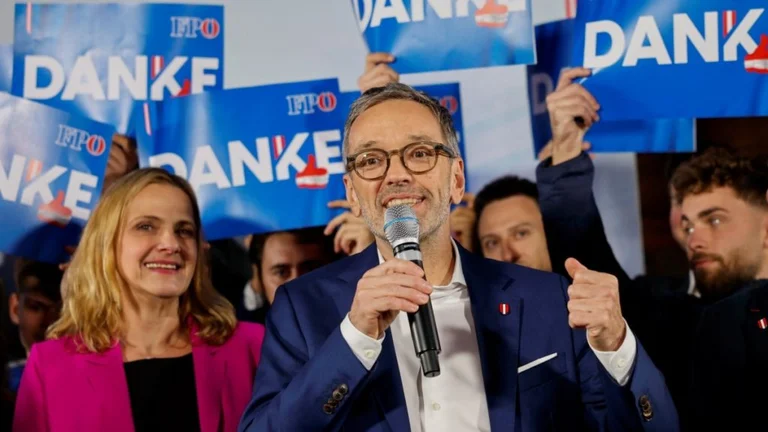
(2 years ago)The far-right Freedom Party (FPO), led by Herbert Kickl, has won parliamentary elections held in Austria on Sunday, according to initial projections. The election results potentially put this party first to form Government, for the first time in post-war history. According to projections, FPO has emerged [...]
The election results potentially put this party first to form Government, for the first time in post-war history.
According to projections, the FPO has come first, but has not won the absolute majority.
This implies that the party needs to find a coalition partner in Parliament to form a stable government if President Alexander Van der Bellen invites this party to form the new executive.
The only party has left the open opportunity for coalition with the FPO is the ruling conservative party, the Austrian People's Party (OVP). But OVP leader Chancellor Carl Nehammer has ruled out the possibility of forming an executive who would also attend Kickl.
Besides, there are Van der Bellen's reserves regarding Kickl. All of this has added questions about whether Kickl will leave and leave another member of his party to become Chancellor. Given how fierce he and his party have campaigned with the idea that Kickl should become <x0volkscanler” or the Chancellor of the people, this option currently seems impossible.
If the FPO is invited to form a governing coalition, the only party with which an OVP can form is the majority.
The two parties have different positions in many key areas, separately in terms of establishing stricter rules for immigration. But these two subjects support cutting taxes to boost the economy, which has been shrinking for two consecutive years.
The negotiations, however, could be complicated due to the poor report between Kickl and Nehammer. During the campaign, Nehammer described Kickl as dealing with conspiracy theories and as a person who is not qualified to rule. The OVP is the ruling party.
It was in every government, except for the short-lived task executive that was the first government composed of three parties in the past 37 years.
While many think OVP is the closest party to the FPO in ideological terms, the OVP should at least have an alternative in principle regarding a coalition with FPO: a tripartite alliance with the party that has emerged third in the election, the Social Democrat Party and one of the two parties that have received less than 10 per cent of the vote, the liberals of Neos or the left-wing Green.
In such a scenario, the OVP would be the largest party, meaning that Nehammer could continue to hold the Chancellor's post. Such a scenario would be more greedy than one in which the OVP would be the smallest partner of the ruling coalition.
President Van der Bellen, former Green Leader, had taken the oath along with ministers from FPO, including Kickl, when his party formed a coalition with the OVP in 2017. The coalition collapsed after a 2019 scandal.
Van der Bellen had also approved the government's decision to dismiss Kickl at the request of then Chancellor Sebastian Kurz, from the OVP, days before Parliament fell the executive.
The Austrian president has voiced reservations regarding Kickl, implying that he will either not allow him to become Chancellor, or will not ask FPO to try to form Government if the first party comes out.
However, the margin of FPO's victory is meant to be greater than the first projections, putting it in a better position, Kickl.
Although it is a practice for the president to ask the first party to form Government, Van der Bellen is not obliged to do so.
This is a practice, but as far as I know this rule is not in Constitution”, Van der Bellen said last year.
What's in the Constitution is that I name the Chancellor... It's one of the few points where the president has completely free hands”
So Van der Bellen can decide to take a completely new approach.