6 minutes ago
Scholz's SPD wins elections as far-right extreme continues growth
Periskopi(2 years ago)
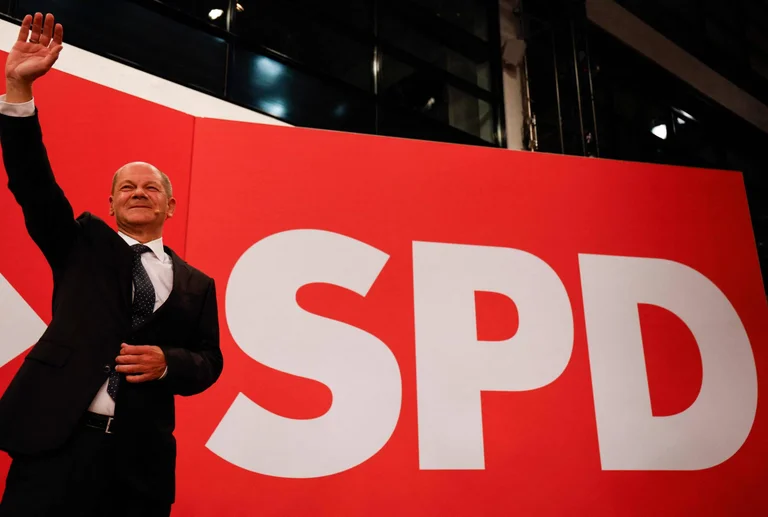
(2 years ago)While far from overcoming difficulties, German Chancellor Olaf Scholz may feel happy at least after Sunday's elections in Brandenburg, the launched of the former Democratic Republic of Germany, which borders the federal capital, Berlin. His Social Democrat Party (SPD), which has led this land since the reunification [...]
His Social Democrat Party (SPD), which has led this land since Germany's reunification, managed to take first place again after it was left behind the far-right party Alternative to Germany ( AfD) almost throughout the campaign.
In the end, the SPD won 30.9 per cent of the vote, marking improvements compared to 26 per cent of what it had won five years ago, and left the AfD back in second place with 29.2 per cent of the vote.
This result is short-term relief for Scholz in many ways. He lives in Potsdam, the capital of Brandenburg, and his party finally scored a victory after terrible results in Turingi and Saxony, the two countries of the former East German, three weeks ago, where he barely survived.
In recent weeks there have been more and more questions about how long the federal government can lead after such poor results. Now, however, it seems that it may at least somehow reach general elections, scheduled for September 2025.
The question, however, is how much credit Scholzi should get for this result. He has changed our tone in recent weeks in an effort to address fears about migration and scepticism for Ukraine, which dominates large sections of the electorate, mainly in the eastern part of the country.
He has recently spoken of peace talks, in which Russia should be included, while in early September, he restored border controls across Germany's borders to try to fight immigration after a deadly stab attack on the western town of Solingen in August, which took responsibility for the Islamic State.
Yet, in many ways, the final result appears to have been achieved thanks to a combination among people who have voted for his party as the last solution to prevent AfD from winning and the popularity of incumbent Brandenburg Prime Minister Dietmar Weidke, who, although he is Schozli's co-party, ignored him during the campaign and criticised the federal government.
Also worth noting that the two partners of the federal coalition, Green and Liberal Party FDP failed completely in Brandenburg. The first received 4.1 per cent of the vote and thus failed to pass the 5 per cent threshold for representation in the land parliament, while the FDP received 0.8 per cent of the vote, which is the worst result ever in regional elections.
And while AfD failed to go first in Brandenburg, it marked growth again. There is no doubt that this party is still the biggest winner after the elections in eastern countries in September.
It ended up in second place very close to the winner in two of them and became the first far-right party from World War II to win one land, Turingina. Of course, the eastern part of the country stands out because much of the electorate is against emogrition and has warmer feelings about Moscow.
This was reflected in the success of the new leftist BSW (Sahra Wagenknecht Alliance), which came third in Brandenburg with 13.5 per cent of the votes won, and has very similar political positions with the AfD.
At the federal level, extreme left and far-right parties could win one-thirds of the vote. They, however, will have an impact on the EU's largest economic player before the elections, putting pressure on immigration and Ukraine.
And this is not just happening in Germany. Czech populist Andrey Babes did well in regional elections held the same weekend as the vote in Brandenburg, and he appears to be in good position to become the country's prime minister next year. Austria will hold parliamentary elections next weekend.
There, the far-right populist party, the Freedom Party (FPO), is moving decisively in the polls. Europe is looking at its interests now. / REL