5 minutes ago
Kosovo Summit for Peace and Democracy: Kosovo- Serbia Must Be Back on Track
Periskopi(2 years ago)
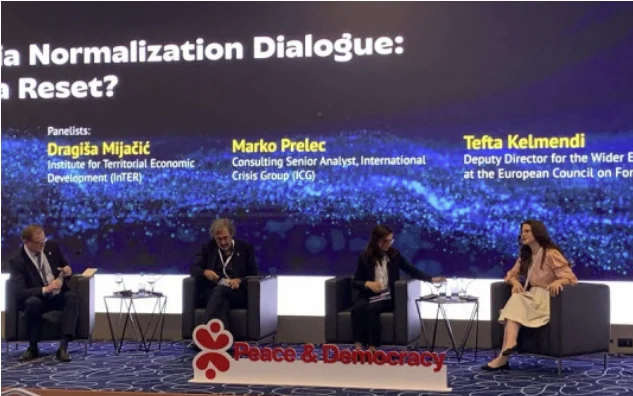
(2 years ago)The third edition of the Kosovo Summit for Peace and Democracy has opened, (KPDS) titled: “Realties radical: ethno-political dynamics and the Euro-Atlantic integration of the Western Balkans”. New Social Initiative Executive Director (NSI), Jovana Radosavljevic, in her opening address said this summit aims to keep the channels of dialogue open and for [...]
The executive director of the New Social Initiative (NSI), Jovana Radosavljevic, said in her opening address that this summit aims to keep the channels of dialogue open and strengthen civic initiatives to be inclusive.
When we first predicted the summit, it was during a time of significant political and social challenges that traced dialogue to any level. Unfortunately, these challenges have only been strained over the past three years. Yet, here we are, resisting, growing up, and prevailing. The organisers of the Kosovo Summit for Peace and Democracy are making extraordinary efforts to keep at least the channels of dialogue open and strengthen civic initiatives intended to be inclusive. Our work is often slow to produce tangible results. But we have seen enough progress to inspire us to continue, even when personal costs are high”, she said.
Meanwhile, the executive director of the Kosovar Centre for Security Studies (QKSS), Mentor Vrajolli, said the Kosovo-Kosovo dialogue process- Serbia must return to the track through balanced implementation of Brussels' basic agreement and the Ohrid annex.
“The QKSS actively promotes the normalisation of relations between Kosovo and Serbia and, of course, the agreement reached in Brussels and its annex in Ohrid manifests an acceptable document that we have the Kosovo government's positions in its full implementation, and if possible in its signatures. The existing process of dialogue should be established on the basis of balanced implementation of the agreement. As we remain critical of the Kosovo government's steps, as far as participation in the dialogue is concerned, we are deeply disappointed with former Serbian prime minister's letter of formal withdrawal from the dialogue, which was later claimed that this letter was withdrawn. We hope that the normalisation process will get on track quickly. And we hope that as a civil society we will be able to contribute to this normalisation process going on track as soon as possible. Our goals with this event are also to send positive messages when it comes to ensuring that the normalisation process in the region and normalisation in Kosovo goes on track as soon as possible, we expect productive discussions... and we hope that messages coming from this event will help in the internal and regional recovery process when it comes to improving relations at the”, he said.
In contrast, Sbunker's executive director, Bardh Bakija, said the future of countries in the Western Balkans should be in the European Union.
However, he expressed concern that nationalism and authoritarianism are taking place in the region, until he said Kosovo- Serbia has gone back in recent years.
Our “The theme of this year, radical realities, etino-political dynamics and Euro-Atlantic integration in the Western Balkans, speaks of double forces that shape our reality. On the one hand, nationalism and authoritarianism are gaining ground, on the other hand, many of us remain committed to the belief that the future of the Western Balkans lies in democracy, co-operation and Euro-Atlantic integration. However, if we are sincere, the gap between these two paths seems to be expanding - something we cannot avoid. Last year has been difficult for all of us, Banjska's attack on September 24th was a strong reminder of how fragile peace is in the region, reminded us that violence unfortunately is still attractive to some and that progress may seem distant. Kosovo-Serbia dialogue has gone back, tensions are deepening, and internationally there is a growing feeling that the European Union's influence is waned. The path towards EU enlargement has become uncertain, and public confidence in that vision is understandable by weakening”, he said.