2 minutes ago
Havenier: Kosovo, Serbia committed seriously to dialogue
Periskopi(2 years ago)
(2 years ago)Western diplomats and representatives of civil society organisations from the region said Wednesday in Pristina that Kosovo and Serbia should engage more seriously in dialogue as the only way towards normalising relations and integrating them into Euro-Atlantic structures. They made these comments along with the work of a meeting for Peace and Democracy [...]
Western diplomats and representatives of civil society organisations from the region said Wednesday in Pristina that Kosovo and Serbia should engage more seriously in dialogue as the only way towards normalising relations and integrating them into Euro-Atlantic structures.
They made these comments along the work of a meeting for Peace and Democracy that is being held in Pristina.
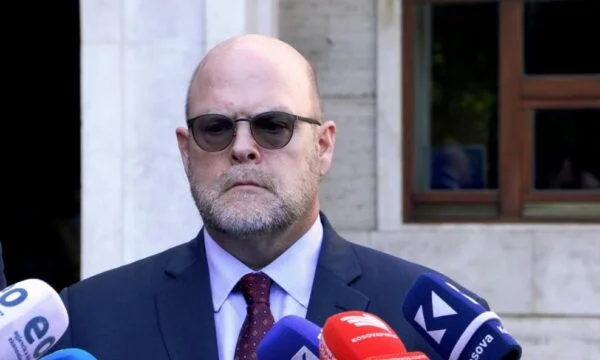
The US Ambassador to Kosovo, Jeff Hovenier, said a re-compliance in dialogue on all sides is needed.
What we need is to end making obligations that are not implemented. We need a serious and goal in this dialogue, you can call it reformation, re-enforcing, new access or more energetic approach, but this is absolutely necessary and this needs to be done by all sides. There are many possibilities for doing so. My government will change on January 20th, the European Union has concluded the elections and has a new leadership structure, so clearly it is an essential moment to see where we are, where we want to go and make some” changes, he said.
German Ambassador to Kosovo Jorn Rhode said the biggest obstacle to normalising Kosovo relations Serbia is the overall lack of political will on both sides, referring to the failure to implement the Ohrid agreement the parties agreed on last year.
“We need an urgent re-agement, there is a new team in Brussels, and I say it again, that Kosovo should be active on the issue of the Association of Serb-run municipalities, because this is a clear way to the integration of the Serb minority in the country. But it would also signal that the Ohrid Agreement is still alive for Kosovo. On the contrary, the European Union remains elusive for Kosovo and Serbia because you cannot convince the bloc's member states without being able to make the minimum”, he said.
The issue of establishing the Association of Serb-run municipalities in Kosovo is the most difficult point of talks on normalising relations between Kosovo and Serbia.
The Balkan expert in the International Crisis Group, Marko Prelec, said that since both sides have launched the negotiation process, its essence has been a kind of broader autonomy for Serbs in Kosovo in exchange for a de facto recognition by Serbia, but such a thing according to him is no longer possible.
The “because many of the problems it was expected to address, especially as far north of Kosovo, have already been resolved unilaterally by the Kosovo government. It is hard to imagine now turning into a situation where the Kosovo government would say okay we have removed all these Serbian institutions and replaced them with constitutional institutions, but now we will give you a self-government structure where Belgrade can play any role, that simply will not happen. So in a way, his heart has been removed from this dialogue and there is no clear thing to replace”, he said.
The chief of the European Union office in Kosovo, Aivo Orav, said that after many years, in a new geopolitical context, the European Union is looking at enlargement in the most serious way and Western Balkan countries should exploit this new moment.
I have to stress the process of normalising relations between Pristina and Belgrade through dialogue, because it is absolutely essential. I know there are expectations from the new governing structure and I would like to quote something from the mandate I have received from the 27 member states that says I should promote a stable, peaceful, democratic and multiethnic Kosovo engaged in regional co-operation, and that I will do. There is a new moment for all of us, and my message to all of us is to be ready when the train comes not to be late”, he said.
For 13 years, Kosovo and Serbia have been involved in negotiations mediated by the European Union. Last year, the parties reached an agreement on normalising relations, but implementation, which is also condition for progress towards membership in the bloc, has stalled.
Participants at the Kosovo Peace and Democracy summit today stressed the importance of both sides, but other Western Balkan countries to maintain the concentration of the Euro-Atlantic community towards the region, on the contrary there is the danger of creating space for malicious foreign influences, especially the Russian influence in the Balkans.