3 minutes ago
Education Knowers: Hard to apply whole-day teaching in Pristina
Periskopi(2 years ago)
(2 years ago)Recognisors of education issues consider that the whole day teaching in Pristina will not be easy to implement, taking into account school overcrowding and lack of infrastructure in capital schools. Youth experts Qehaja and Silver Osmani estimated that if they did, this programme would be an excellent opportunity for improvement [...]
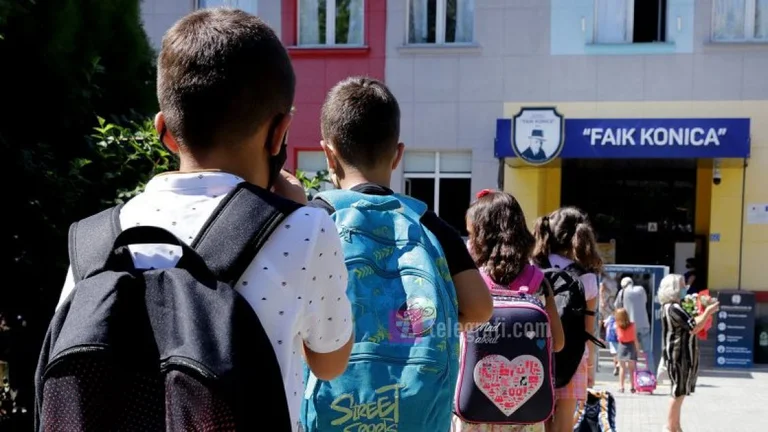
Recognisors of education issues consider that the whole day teaching in Pristina will not be easy to implement, taking into account school overcrowding and lack of infrastructure in capital schools.
Experts Youth Qehaja and Silver Osmani estimated that if they did, this programme would be an excellent opportunity for improving the quality of education.
“Institute Director Edgood” Youth Qehaja, has told Online Economy that previous experiences of similar reforms have often failed after the end of local government mandates.
This process no doubt serves the community itself, is in the interest of children, and if well-managed, it can become a super profitable policy and something that contributes to improving quality in education. But what its application will be as consistent as this reform is and how much that consistency guarantees for us a stability is something that remains to be seen. I remember that similar reform we had in some mandates earlier in the same municipality, we had in previous municipalities. But since the end of the mandate by local government, it has concluded that it also implemented the whole day's stay. This cannot happen to us because we need to return as a constant benefit that the structure has organization, has support for schools that are on the pilot, but also for the whole municipal level, and not only”, he said.
Qehaja has said that whole-day learning has meaning only in schools that have the capacity of adequate infrastructure, warning that without the construction of new educational institutions, this process could end in improvisement.
He recalled that the Pristina municipality has over 37 schools and that it is necessary that standards of management and teaching infrastructure should be implemented for all schools, not only for those on the pilot.
The entire day's teaching makes sense in schools that have infrastructure capacities that are with a shift, and the whole day's learning goes parallel to capital investments in building new schools, so there's no sense in whole day teaching being introduced as politics if there's no new educational institutions. On the contrary, we go back to an improvised process in two or three schools, but it reminds us that the Pristina municipality has more than 37 schools, so what's in community interest is an entire day lesson that is beneficial for all schools and not just a few schools that may have a dedicated management, more sound infrastructure but not worth the same for others, and this standard of whole day management and infrastructure should be applicable for all the <x1 schools, he said.
Qehaja has said that many schools in Pristina are overcrowded and that lack of spaces such as kitchens and libraries is an obstacle to implementing the entire day's learning.
Pristina's <x0munica, I recall that most schools are still missing in proper spaces, are overcrowded and that overcrowding undoubtedly made it impossible to implement whole-day learning. Most of the schools are missing in the kitchen, in resorting spaces are missing in libraries, and all of these are indicators of the success of the entire day's learning because this daily lesson goes beyond a regular lesson, in fact, the success of this reform depends on what students do at school in the afternoon and what they do in the morning”, he said.
Education issues acquaintance, Silver Osmani, said the application of daily learning in Pristina is a good step, but that challenges, such as lack of infrastructure and learning spaces, must be addressed.
It recommended that this model also be developed in rural areas, where there are more learning spaces.
There is no doubt that the field of education is a very complicated area and as such is subject to frequent shifts that are conveyed, of course, by following the changes in society, technological development, and others. Such changes that have recently appeared in Kosovo, namely, with the application of daily learning in Pristina are certainly welcome if they will be successful. It should be seen that the problems that are facing and that will be obvious in the future are primarily connected with the lack of infrastructure but also with the organisational learning process. So in rural areas, we have excessive learning spaces, and in the urban part, when we talk about Pristina we have a serious lack of these spaces. So if this kind of teaching is designed to be organized throughout Pristina's entire municipality, it would be possible and better infrastructure preconditions for this to be done in rural areas and that we actually take some kind of piloting of it to Urban Pristina”, he said.
Osmani stressed that although there are opportunities for success, the problems faced so far will affect the effective implementation of the process.
The “Problem has had and will follow this process all the time, I say if it was successful it might have been a good example and it could contribute to quality raising. But with all the problems that have emerged since the start of its implementation I think will not be easy implementation of it”, he said. / EO