14 minutes ago
Lajcak: Societys in Kosovo, Serbia not ready for normalisation
Periskopi(2 years ago)
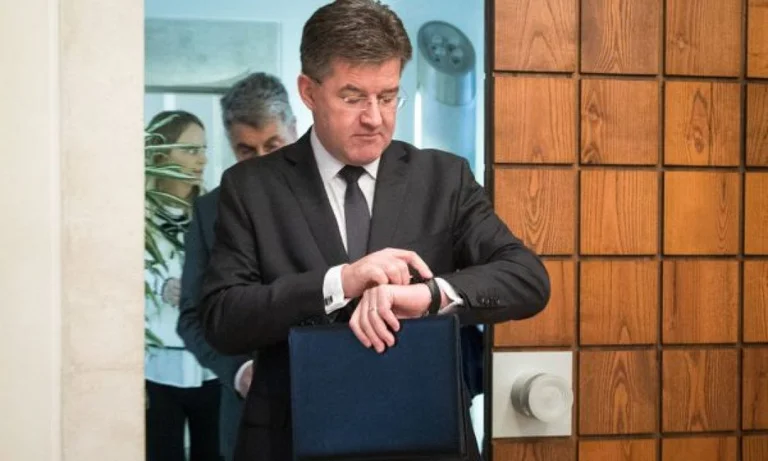
(2 years ago)The European Union's envoy for dialogue between Kosovo and Serbia, Miroslav Lajcak, has said there is a danger of destabilising the Western Balkans if the parties do not engage in dialogue and continue to do uncoordinated and urgent actions. In an interview for Radio Free Europe, in the margin of the Globsec Forum, which is being held at [...]
In an interview for Radio Free Europe, in the margin of the Globsec Forum, which is being held in Prague, Lajcak has acknowledged that not enough has been done to implement the Ohrid Agreement, reached between the parties last year, but that the best agreement cannot be reached and that the parties should realise that progress in dialogue is deeply linked to their path towards the EU.
Set and in Serbia] are not ready for normalisation”, he has stressed.
Asked how the dialogue should end, even if mutual recognition should be included, he has said it is up to the parties to decide in that respect. He has also spoken of the attack on Banjska and the charges made by Kosovo officials for unfair access to the country.
Radio Free Europe: Mr. Lajcak, you are close to the end of the mandate as the European Union's special envoy for dialogue between Kosovo and Serbia. Most, including the EU itself, say little has been done, and some say dialogue has failed, have died. What went wrong?
Miroslav Lajcak: Dialogue is crucial for Kosovo and Serbia, if they are serious about their European aspirations, because the European Union has made it very clear that before they are seriously considered for [EU] accession, they must normalise relations. So there's no way around this. That's one thing.
Second, the European Union is the mediator of this process, but the process is owned by both sides -- Kosovo and Serbia. We are doing our best to help them normalise relations, but I must say that the speed of the process and the outcome of the process do not depend on the European Union, but on the parties.
When I look back at my mandate, there have been concrete results, such as recognition of identification documents, recognition of license plates, a very important multimillion-dollar energy deal. Since the beginning of this year, we have a standard situation where people are registered and they pay for the energy, the electricity they consume.
But, of course, the most important achievement is the agreement on the road to normalisation, which was reached and for which reconciliation was reached last year in Ohrid. With this agreement, there is no need for negotiations, but for implementation.
And, yes, unfortunately, implementation has not started seriously. Some things have been done, but of course last March of Ohrid I expected us to succeed more. Why isn't this happening? Don't ask the mediator, ask the parties.
But, of course, they have to do their part. And if you don't want to do your part, then you ask for excuses. But nothing prevents either Kosovo or Serbia from doing what they pledged in Ohrid. And it's clearly written... this document is public.
Again, if you ask me, the problem is that both societies are not ready for normalisation. I don't see any delays from within, from political parties, from the academy, from civil society, to demand that leaders make progress towards normalisation. On the contrary, whenever there is a deal, there is more criticism that concessions have been made. Leaders are not encouraged to make progress towards normalisation.
So we have to work to change our thinking. People need to understand that normalization implies compromise. Normalization means mutual profit. Normalisation means that the agreement can be presented to the public and parliaments, both in Kosovo and Serbia.
As long as you live in illusions that this is a victory for one and one loss for the other, there will be no progress. But if there is no progress towards normalisation, there will be no progress towards European integration. Everything else is an illusion and madness.
Radio Free EuropeBut you said that both sides are not ready and unwilling to achieve normalisation. So we seem to know the problem. So, what should the new EU leadership do? Should you change tactics, priorities, since you're the mediator? Can you do more to convince them?
Miroslav LajcakLook, the basic parameters won't change. The basic parameters of this process are well known. And of course, this includes the fact that the Serb community in Kosovo should be able to preserve its identity, feel secure and protected, have institutional relations with Serbia in line with European standards and within the legal framework of Kosovo. Let's be very clear about this. And, in exchange, Serbia must meet all elements of normalisation of relations.
So that can't change. And again, I don't think there's gonna be a new deal. Because if there was a better deal, someone would have proposed it. They're the greatest minds they've ever worked on this deal. This agreement is fully supported by the United States, by the 27 European Union member states, and in particular by Germany, France and Italy.
So it is again an illusion to believe that with the new High Representative [of the EU], there will suddenly be a new process. The key parameters won't change. And for that reason, all that has been agreed upon is the basic principle. And the sooner we understand that, the better.
Radio Free Europe: You mentioned that in terms of Kosovo Serbs, their rights should be respected. What do you expect as a priority on the other side? You also mentioned compromises. What two major compromises must each side make?
Miroslav LajcakLook, everything's in agreement. That means Serbia vows to recognise Kosovo symbols, documents, institutions. There's a mission exchange agreement. There is an agreement not to undermine Kosovo's membership in international organisations. So read the deal and everything is there.
As I said, nothing prevents the parties from doing their part, except that there is very little trust among them. Unfortunately, my mandate has probably been more devoted to crisis management than to promoting normalisation.
But, an important element that I will stress, of course, for my successor and for the new High Representative, is that this process should be explicitly and directly linked to European integration. Because in the past, when the parties knew that some progress towards normalisation would also bring obvious progress on the road to the EU, that was a very strong motivation.
“
Radio Free Europe: Are you working for a new summit between Kosovo and Serbia?
Miroslav Lajcak: Currently, we are preparing the next meeting at the chief negotiator level. And we're always ready for this. There must be an agenda, there must be readiness. For now, the next step is the meeting of the chief negotiators.
Radio Free Europe: How should the dialogue end? What should be the final agreement between the two sides?
Miroslav Lajcak: To answer that question, in my current role, I can only use the official language of the European Union, that dialogue must end with the legally binding agreement on normalising relations between Kosovo and Serbia, which would solve all remaining issues and pave the way for the European future.
Radio Free Europe: I asked you, because at first it was widely said that dialogue should end with mutual recognition. In time, though, this was somewhat overshadowed. Should the dialogue conclude with mutual recognition?
Miroslav Lajcak: The European Union's stance has not changed. And also, the European Union says it is up to the two sides to decide what the end will be. We're not imposing, we're not dictateing. But, of course, we have our expectations. And when I mention the legally binding agreement, it speaks a lot, too. But we're not there, and of course it would be my diplomatic mistake to say how I see the end of the process. I am here to help the parties reach legally binding agreements for normalising their relations.
“
Radio Free Europe: Mr. Lajcak, the European Union and you yourself have been accused by Kosovo leaders of not being fair to the country. How do you comment?
Miroslav Lajcak: I've been on this job long enough to know all these games. For one thing, personal attacks are not a European way. We don't do this in Europe. You should see the case.
The second, what is required by Kosovo, under the Ohrid Agreement, is something Kosovo has already pledged to do in 2013, and has even ratified in Parliament. Tell me how such a thing is not fair.
If you think you can get everything for free, then of course, when you are asked to do your part, you may find it unfair. But in real life, among adults, you have to give to get. Both sides. That's the only way you can reach a deal. And personal attacks won't help because they actually discredit people who attack.
Radio Free Europe: Do you see any risk of destabilisation in the Balkans if dialogue continues at the current pace and both sides continue to do what you consider unilateral steps?
Miroslav Lajcak: Yeah. Because, either we will have normalisation, which would bring stability, it would pave the way for regional co-operation, which is currently stalled, or we will proceed with uncoordinated action, with urgent actions, which are still co-ordinated, and can become hostile or even violent. And, you know, we can be busy for many years with this repetition, I would say, of destabilizing [state] explosions.
This, of course, enables the region to progress on the European road. Therefore, normalising relations between Kosovo and Serbia is not just their issue. It's a regional and European issue, even.
Serbia has not withdrawn from Ohrid Agreement”
Radio Free Europe: Kosovo President Vjosa Osmani has said in an English-language interview for Radio Free Europe that she considers Serbia has already withdrawn from the Base Agreement. Therefore, if Kosovo is again required to form the Association of Serb majority municipalities, it should sit down and speak with its allies to seek security guarantees. How realistic is this?
Miroslav Lajcak: Serbia has not withdrawn from the deal. It continues to be legally binding and valid in its entirety. The European Union has said that many times. And, likewise, all of Serbia's obligations under the Agreement have already been granted in Chapter 35 of Serbia's EU membership negotiations. So they are also legally binding between Serbia and the European Union.
So, there's no need for alternative access. I think the president [French, Emmanuel] Macro said it very clearly yesterday [in Belgrade]. The road is paved. And the road is the Ohrid Agreement. He said Serbia has a place in Europe. But, he, too, criticised Kosovo for... I'm referring to the part about the dialogue. He made it very clear that he fully supports the Ohrid Agreement. France has played a very important and active role. And, second, there is no alternative to implementing the Ohrid Agreement. That was, I think, very clear from what he said. And I'm letting others comment.
“has not been made enough to try out those responsible for the attack on Banjska”
Radio Free Europe: New American envoy for the Balkans Alexander “Sasha” Casanoff will participate in the Globsec forum. Will you see him? Have you contacted him?
Miroslav Lajcak: Of course. We contacted him over the phone. But we'll meet for the first time here personally in Prague, in Globsec.
Radio Free Europe: Even some Western Balkan leaders are expected to come here. Will you meet them? Do you have anything planned?
Miroslav Lajcak: I always meet them. For me Globsec is the second conference of three such ones to be organised at this time. I was in Alpbach. I'm in Globsec now. I'll be in Blade next week. At each of these conferences, I have many meetings with Balkan leaders, and I have done so over the years. It's always a good opportunity to meet and discuss current issues.
Radio Free Europe: We're gonna change the subject a little bit. Kosovo repeatedly says Serbia's president, Aleksandar Vuciq, is behind the attack on Banjska. How do you comment?
Miroslav Lajcak: Security agencies have already made their statements and I can only repeat what they have said. Of course it was something very terrible and very dangerous. And much has changed in regional dynamics. The European Union's position is that everything should be properly investigated and those responsible must take responsibility.
Radio Free Europe: Has Serbia done enough to try those who have been responsible for the attack on Banjska, including Milan Radocicin, who is free and believed to be in Serbia?
Miroslav Lajcak: Clearly, it cannot be said that it has been done enough when the people responsible, starting with Milan Radoiciqi, who has admitted responsibility, have not yet faced justice. Of course, no one can say that enough has been done. We repeat that he must be held responsible for what he has done.
“Getting more difficult to remove steps”
Radio Free Europe: Why has the EU not yet removed the measures on Kosovo?
Miroslav Lajcak: This is in the hands of member states. Member states have made the decision to impose measures, and member states are now discussing what to do with the measures. This is not a question of dialogue. The dynamics of member states are to have consensus on 27 member states.
Radio Free Europe: I understand, but we've heard from some diplomats that some countries are hesitant. Have you been able to talk to these countries? What are their dilemmas? Why aren't they pulling the measures?
Miroslav Lajcak: I made my position very clear publicly. Immediately after Banjska I have made public calls for lifting measures against Kosovo, as a gesture of support and solidarity in this difficult period. I think we missed a good chance to get rid of them. Later, as we can see, it's getting more complicated and more difficult. But it is on the agenda of the Council and member states are continuing to discuss them.
“With the new envoy will not have new dialog process”
Radio Free Europe: Will there be new EU envoys for dialogue after you complete the mandate? We have heard from some diplomats that this position will no longer exist and that the High Representative for Foreign Affairs will handle the dialogue, which means Kaya Kallas in the next legislature.
Miroslav Lajcak: I will meet with the new EU envoy in the coming days and discuss, of course, all in detail. We have an appointment. But I don't want to predict the outcome, but I can be sure there will be EU envoys and the team will continue because it has proved to be important, especially to the High Representative, because the High Representative has a lot of work ahead of himself. The Balkans and the normalisation process need someone who is focused on it and observes it 24/7. That's exactly what we do. The work has not yet been done and therefore must continue. I believe there should be EU envoys assisting the High Representative until the Ohrid Agreement is implemented. This is a very clear position.
“
Radio Free Europe: In the end, EU enlargement is stalled in 2013, and Croatia is the last to have joined. Will the dynamics change, or should they change under the new EU leadership?
Miroslav LajcakThe dynamics have already changed. The fact that the enlargement process has been banned is regrets, and it is a huge mistake that has contributed to many negative developments in the region.
The European Union has realized it has been wrong and we have to be more serious about enlargement. Paradoxically, this wake occurred as a result of [Russian president Vladimir's] aggression. Putin versus Ukraine, and when the EU decided to invite Ukraine and Moldova to join the EU. This is a great opportunity for the Balkans. The door that's been locked for 10 years and now it's open. Geopoliticality has opened the door, but it will not guarantee the membership of the Western Balkans.
Therefore, it is up to every state of the Western Balkans to use this opportunity, as long as possible, to keep the door open. There is a new moment, but the homework needs to be accomplished, there must be reforms. It's important because in the past, you may have been ready, but the door was locked. Now the door is open. This means that those who are ready and devoted have this historic opportunity.